It may be all parts, not just Part I. But just in case.
I was tempted to call the post Sniveling Sells to make fun of his book title Love Wins. But that would not only be childish of me, it would not be accurate. The book is at least better than that, in general. It has moments of sniveling, and I do not think they are unfortunate stylistic accidents that a good editor could have removed, but central to Bell's style. He is clearly young, full of himself, and not nearly as smart as he thinks he is.
He is nonetheless still more right than wrong in what he is trying to accomplish, and irritating as he is, he deserves attention. First, the preface is excellent. It is not flawless, but it bears a message to evangelicals that they need to hear, and it is done with kindness, and earnestness, and even a fair bit of wisdom. If you can get ahold of the preface and nothing else, I suggest you read it and contemplate it. My guess is that your contemplation of the legitimate issues he brings up will be more valuable than what he writes.
I think that the garden must be weeded before we can judge how this crop is doing.
Bell's style of rapid-fire questions is not merely stylistically irritating. It reveals an unfairness, even akin to dishonesty, in his entire approach. He does not merely question, imitating Jesus's return questions to his critics, as Bell claims. These are different questions, not at all like Jesus's. We have seen this before, and I have mentioned it in a post about Chesterton last year, A Note of Interrogation. Or, you may pick up the thread of this by reading Bell, not from the perspective of a like-minded accuser trying to get general evangelical authorities to listen, but from the POV of a person who is hearing the questions and attempting to answer them. Very quickly one understands: Oh, I get it, it's not just impatience that prevents you from waiting around for attempts at an answer. It's that you don;t want answers. You want to tell me answers. Got it. I get the impression, and perhaps it is an unfair leap on my part, that from the perspective of Mars Hill, some people get to ask questions and others don't.
Nor is it just a device in the first chapter to set out all his questions at once. He's still doing it by page 103. These are not bad questions. In fact, nearly all of them are excellent questions. They are just not being honestly asked to elicit discussion.
Second, two psychological bits that most readers are going to miss, but need to be pointed out by the few of us who have the necessary experience (not much wisdom needed) to notice. Bell uses an image in the preface of black letters on a page, while he and others read into the "white space." As if that is a good thing. It sounds like a clever image, whose only flaw might be being too clever by half. But "reading the white space" has a very specific, and not very complimentary, meaning in the Rorschach. It refers to a person being unnecessarily oppositional, often in a showy way. It is one of the most accurate bits of interpretation in that much-maligned projective test. When the psychologist tells you "He saw four pictures in the white space, three different cards," diagnoses of personality disorder begin to float into the conversation as possibilities. One, maybe, but it better be pretty offhand. It's not a good thing. I'm not suggesting personality disorder, much less diagnosing it, in Bell. I am noting that he is showing one symptom.
Also in the psychological sphere is his early quote of Renee - I intentionally do not mention her last name - who has written a book, and in it are accusations that her father sexually abused her while reciting the Lord's Prayer, and such like. Bell clearly takes this at face value in part of his accusation of evangelicals.
How does one put this nicely? People with Borderline Personality Disorder sometimes make accusations that are poetically true, but not literally true. Taken that way, there are indeed evangelical children who have had their perpetrator's Christianity as an inseparable part of their victimization. I looked up the woman's name, went to her website and read extensively of her story, and found much to like about her. I don't doubt she experienced horrible abuse, and has done well building some kind of reasonable life out of the broken pieces. But her romance with victimhood, and how it still rules her and gives her a club of self-righteousness to bring to her social and political beliefs, remains obvious. It's very typical. Setting oneself up as a defender of the oppressed is a pretty good response to one's own history of oppression. Except you can then never see the victim as having any part in their fate, nor the "system" that oppresses them as being any sort of a balance or compromise between goods.
Why then, would I object at all? Isn't it true enough? (See how my questions can be sly and unfair?) Because it's a lie, and I have seen people ruined by accusations from people with that diagnosis, who will admit when in therapy that they aren't really sure what the reality of their past is and what people mean now, and that's part of their problem, yet are still quick to accuse. I say this as one who counts well-recovered individuals of this type as among my favorite patients, most admired people, and even sometimes friends, as much as we can allow that in this business.
It was an unlikely accusation, wouldn't you have thought? If you were going to use it to prove your own point, wouldn't you have wondered, just for a moment, whether you should perhaps make some effort to find out if it's actually, uh, true?
Of course not. You need the victim to be a victim. Case closed. So by page 7 I am not only irritated by Bell's style, but I don't trust his judgement and honesty.
And yet. And yet there is still much in this book that is wise. It deserves to be noted that the criticisms of Bell have often been less Biblical, and display less ability to listen, than Bell does himself. I wish someone else had written the book.
Monday, October 03, 2011


Sunday, October 02, 2011
Evolution - Creationism Series
Reposted from July 2010. Nothing new to see here, but folks might like the review.
Creationism and Politics
There are some interesting practical considerations, however, and that might be fun. (For me, that’s who.) Volokh Conspiracy recently had a thread about a 7D creationist running for political office, and whether that should be an automatic disqualifier. As an evangelical and an evolutionist, the question interests me.
Thought Experiment: Genesis and Science
If the first eleven chapters had somehow gone missing for centuries and were only recently rediscovered, it would be academics telling Christians they should accept them gladly, and the fundamentalists who would resist this most strongly.
Evolution and Young-Earth Creationism
Impressions Versus Science
If you bing, google, or yahoo up “first humans” you get a collection of estimates of upright figures who lived somewhere further than 2 million years ago. Artistic images from the Olduvai and Laetoli discoveries likewise show bipedal creatures, a bit hairier than us, heads a little different, but clearly meant to emphasise their similarity to us. They hold hands. They look off to the horizon. I will call this the National Geographic impression, as that is the popular-culture representative of the textbooks and educational videos which teach that view.
Evolution and Young-Earth Creationism 1A
Journal entries for grad student assigned to watch earth develop.
2,100,000 years. No change to report. This batch got smarter than the other apes and then stopped dead. I think we should drop humans as a study.
2,200,000 years. There might be some hints of progress here, but I'm probably imagining things because I want to see it. Hope springs eternal in the Martian gazorninplat and all that.
Evolution and Young Earth Creationism 2
It was pretty clear what I was driving at with the contrast between the National Geographic 2M+ years impression of the origin of humanity versus the Genesis impression. For 97% of that 2,300,000 years, those creatures didn’t have sophisticated language as we know it.
Rapid Language Development
There are lots of genetic and cultural foundations to language that likely developed in spurts over time. Yet some final genetic piece seems to have been a tipping point that sent communication from primitive to complex very rapidly
Founding Population
We pulled the beginning of behaviorally modern humans from over 2 million years ago down to something like 50,000 - perhaps even 10,000 years ago. But there are other objections to the Genesis account. It narrows the founding population to two people, Adam and Eve, for example
Location, Location, Location
When we compared anatomically modern humans (minimum 2M years ago) to behaviorally modern humans (max 60K years ago), I gave a hint that even stricter definitions of behaviorally modern humans might bring our definition even closer than the important dividing line of the emergence of language. Because Ice Ages forced the widely-spread peoples into now-tropical areas, we seemed to learn to interact more peacefully about 18,000 years ago.
Impossible Things
We change our thinking not because we find one impossible thing in our old beliefs, but because we find too many
To Correct Impressions
As historian Paul Johnson notes, both the Wellhausen (Critical Method, Documentary Hypothesis) followers and the fundamentalists had a comforting simplicity to their ideas: The fundamentalists that the Bible was always literally true word for word, the scholars that it never was.
Creationism and Politics
There are some interesting practical considerations, however, and that might be fun. (For me, that’s who.) Volokh Conspiracy recently had a thread about a 7D creationist running for political office, and whether that should be an automatic disqualifier. As an evangelical and an evolutionist, the question interests me.
Thought Experiment: Genesis and Science
If the first eleven chapters had somehow gone missing for centuries and were only recently rediscovered, it would be academics telling Christians they should accept them gladly, and the fundamentalists who would resist this most strongly.
Evolution and Young-Earth Creationism
Impressions Versus Science
If you bing, google, or yahoo up “first humans” you get a collection of estimates of upright figures who lived somewhere further than 2 million years ago. Artistic images from the Olduvai and Laetoli discoveries likewise show bipedal creatures, a bit hairier than us, heads a little different, but clearly meant to emphasise their similarity to us. They hold hands. They look off to the horizon. I will call this the National Geographic impression, as that is the popular-culture representative of the textbooks and educational videos which teach that view.
Evolution and Young-Earth Creationism 1A
Journal entries for grad student assigned to watch earth develop.
2,100,000 years. No change to report. This batch got smarter than the other apes and then stopped dead. I think we should drop humans as a study.
2,200,000 years. There might be some hints of progress here, but I'm probably imagining things because I want to see it. Hope springs eternal in the Martian gazorninplat and all that.
Evolution and Young Earth Creationism 2
It was pretty clear what I was driving at with the contrast between the National Geographic 2M+ years impression of the origin of humanity versus the Genesis impression. For 97% of that 2,300,000 years, those creatures didn’t have sophisticated language as we know it.
Rapid Language Development
There are lots of genetic and cultural foundations to language that likely developed in spurts over time. Yet some final genetic piece seems to have been a tipping point that sent communication from primitive to complex very rapidly
Founding Population
We pulled the beginning of behaviorally modern humans from over 2 million years ago down to something like 50,000 - perhaps even 10,000 years ago. But there are other objections to the Genesis account. It narrows the founding population to two people, Adam and Eve, for example
Location, Location, Location
When we compared anatomically modern humans (minimum 2M years ago) to behaviorally modern humans (max 60K years ago), I gave a hint that even stricter definitions of behaviorally modern humans might bring our definition even closer than the important dividing line of the emergence of language. Because Ice Ages forced the widely-spread peoples into now-tropical areas, we seemed to learn to interact more peacefully about 18,000 years ago.
Impossible Things
We change our thinking not because we find one impossible thing in our old beliefs, but because we find too many
To Correct Impressions
As historian Paul Johnson notes, both the Wellhausen (Critical Method, Documentary Hypothesis) followers and the fundamentalists had a comforting simplicity to their ideas: The fundamentalists that the Bible was always literally true word for word, the scholars that it never was.
Tribes Collection
Reposting the old series from 3-5 years ago. I collected all my “tribes” writing into one post for easier reference later. And now it's later. People who have been following the blog might enjoy the refresher. Newer readers might like to see what is probably my main partly-original contribution to the world's discussions. These are in chronological order, not importance or intelligence.
The Influence of Doonesbury
The Influence of Doonesbury
Trudeau inherited the mantle of righteousness from the folksingers, and became the chief exponent of the idea that conservatives were essentially stupid and had evil motives.Early Tribes Writing
I recall going into Walmart a few years ago and thinking "There's a lot of ethnic folks here. Huh." I thought immediately after, "I wonder if that's what the people who hate Walmart are really objecting to. There are poor people here, immigrants, odd-looking people."Types of Answers in Education
Modern study in much of the Liberal Arts and Humanities rewards students for a certain type of answer.Postliberal
But "Postliberal" also gives a sense of my history and my approach to issues.Evolutionary Psychology
Evolutionary psychologists speak of survival strategies of individuals being bound up in the survival strategies of the group.Not Their Tribe
The Arts & Humanities crowd in America do not support OIF, or indeed nearly any war, because they do not perceive their tribe to be in danger.Hoist On My Own Petard
John b made the claim that doubt was the defining characteristic for Episcopalians, which I scoffed at.A Thought On Hollywood Liberals
The explanations why entertainment folks lean left usually identify two factors: they make their livings via emotion, and they aren’t very bright. That’s too facile. I offer two factors which have more explanatory power.The Sadness of NPR Christmas
Year-round, NPR tends to the bittersweet, the witty rather than uproarious, the world-weary rather than the cynical, the poignant, the melancholy, the wistful.C.P. Snow's Two Cultures Today
Scientist and novelist CP Snow declared fifty years ago that the educated classes were becoming two cultures, literary and scientific.Renaming The Tribe
I have already mentioned my desire to rename what I have been calling the Arts & Humanities Tribe. While the name has the right feel to it, it does not enclose the group as neatly as I would like. It does not mention the social science folks who make up a large portion of the tribe, and it suggests a connection between the humanities and political liberalism that is permanent rather than temporary.The Other Tribes
Science and Technology Tribe – Call it the Geek Tribe if you want, but they are gradually taking over social sciences, and making inroads into arts and entertainment, so I wouldn’t insult them too much.State of the Discussion
Several commenters have advocated that I delineate my tribes according to cognitive styles: left-brain, right-brain; pragmatic, synthesizer.A&H Tribe - Plodding Onward
Pew’s identified group of Liberals (19% of the population) are outliers on many issues.Tribe, Class, and Cold Pizza
In the comments sections of one of my Tribal posts, Cold Pizza linked to a long but excellent article on the Rand Corp site about tribalism and its effect on societal development.Arts & Humanities Clans
There are A&H subgroups, with varying degrees of adherence to the larger group’s values.Science & Technology Tribe in Humor
All those MIT and Caltech jokes over the years - the third guy on the guillotine who looks up at it and says "Hey, I see why that thing doesn't work," for example, illustrate the S&T culture. This group often has the enormous social confidence of themselves writing most of the humor making fun of them.How Shall The Country Be Run?
When disputants not only give different answers, but different types of answers, it is likely they are answering different questions. If they not only give different evidence, but different types of evidence, we can use this to discover what are the questions behind the questions that the various parties are asking.Rosenstock-Huessy
Peter Leithart over at Leithart.com has been making frequent reference to Eugen Rosenstock-Huessy, a German social philosopher who moved to America in 1932, teaching first at Harvard, then many years at Dartmouth. I had never heard of this man in any context that I remember, but he does seem to have been quite brilliant, and quite fascinating.That Tribal Name Again
I had thought the term chattering classes was older. A Dorothy Parker term or something of that era. According to the revised OED entry, however, it dates from 1980.Running Commentary
Robert Fulghum has a mildly interesting piece about American tribal behavior. I recall similar pieces from college sociology and anthropology texts, purporting to view America from an objective standpoint.Sunday Mornings
The idea of having other gods is a commonplace for Christians. We hear sermons on it, read books about it, teach it to our children. We know from the examination of our own hearts that such things are not only possible, but the natural state of things. There is a spiritual Second Law of Thermodynamics that says we will move inexorably toward lesser, path-of-least-resistance gods unless organizing energy is put into the system.Imus In The Morning
He had Chris Matthews this morning complaining about George Bush. I keep telling you, they hate him because he's from the wrong tribe.The Long Post
It starts on family culture, ends on American Tribal Politics. I will summarize the latter soon under "Surprise #2." For those scoring at home, I am in my 50's - the uncle I write to here is 80. The Arts & Humanities Tribe may be changing in the younger generations.The Soul of America
Conservatives complain that the left is not serious about the War on Terror, but is treating Bush and the neocons as the enemy. Put less confrontively, the left is fighting a different battle - one for the soul of America.The Ideas, and Why They're Wrong
If we fight, we are becoming just like our enemies. Well, no. The express train to becoming like our enemies is to be conquered by them. A slower, but equally reliable train, is to negotiate with them.The Internationalist Elite as Secular Religion
Kenneth Anderson of Washington College of Law at American University and the Hoover Institute at Stanford has an article which will be dear to the heart of those who have participated in the discussion of American tribes: Secular Eschatologies and Class Interests of the Internationalized New Class.Why Do Intellectuals Oppose The Military?
Schooling, maintains Nozick, breeds in intellectuals a sense of superiority, and with it a sense of entitlement to the highest rewards society has to offer - not just top salaries but praise comparable to that lavished on them by their teachers.
20/20 Tito
Just to show how slight the difference is, not only in impressions, but in the reality behind the impressions.
The Red Sox collapsed by going 7-20 in September. The accusation is that they were soft in many ways. People did not push themselves and play hurt, as one might expect in a pennant race. This is regarded as at least partly Francona's fault. He mighta, shoulda, coulda pushed 'em. He's a "player's manager," which means he coddled them, didn't react strongly enough to bad attitudes, etc. Well, that's true, to some extent. Some players had bad attitudes and were whining - I mentioned it as far back as July - and it's the managers job, at a few million a year, to uh, manage that. But had the Red Sox won just a few more games, had they gone an unexciting 13-14 in September, they would have won 96 games, never been challenged for the wild card, and everyone would be oohing and aahing that everyone was healthy for the playoffs, and how brilliant Tito was not to panic and let everyone heal without hurrying back. And in baseball, it is easy to find a few games that could have gone the other way.
Similarly, the Sox showed very poor focus, making a lot of mental errors in September. Sometimes they tried too hard, attempting stolen bases or extra bases - sometimes they were asleep at the switch, missing cutoff men, mixing up scouting reports, and not noticing pinch hitters and pickoff plays until it was too late. You can fairly blame this on a manager as well. But a criticism that says "sometimes he pushed them and sometimes he didn't, and he missed the balance" is a rather weak complaint, isn't it? Yet again, with even a 10-17 September, everyone here would be sagely noting that it's a long season, and keeping an even keel is as important as keeping sharp. Which is also true.
In both of those alt-histories, what Boston did in the playoffs would then be used to retrospectively interpret the managing during the season. Bad playoffs - similar criticisms to now. Good playoffs, Francona is brilliant.
He has been a wonderful manager in the past. This year's collapse - did he stick with Wakefield too much? Did he give Lackey too much rope? Did he let players make their own determination about when they should play and how they should act? Easy to say yes. Obviously, if we could replay history we would play those decisions differently. But does that make it true? He was criticised for sticking with Pedroia early in his career - that worked. Last year he was criticised for sticking with Ortiz, then for not making Ellsbury come back and play sooner. Terry looks good on those calls in retrospect, doesn't he?
I hope he gets a good gig, wherever he goes. Upper management has not been entirely complimentary about his leaving, damning with faint praise in places in hopes of diverting criticism away from themselves. But Tito left decently and didn't throw anyone under the bus.
The Red Sox collapsed by going 7-20 in September. The accusation is that they were soft in many ways. People did not push themselves and play hurt, as one might expect in a pennant race. This is regarded as at least partly Francona's fault. He mighta, shoulda, coulda pushed 'em. He's a "player's manager," which means he coddled them, didn't react strongly enough to bad attitudes, etc. Well, that's true, to some extent. Some players had bad attitudes and were whining - I mentioned it as far back as July - and it's the managers job, at a few million a year, to uh, manage that. But had the Red Sox won just a few more games, had they gone an unexciting 13-14 in September, they would have won 96 games, never been challenged for the wild card, and everyone would be oohing and aahing that everyone was healthy for the playoffs, and how brilliant Tito was not to panic and let everyone heal without hurrying back. And in baseball, it is easy to find a few games that could have gone the other way.
Similarly, the Sox showed very poor focus, making a lot of mental errors in September. Sometimes they tried too hard, attempting stolen bases or extra bases - sometimes they were asleep at the switch, missing cutoff men, mixing up scouting reports, and not noticing pinch hitters and pickoff plays until it was too late. You can fairly blame this on a manager as well. But a criticism that says "sometimes he pushed them and sometimes he didn't, and he missed the balance" is a rather weak complaint, isn't it? Yet again, with even a 10-17 September, everyone here would be sagely noting that it's a long season, and keeping an even keel is as important as keeping sharp. Which is also true.
In both of those alt-histories, what Boston did in the playoffs would then be used to retrospectively interpret the managing during the season. Bad playoffs - similar criticisms to now. Good playoffs, Francona is brilliant.
He has been a wonderful manager in the past. This year's collapse - did he stick with Wakefield too much? Did he give Lackey too much rope? Did he let players make their own determination about when they should play and how they should act? Easy to say yes. Obviously, if we could replay history we would play those decisions differently. But does that make it true? He was criticised for sticking with Pedroia early in his career - that worked. Last year he was criticised for sticking with Ortiz, then for not making Ellsbury come back and play sooner. Terry looks good on those calls in retrospect, doesn't he?
I hope he gets a good gig, wherever he goes. Upper management has not been entirely complimentary about his leaving, damning with faint praise in places in hopes of diverting criticism away from themselves. But Tito left decently and didn't throw anyone under the bus.
Hokkaido II
This article by Philip Seaton had interesting tendrils stretching out in several directions. The occasional use of academic-speak seems entirely appropriate rather than designed to obfuscate and keep the unwashed at bay. "Identities are multilayered and situational," for example, could lead to drivel but in this case is the lead-in to an intelligent discussion of the meaning of war memorials and remembrances in Japan.
Aspects of people’s multilayered identities, therefore, are used individually or in complex combinations according to the situation to determine whose war experiences are identified with and the nature of historical consciousness. Within this process, family, friendship group or furusato identities are just three of the many identities that may be employed, but they are significant for being based on the closest emotional, biological/social and spatial bonds that human beings possess. National identity is now often described as the sense of identification with, in Benedict Anderson’s suggestive phrase, the “imagined community” of the nation. By contrast, the closer one gets to “home” the less is “imagined”. In particular, the family is the ultimate “unimagined/real community” in the sense that it is built on intimate knowledge of the personalities and day-to-day and face-to-face actions/experiences of relatives.Contrasting this with the American experience,
For both the war and postwar generations in the UK and US, using family, local or other identities to challenge national views of war history is risky given the widely believed and morally comfortable dominant legend. In this situation, family and local identities tend to play a supporting role to the dominant legend in national discourses and are used primarily to add nuance to rather than challenge national history.It is easy to overplay that "dominant legend" idea from a Western academic POV when one is simply trying to kick the US in order to look like a brave intellectual, seeking ever-more-obscure counter-narratives to highlight. But it is also an absolutely true idea when held in proper tension, and deserves discussion. I was drawn to the article through a chain of discussions of Japanese rationalization and reluctance to admit wrongdoing. There remain those in Japan who justify the attacks as an integral part of the liberation of colored races from colonialism.
I think the Japanese contributed to the change from colonization to liberation of other colored races around the world. It is a fact that Nobel Peace Prize winners from southern Asia have said that it was thanks to Japan that they could gain their independence. (Ueno Seiji, soldier)I can't imagine who he means with that. Aung San Suu Kyi from Burma is my only guess, and she doesn't seem likely. And if that were Japan's aim, why Manchuria? Why Nanking? Why the enslavement of Koreans? Perhaps there is much that as an American I simply cannot see. But the lengthy discussion of this is mostly spot on, as it illustrates that what is true for soldiers everywhere was also true for Japanese soldiers. Great patriotisms fairly quickly resolve into thoughts of defending one's hometown, one's family, or upholding the honor of one's region or one's regiment. There is not much difference in the end between CS Lewis's quote "In battle it is not syllogisms that will keep the reluctant nerves and muscles to their post in the third hour of the bombardment. The crudest sentimentalism (such as Gaius and Titius would wince at) about a flag or a country or a regiment will be of more use. We were told it all long ago by Plato." and Inomata Kiyoko's quote from her brother who fought in China.
Recounting an incident when he had cried as he held a dying comrade in his arms, he said: “Y’know Kiyoko, when soldiers die they don’t shout banzai to the emperor. They say their mothers’ and wives’ names.”Seaton teaches at the University of Hokkaido.
Saturday, October 01, 2011
Cleaning Up
As you will note, I am doing some housecleaning. Under the old template, extended conversation could be put on the sidebar. I can't seem to do that without destroying other parts of the sidebar now. Perhaps I will figure it out.
Until then, I will be dropping in links to old series as well as new: Cultural Tribes, for certain; Wyrd and Providence; Evolution and Creationism. I think I will not put in the effort for the Emerging Church and Origins of Liberalism series.
Until then, I will be dropping in links to old series as well as new: Cultural Tribes, for certain; Wyrd and Providence; Evolution and Creationism. I think I will not put in the effort for the Emerging Church and Origins of Liberalism series.
Recent Conversations - Old Route 28
Route 28, a secondary highway in MA and NH, was important in family
history, especially above Manchester. I was curious about what the road
had looked like in the 30's and the 50's, and put some energy into
discovering this. It was harder than I thought, but quite satisfying in
the end.
Recent Conversations - May We Believe Our Thoughts
The full series of posts and discussion on how much we do - and do not - delude ourselves.
Recent Conversations - Wayfinding
The full discussion about giving directions and navigating, which is called Wayfinding in research.
Thursday, September 29, 2011
Vintage Red Sox
This season was reminiscent of the 1970's Red Sox. I would say about 50% the 1974 season, 25% the 1972 season, and 25% the devastating 1978 season.
They find a new way to kill us every year. (The WS years of 2004 and 2007 did not return to kill us until the steroid information came out years later. A different kind of death.) The story is told, in Peter Gammons excellent Beyond The Sixth Game, of an elderly Irishman entering a bar in South Boston where the Sox game is playing on a small TV above the bar in 1974. He squints, scowls. "They killed our fathers and our grandfathers, and now the sons o' bitches are comin' after us!"
There were moments of inches either way from last night's game, the sort of almosts that could torment a fan for years. Forget them. I can tell you six ways the Sox should have won in the 10th inning in 1986, and that knowledge has improved my life not one bit. Do not allow these thoughts space in your mind.

They find a new way to kill us every year. (The WS years of 2004 and 2007 did not return to kill us until the steroid information came out years later. A different kind of death.) The story is told, in Peter Gammons excellent Beyond The Sixth Game, of an elderly Irishman entering a bar in South Boston where the Sox game is playing on a small TV above the bar in 1974. He squints, scowls. "They killed our fathers and our grandfathers, and now the sons o' bitches are comin' after us!"
There were moments of inches either way from last night's game, the sort of almosts that could torment a fan for years. Forget them. I can tell you six ways the Sox should have won in the 10th inning in 1986, and that knowledge has improved my life not one bit. Do not allow these thoughts space in your mind.

Hokkaido
I look for one thing, I find something else. I was interested in the various views of WWII in Japanese culture today, because I am interested in rationalisation, and one-sidedness, and perspective. I slipped into another topic.
My father was in the army of occupation in Hokkaido after the war. He had been trained as a paratrooper, so discovering that the 11th Airborne was the primary unit in the occupying force wasn't surprising. Smacking up against the accusations of rape and other crimes against the people of Hokkaido has a different look to me than it might to others. Other people likely look at the broader questions of whether knowledge of the crimes was suppressed or the evils exaggerated - whether the sexual crimes of the Japanese army against it's own women (and more horribly against the Koreans) are conflated in the totals and whether that changes the picture - and whether the odd cooperation of the Japanese in setting up brothels, followed by MacArthur's closing of them, followed by the increase in rape...well, it's a long and complicated picture. But it is a general, national picture, of whether Americans were blameable or not blameable for X, the Japanese blameable or not blameable for Y.
Different questions leap out at me. My father committed sexual crimes against little girls back here, either in Southington CT or Granby, MA. Or both. The rapist and the molester are generally not drawn from the same pool, but this situation may be more worrisome. Oriental women are smaller, slighter, look younger, and the age at which they "allowed" (read "sold") their daughters to be prostitutes was younger than would be considered here. And under occupation, in privation and poverty, in a culture where the individual is expected to endure suffering for the sake of the family...
Where does one learn that child attraction? Is it learned? I believe that attractions can be either innate or learned. Simple operant condition would suggest that orgasm is sufficient reward to teach someone to enjoy a category of partners one was neutral to before - or even antipathetic towards.
My family and my country are two different things. That one is justified against an enemy does not mean that the other automatically gets a pass. Only once did I hear him talk about Hokkaido - he ran, or was well up in running the post office there. I was hyperalert and caught a few places where the narrative diverted. I think at one point, when describing how grateful the person he replaced was to see him, and how he showed him around and showed him the ropes, he was on the verge of saying "...and where the best whorehouses were," but caught himself (wife present, I think grandsons present; sons, anyway) and said "teahouses" instead. As if. Brothels would be a lesser sin, I suppose, though I'm not sure what my ranking is based on.
I'm coming back to the general, national issues for the reasons in the first paragraph. I don't see what else I have to say on the personal issue. It's there.
My father was in the army of occupation in Hokkaido after the war. He had been trained as a paratrooper, so discovering that the 11th Airborne was the primary unit in the occupying force wasn't surprising. Smacking up against the accusations of rape and other crimes against the people of Hokkaido has a different look to me than it might to others. Other people likely look at the broader questions of whether knowledge of the crimes was suppressed or the evils exaggerated - whether the sexual crimes of the Japanese army against it's own women (and more horribly against the Koreans) are conflated in the totals and whether that changes the picture - and whether the odd cooperation of the Japanese in setting up brothels, followed by MacArthur's closing of them, followed by the increase in rape...well, it's a long and complicated picture. But it is a general, national picture, of whether Americans were blameable or not blameable for X, the Japanese blameable or not blameable for Y.
Different questions leap out at me. My father committed sexual crimes against little girls back here, either in Southington CT or Granby, MA. Or both. The rapist and the molester are generally not drawn from the same pool, but this situation may be more worrisome. Oriental women are smaller, slighter, look younger, and the age at which they "allowed" (read "sold") their daughters to be prostitutes was younger than would be considered here. And under occupation, in privation and poverty, in a culture where the individual is expected to endure suffering for the sake of the family...
Where does one learn that child attraction? Is it learned? I believe that attractions can be either innate or learned. Simple operant condition would suggest that orgasm is sufficient reward to teach someone to enjoy a category of partners one was neutral to before - or even antipathetic towards.
My family and my country are two different things. That one is justified against an enemy does not mean that the other automatically gets a pass. Only once did I hear him talk about Hokkaido - he ran, or was well up in running the post office there. I was hyperalert and caught a few places where the narrative diverted. I think at one point, when describing how grateful the person he replaced was to see him, and how he showed him around and showed him the ropes, he was on the verge of saying "...and where the best whorehouses were," but caught himself (wife present, I think grandsons present; sons, anyway) and said "teahouses" instead. As if. Brothels would be a lesser sin, I suppose, though I'm not sure what my ranking is based on.
I'm coming back to the general, national issues for the reasons in the first paragraph. I don't see what else I have to say on the personal issue. It's there.
Wednesday, September 28, 2011
Refrigerator Blues
The downside of my sidebar posting what's newest on my blogroll is that the inattentive blogger can have three strong posts and a throwaway in quick succession and only have the worst one showing. I do that a fair bit, I think.
Retriever's posting on Refrigerator Blues is excellent, with great internal links, but it got buried by a nun joke. Sort of like the cheesecake that's currently heading up my site...
Tuesday, September 27, 2011
Mixed Up
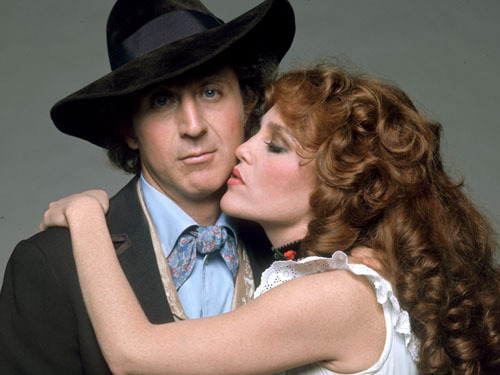
Sam noted, and I concurred, that he had long mixed up Madeline Kahn and Bernadette Peters. In looking up images to post, I found this forum discussion Do You Ever Get Bernadette Peters and Madeline Kahn Mixed Up? So we're not the only ones.
Here's Madeline

 Here's Bernadette

 I'm noting a certain resemblance


Monday, September 26, 2011
New Harmony
New Harmony, Indiana, was founded by the Harmony Society, a German utopian, socialist, anarchist, pietist,,,well, you get the idea - group that got going around 1800. My favorite line from the description:
The experiment was established in 1825 and dissolved in 1829 due to constant quarrels.Figures.
200,000 Books
Philip M. Parker has written 200,000 books. Over 100,000 are on Amazon. He has done this by means of an algorithm which researches databases and the internet and organises information into book form. Said books are then sent out electronically to order, or are printed on demand. Ingenious, what? His wikipedia entry identifies six books he has written in more conventional fashion, though using much or the power of said algorithm. That Physioeconomics one looks especially interesting. That a reviewer called it "thinly-disguised racism," not checking how the book was researched, is a touch amusing.
Rover Boys
I was looking for something on the book series, the first of the Stratemeyer Syndicate that also published The Bobbsey Twins, The Hardy Boys, Nancy Drew, and Tom Swift series. There were multiple authors in each series, each publishing under a single pseudonym. Rover was something of a romantic term in the early 1900's, but less so by the 1950's, so I was surprised to see this group pop up. Their biggest hit, Graduation Day, was done just a touch later in a more lush version by the Four Freshmen, then by the Vogues and the Lettermen. The Beach Boys version is perhaps the one we are most familiar with. But the Rover Boys were there first.
Come to think of it, Irish Rovers, Gypsy Rover, naming half the dogs in America Rover - the name had a resurgence in the 50's, and so wasn't so odd after all. I can find no suggestion that the band's name had anything to do with the children's books. That sort of irony did not occur to people then.
XBH

It's about one player per year when it's legit. This year there are two: Robinson Cano and Jacoby Ellsbury.
Sunday, September 25, 2011
Complex Systems
David at Photon Courier has excellent commentary on Doerner's The Logic of Failure, experiments on complex decision-making and how it goes bad. All three links from within the article are worth pursuing.
From his review:
From his review:
The subjects who fail at this game, Doerner finds, are those who apply rigid, context-insensitive rules...such as "always keep the units widely deployed" or "always keep the units concentrated" rather than making these decisions flexibly. He identifies "methodism," which he defines as "the unthinking application of a sequence of actions we have once learned," as a key threat to effective decision-making. (The term is borrowed from the great military writer Clausewitz.) Similar results are obtained in another simulation, in which the subject is put in charge of making production decisions in a clothing factory. In this case, the subjects are asked to think out loud as they develop their strategies. The unsuccessful ones tend to use unqualified expressions: constantly, every time, without exception, absolutely, etc...while the successful "factory managers" tend toward qualified expressions: now and then, in general, specifically, perhaps,...The connection with government interventions seems inescapable to me.
Saturday, September 24, 2011
Neutrinos
Notice on the sidebar that "I don't know, but..." actually seems to understand this. Like the bridge hand in the newspaper, I can follow what he's saying as I read it, but am unable to recreate it moments after finishing.
New Style
I went looking for an older post of mine, and when it came up, the entire month's posts expanded out in the archive section. Much more convenient than my "Best of" series.
Time Out
I commented during interleague play this summer that the Red Sox were whining about not having the DH. Where does that come from? That's been the case since interleague play began. Worse, Terry Francona seemed to be encouraging this childish attitude. Incidents are coming back to me now - Ortiz breaking in on a Francona interview to complain about an official scorer; Crawford signalling that Varitek had called him out; multiple players out of shape and for the third straight year, too many injuries (the two are often connected); the sense of panic over the last month in late innings, swinging at pitches early in the count; Francona staying with pitchers too long because it would insult them to be taken out.*
It's hard to refrain from rooting for the team you have always treasured. But I am increasingly not rooting for this team. They are entitled, spoiled whiners (exceptions apply). I want them to go to time out, like your child, who you love but needs to get the message. Go sit in your room until you are willing to admit what you did wrong.
*Check the Weilland stats for first 25 pitches versus second 25 pitches.
It's hard to refrain from rooting for the team you have always treasured. But I am increasingly not rooting for this team. They are entitled, spoiled whiners (exceptions apply). I want them to go to time out, like your child, who you love but needs to get the message. Go sit in your room until you are willing to admit what you did wrong.
*Check the Weilland stats for first 25 pitches versus second 25 pitches.
Thursday, September 22, 2011
Tuesday, September 20, 2011
1969
Don't be alarmed if you don't get most of the references. Neither did we, though we got the idea.
Actually, I still don't get most of the references, just the tone of them. I remember that classmate Marnie Joyce understood many and explained them to us. Marnie had other qualities that were far more impressive, but I, geek that I was, was most impressed with that.
Actually, I still don't get most of the references, just the tone of them. I remember that classmate Marnie Joyce understood many and explained them to us. Marnie had other qualities that were far more impressive, but I, geek that I was, was most impressed with that.
SAT Proposal
Steve Sailer has a proposal for eliminating some of the gaming of the college-entrance system by heightening reliance on the Educational Testing Service's AP exams. You do have to read a ways before you get to that part. If you are not used to Sailer's discussions on this issue, he has written volumes on Asian-American ascendance, test-prep, grade inflation, and predictive value. He has also done his homework, so please hesitate before rejecting some of his statements out-of-hand.
The SAT issue used to be bigger in this house. Not so much anymore. I also wonder, as the payback value of all but the elite colleges declines, whether this is going to matter much at all in 20 years.
Speaking of "in 20 years" thinking, we will soon see a generation of children which does not need to learn to drive. My granddaughters likely will, but I don't know how far beyond that the skill will need learning, particularly at that price. Automated freeways are people's first thought, but automated parking will probably be just as valuable.
The SAT issue used to be bigger in this house. Not so much anymore. I also wonder, as the payback value of all but the elite colleges declines, whether this is going to matter much at all in 20 years.
Speaking of "in 20 years" thinking, we will soon see a generation of children which does not need to learn to drive. My granddaughters likely will, but I don't know how far beyond that the skill will need learning, particularly at that price. Automated freeways are people's first thought, but automated parking will probably be just as valuable.
Death and Cameras
Retriever sent me the link to her new post with that title. I was a touch apprehensive. It has an EB White feel.
Interstate 92
I-92 was proposed, but never built. There were (and I suppose, are) several proposed routes from somewhere in NY to somewhere in ME which cut across NH and VT. The expectation was that it would be a spur to prosperity, especially to the interior of ME, but somehow the numbers never worked out. I recall hearing years ago that VT increasingly objected, ostensibly for environmental but actually for aesthetic reasons, and this was what had driven the final nails in the idea.
Yet still, if you look at a map of the Northeast, it just makes sense.
I thought the suggestion that the old Yankee joke "you can't get there from here" is based on the absence of E-W routes was silly at first, but on reflection, it might be so. The whole site at the link is interesting, though more so around Boston roads than NH ones.
Yet still, if you look at a map of the Northeast, it just makes sense.
I thought the suggestion that the old Yankee joke "you can't get there from here" is based on the absence of E-W routes was silly at first, but on reflection, it might be so. The whole site at the link is interesting, though more so around Boston roads than NH ones.
Links
I haven't done any in awhile. Things you might have missed.
Virginia Postrel is not impressed with Harvard's "kindness" pledge.
Steven Levitt - I am only a moderate fan - is quite moving talking about his adopting two daughters from China.
Harvard econ profs Greg Mankiw and Robert Barro write on what would help the economy. In the NYT. Will anyone listen?
And from Mankiw, a telling quote from Paul Samuelson in 1967 about Social Security. Preview: the phrase Ponzi scheme occurs - but it's meant as a compliment, I think.
And under the "I shoulda posted this years ago" category, we have John Hawks anthropology blog, and the history of Ireland in maps
Virginia Postrel is not impressed with Harvard's "kindness" pledge.
Steven Levitt - I am only a moderate fan - is quite moving talking about his adopting two daughters from China.
Harvard econ profs Greg Mankiw and Robert Barro write on what would help the economy. In the NYT. Will anyone listen?
And from Mankiw, a telling quote from Paul Samuelson in 1967 about Social Security. Preview: the phrase Ponzi scheme occurs - but it's meant as a compliment, I think.
And under the "I shoulda posted this years ago" category, we have John Hawks anthropology blog, and the history of Ireland in maps
Saturday, September 17, 2011
Thursday, September 15, 2011
Toponomy Myth
I have commented before on the unoriginality of our ancestors - everyone's ancestors - in naming things. A lot of rivers are just named "river" from a language previously spoken in the area. We do have some originality in Goffstown, but we wait until children are suitably mature before letting them in that the Uncanoonucs, North and South, mean "young woman's breasts." Yes, they are about the same height, knucklehead.
There has been a charming tale about an English toponym going around for some years, that Torpenhow Hill means Hillhillhill Hill, from four different languages. I am proud that I was always suspicious of the tale, finding it too neat. For example.
There has been a charming tale about an English toponym going around for some years, that Torpenhow Hill means Hillhillhill Hill, from four different languages. I am proud that I was always suspicious of the tale, finding it too neat. For example.
... is Torpenhow Hill in Cumbria, whose name seems to have grown by the addition of new elements by people who did not understand the original name: the first syllables tor is Brythonic, pen is Celtic, how is derived from the Old Norse haugr, and hill is Old English, but all four mean 'hill'.I came across the debunking today, which seemed precise enough. The short version is that no such place name can be found in full, even the partial form is completely across the country from where it was reported to be, and each element can mean different hill aspects.
Torpenhow Hall and church, which doubtless form the nucleus of the settlement, stand on a `rising topped hill' which is itself on the northward slope of a long hill, and the name Torpenhow is doubtless descriptive of the site. The first element is the British torr, `peak', This would seem to have been compounded with British pen, Torpen then denoting `peak-head'. To this was added in Anglian days the English hoh, giving forms Torpenho and the like. The old story, that the name bears witness to three successive races--British (Pen), Saxon (Tor), and Danish (How)--is incorrect: torr, though occasionally found in Old English, is really a loanword from British and torpen may well be pure British. The added how, to judge by earlier forms in -oc and -oh (ie Torpenoc, Torpenoh), would seem to be from English hoh rather than Old Norse haugr.The complete story here, for those interested.
Wednesday, September 14, 2011
Heresies
Ben Quash and Michael Ward edited Heresies, a series of sermons on many of the early heterodox opinions in the church and why certain doctrines were rejected in favor of others. It starts out as a set of pretty decent summaries, then limps downhill.
I've always had a hard time keeping them straight, all the Montanists, Donatists, docetists, Marcionists and whatever. Some of the writers thought there was an observable trend that heresies were attempts to avoid one problem so thoroughly that an opposite error emerged. Others thought that the vagueness and ambiguities of heresies, especially those propounded by mystics, made it difficult to identify if there was much wrong for quite a few years. I don't think either generalisation holds for long. What did fascinate was the perseverance of some heresies in the folk beliefs around the Mediterranean, and modern emergences of old falseness.
What they did convince me was important about all this is that people putting forth bad ideas often insist on them and force a crisis. Rank-and-file believers would often just as soon be left alone - which is why many orthodoxies did not reach final form for centuries after Christ. But heretics often have that push, that bulldog tendency, or a desire to be a somebody and have followers (not all). Secondly, they often rely on a few scripture sections to the exclusion of others to prove their points.* They force the doctrinal issue, as everyone else has to sit down and thumb through a lot of NT books and argue to decide what, precisely, do we believe the right doctrine to be?
But all in all, you might do better just reading the Wikipedia articles. This has a lot collected in one place, which is nice, but not enough. I bought it for Ben and will send it along, but don't be surprised if you see his copy in a used bookstore in Spring, TX.
*Now there's something that continues into the modern day...
I've always had a hard time keeping them straight, all the Montanists, Donatists, docetists, Marcionists and whatever. Some of the writers thought there was an observable trend that heresies were attempts to avoid one problem so thoroughly that an opposite error emerged. Others thought that the vagueness and ambiguities of heresies, especially those propounded by mystics, made it difficult to identify if there was much wrong for quite a few years. I don't think either generalisation holds for long. What did fascinate was the perseverance of some heresies in the folk beliefs around the Mediterranean, and modern emergences of old falseness.
What they did convince me was important about all this is that people putting forth bad ideas often insist on them and force a crisis. Rank-and-file believers would often just as soon be left alone - which is why many orthodoxies did not reach final form for centuries after Christ. But heretics often have that push, that bulldog tendency, or a desire to be a somebody and have followers (not all). Secondly, they often rely on a few scripture sections to the exclusion of others to prove their points.* They force the doctrinal issue, as everyone else has to sit down and thumb through a lot of NT books and argue to decide what, precisely, do we believe the right doctrine to be?
But all in all, you might do better just reading the Wikipedia articles. This has a lot collected in one place, which is nice, but not enough. I bought it for Ben and will send it along, but don't be surprised if you see his copy in a used bookstore in Spring, TX.
*Now there's something that continues into the modern day...
I Am Second
My son's department at The Woodlands United Methodist Church has uploaded a series of videos. These are not solo projects of Ben's but he did a lot of them.
Their YouTube channel is here
They have done this as part of a larger program "I Am Second." I don't pretend to know much about that. Ben speaks highly of it.
Tuesday, September 13, 2011
The Peopling of New England
Via Josh Kercsmar, This site with numerous maps on the peopling of New England. Apparently this Blake Gumprecht is preparing these for a book. The maps show which ethnic groups are dominant in which NE towns, both recently and by ancestry. Much of this is unremarkable - the Irish Riviera south of Boston, Italians in Rhode Island and in Revere/Saugus. There are some surprises, however.
Here's a fun one: In the first map, the lone pink "other" in suburban Boston is Sharon, and thus the dominant ethnicity must be Jewish.
And yes, parts of Maine really do belong to Canada.
Monday, September 12, 2011
Labeling
I have succeeded in labeling the last year's posts. I tend to use too many labels, because I don't want to have to do it again, I suppose.
I doubt it will come as much of a surprise that a particular cluster - self observation, self observation (liberal), anosognosia, irony, trusting our thoughts, May We Believe Our Thoughts - is strongly represented, with a bible/church and culture cluster, a music/nostalgia cluster, and political also strong.
I do think that self observation is key, and I do think that liberals are especially bad at it. But fundamentalists are, if anything, worse, and I haven't picked on them much. Not fair of me, perhaps, but I'm just not that interested. I also try to put in special effort to subject my own thoughts to observation when I am being critical of another group. That is a fairness I am apparently attached to.
Sunday, September 11, 2011
Tired of 9/11
I couldn't get away from memorialising 9/11 today. There was even a good-sized section cut into the worship service. The emotions are powerful enough that a lot of people feel that they just have to express them formally, or worse, use them to strike particular notes.
Jonathan Last had a post that I think refocuses the perspective off the towers and onto the beginning of the resurgence, with Flight 93.
HT: Steve Sailer
Saturday, September 10, 2011
Yosemite
A recent National Geographic cover picture of some guy standing on a very narrow ledge in Yosemite. It is clearly dangerous to the point of flirting with suicide, and there is tacit approval of this. Because it's outdoorsy and cool and nature and all that. I doubt we are going to see many NG covers on less-fashionable suicidal pursuits.
 They know their audience, after all.

Meerkats

So here's the deal, son. We're animals, and we live by our wits, and we never own anything. Plus, our wits are really just instincts, so it's not going to get any better. No, don't thank me. It's what being a meerkat is all about. Welcome to adulthood.
Heresies
I am finishing the last of the pile of used books I bought Ben for his birthday - one figures that out of six, at least a couple will suit - which I may discuss in some depth when I finish. Until then, two things caught my attention, It examines the early heresies of the church, with some discussion of how those have played out in later centuries. Yet it doesn't have a bad word to say about the heretics themselves nor the doctrines they put forward. Heresy is not used as a near-equivalent to blasphemy, sacrilege, or denial of belief, but as a precise term for doctrines that look at first as if they could be true. Heresies are theories about Christ that had a following at one point, and had to be examined closely for their implications and faithfulness to all scripture, not just one section.
The second interesting bit was an unpursued analogy to color in describing the nature of Christ. I pushed it a little further for my own amusement. Consider God to be blue, and humanity yellow. The dual nature of Christ, recognised quite early though a full doctrine of Trinity took longer, was difficult to get one's mind around. Still is. Was Jesus, then, essentially blue, but painted over to look yellow? Or essentially yellow, somehow covered in blue? After much wrestling, it was decided that neither was a true picture: Jesus was fully blue, and fully yellow. That led to a next set of questions: can we say that Jesus was green, then? Much debate, and as these things go, the debates were not often gracious. No, not green. Jesus is not a hybrid, new thing, but very blue, and very yellow. Hmm. Striped, then, whether in bold flag-stripes, concentric circles, or a million imperceptible, interpenetrated stripes? No, not that either.
Well then, what? Something can't be both blue and yellow. It has to fit one of the descriptions above. But it doesn't, and by AD 450 or so, there was eventual agreement that this is as close as we can get with our limited understanding. Analogies for mysteries are worrisome, but they are all we have. We like to come up with analogies for the Trinity. A Sunday school favorite is the apple, with skin, flesh, and seeds. It's a terrible analogy - we don't eat the seeds, the skin has no contact with the seeds, what exactly is the tree in this whole process... but we seem to feel we should try something to make it clearer. God as coach, putting down his clipboard and whistle and playing goal as a demonstration for we humans...well, it captures something, but it obscures just as much. The problem is with the arrogance of believing that we've got this mystery under control with our analogy - and yes, I have heard stupid persons, when discussing the Trinity, bring up some favorite analogy as if it settled everything, and the rest of us need discuss no more.
There is a tradition of mystic understanding of mystery call the apophatic, the understanding by negation. God is not this, God is not that. But its practitioners are quite clear that one cannot start from there, but must first build up a structure, from which pieces are discarded: not thus...not thus...not thus... The practice is more common in the Eastern churches, but CS Lewis fans will recognise that he uses apophatic techniques in his descriptions of God often*. We see something of this in the creed from the Council of Chalcedon in 451 - after several positive statements about the nature of God and Christ, a whole section turns to statements in the negative.
The second interesting bit was an unpursued analogy to color in describing the nature of Christ. I pushed it a little further for my own amusement. Consider God to be blue, and humanity yellow. The dual nature of Christ, recognised quite early though a full doctrine of Trinity took longer, was difficult to get one's mind around. Still is. Was Jesus, then, essentially blue, but painted over to look yellow? Or essentially yellow, somehow covered in blue? After much wrestling, it was decided that neither was a true picture: Jesus was fully blue, and fully yellow. That led to a next set of questions: can we say that Jesus was green, then? Much debate, and as these things go, the debates were not often gracious. No, not green. Jesus is not a hybrid, new thing, but very blue, and very yellow. Hmm. Striped, then, whether in bold flag-stripes, concentric circles, or a million imperceptible, interpenetrated stripes? No, not that either.
Well then, what? Something can't be both blue and yellow. It has to fit one of the descriptions above. But it doesn't, and by AD 450 or so, there was eventual agreement that this is as close as we can get with our limited understanding. Analogies for mysteries are worrisome, but they are all we have. We like to come up with analogies for the Trinity. A Sunday school favorite is the apple, with skin, flesh, and seeds. It's a terrible analogy - we don't eat the seeds, the skin has no contact with the seeds, what exactly is the tree in this whole process... but we seem to feel we should try something to make it clearer. God as coach, putting down his clipboard and whistle and playing goal as a demonstration for we humans...well, it captures something, but it obscures just as much. The problem is with the arrogance of believing that we've got this mystery under control with our analogy - and yes, I have heard stupid persons, when discussing the Trinity, bring up some favorite analogy as if it settled everything, and the rest of us need discuss no more.
There is a tradition of mystic understanding of mystery call the apophatic, the understanding by negation. God is not this, God is not that. But its practitioners are quite clear that one cannot start from there, but must first build up a structure, from which pieces are discarded: not thus...not thus...not thus... The practice is more common in the Eastern churches, but CS Lewis fans will recognise that he uses apophatic techniques in his descriptions of God often*. We see something of this in the creed from the Council of Chalcedon in 451 - after several positive statements about the nature of God and Christ, a whole section turns to statements in the negative.
...inconfusedly, unchangeably, indivisibly, inseparably; the distinction of natures being by no means taken away by the union, but rather the property of each nature being preserved, and concurring in one Person and one Subsistence, not parted or divided into two persons, but one and the same Son, and only begotten...(An intro to the Creed of Chalcedon here.) *Start with Narnia, Screwtape, and Great Divorce, and very especially Till We have Faces for this.
Buoyancy
Buoyancy is actually a good metaphor for mood. The image captures nicely both the sense of being above danger when things are going well - light, far-seeing, able to carry some burden - as well as the opposite mood of being slowed, unable to see beyond the next wave, requiring energy to keep any part of oneself above water.
Our base buoyancy comes on us very early. Genetic, prenatal, and early childhood influences are solidly established long before we have any awareness of the question of mood, disposition. Circumstances and actions or attitudes can change our buoyancy, certainly, which is why the naturally buoyant believe they have done something right in order to be the cheerful people they are. Which irritates the hell out of those who know that isn't true.
It is true enough to matter, however, regardless of whether writers of inspirational books and sayings overestimate it. The hardest parts are the twinned demons of hopelessness and anhedonia - that even if we roused ourselves to squeeze some water out of the vessel another wave would soon come, and that even if we were floating better, there's nowhere we would enjoy going anyway.
Our base buoyancy comes on us very early. Genetic, prenatal, and early childhood influences are solidly established long before we have any awareness of the question of mood, disposition. Circumstances and actions or attitudes can change our buoyancy, certainly, which is why the naturally buoyant believe they have done something right in order to be the cheerful people they are. Which irritates the hell out of those who know that isn't true.
It is true enough to matter, however, regardless of whether writers of inspirational books and sayings overestimate it. The hardest parts are the twinned demons of hopelessness and anhedonia - that even if we roused ourselves to squeeze some water out of the vessel another wave would soon come, and that even if we were floating better, there's nowhere we would enjoy going anyway.
Friday, September 09, 2011
Self-observation
In the "May We Trust Our Thoughts" series and Gardner's The Science of Fear which I just finished, I repeatedly ran across the laboratory evidence that people come away from having their ideas challenged with an even stronger belief in their original opinion. The act of defending seems to harden the thought.
I have to think this is variable. I know people who take being challenged as proof they are right. If this seems entirely backward, well, it is, yet I think most Christians know someone who regards opposition as proof that the devil is working against him, and thus proof he is on the right track. (I would use gender-neutral pronouns here, but I think this one is much more common in men. If you think otherwise, let me know and I'll change it.) I am also thinking of a particular political individual who seems to revel in the anger directed at him - as if that in itself were the goal, to bait and goad another tribe.
I get it that showing examples of one's opponents fuming, being jerks, and not responding fully rationally is rhetorically useful, as it carries the strong emotional suggestion that I am being the reasonable one here. My tribesmen are the reasonable people in this argument. But that is not a logical argument either. It goes no distance in establishing that one is in fact correct on the merits. It's a political sleight-of-hand masquerading as logic. It could be, and often is, that the anger and even rage one receives in response comes from one's own nastiness. The vicious put-down disguised in polite language carries a double danger. Bad enough that we be hypocrites, mock innocents who know we are driving in the poisoned blade while maintaining plausible deniability, as the politicians say. Far worse to have become gradually unaware of our own insults, until we speak to opponents that way because that is "what they deserve."
This strikes me as an especially dangerous aspect of human thought. I doubt I am immune to it. More likely, my impression that I respond to challenge by questioning my conclusions is but an artful disguise, to keep concealed from my self what My Self is doing. Still, I think it is important to at least make an appearance of an attempt. Much that is polite in discourse is not merely polite, not mere convention, but a reminder of what is required of us if we are to be our best selves. Argue with vigor and give a full-throated defense. But first, check whether you are actually right, or if your opponent may not have something worthwhile to add.
I have to think this is variable. I know people who take being challenged as proof they are right. If this seems entirely backward, well, it is, yet I think most Christians know someone who regards opposition as proof that the devil is working against him, and thus proof he is on the right track. (I would use gender-neutral pronouns here, but I think this one is much more common in men. If you think otherwise, let me know and I'll change it.) I am also thinking of a particular political individual who seems to revel in the anger directed at him - as if that in itself were the goal, to bait and goad another tribe.
I get it that showing examples of one's opponents fuming, being jerks, and not responding fully rationally is rhetorically useful, as it carries the strong emotional suggestion that I am being the reasonable one here. My tribesmen are the reasonable people in this argument. But that is not a logical argument either. It goes no distance in establishing that one is in fact correct on the merits. It's a political sleight-of-hand masquerading as logic. It could be, and often is, that the anger and even rage one receives in response comes from one's own nastiness. The vicious put-down disguised in polite language carries a double danger. Bad enough that we be hypocrites, mock innocents who know we are driving in the poisoned blade while maintaining plausible deniability, as the politicians say. Far worse to have become gradually unaware of our own insults, until we speak to opponents that way because that is "what they deserve."
This strikes me as an especially dangerous aspect of human thought. I doubt I am immune to it. More likely, my impression that I respond to challenge by questioning my conclusions is but an artful disguise, to keep concealed from my self what My Self is doing. Still, I think it is important to at least make an appearance of an attempt. Much that is polite in discourse is not merely polite, not mere convention, but a reminder of what is required of us if we are to be our best selves. Argue with vigor and give a full-throated defense. But first, check whether you are actually right, or if your opponent may not have something worthwhile to add.
Thursday, September 08, 2011
Driving Lesson
And so here I am again, for the fifth time, teaching a 15.5 year old boy how to drive. Over the years I have learned to say "correct" instead of "right," even in everyday discourse. Many statements that are precise to other drivers, such as "take your next right," are ambiguous to non-drivers, who wonder if you mean any break in the curbing, only paved areas, only marked roads, or what? A friend who had an in-garage accident with his son figured out - much too late - that "Stop!" to a driver means stop the car, but to your son, who you have yelled at for years, it means Freeze. Stop whatever you are doing right now.
Which is sometimes not what you want him to do as a driver.
Tonight I was reminded that cut the wheel; cut it hard is ambiguous to a non-driver. No damage, no emergency, just a caution flag for me.
Driving a standard is always an adventure, because understanding the concepts only takes you so far. Your foot and leg muscles have to develop memory through repetition to get the feel for it, and there just isn't any substitute.
It's a good time to remember James Thurber's grandfather, in Chapter 9 of My Life and Hard Times.
Which is sometimes not what you want him to do as a driver.
Tonight I was reminded that cut the wheel; cut it hard is ambiguous to a non-driver. No damage, no emergency, just a caution flag for me.
Driving a standard is always an adventure, because understanding the concepts only takes you so far. Your foot and leg muscles have to develop memory through repetition to get the feel for it, and there just isn't any substitute.
It's a good time to remember James Thurber's grandfather, in Chapter 9 of My Life and Hard Times.
Victoria Shouldis
A friend of mine has terminal cancer, and there was a nice write-up of her in the Concord Monitor, for which she has written for many years. I mentioned her in a post more than five years ago, which might give you an additional flavor for the sort of person she was.
Wednesday, September 07, 2011
Oh Foolish Galatians
I will be leading a book study at church this fall, and I am 90+% certain I'm doing Galatians, one chapter at a time, then something from the next 3 books for the second half of the class. I do almost as well on the fly as I do with careful planning,* so leaving that open is not a problem, but an adventure. In my initial browsing, following a rather obscure trail I am unlikely to feature much in the class, I ran across this by NT Wright, which impressed me greatly.
I had liked Wright before, but I have noticed previously that you get really excited about an author when you are looking for an answer, and his is on the top shelf.
*Actually, that is unknown. I've never done careful planning.
I had liked Wright before, but I have noticed previously that you get really excited about an author when you are looking for an answer, and his is on the top shelf.
*Actually, that is unknown. I've never done careful planning.
Tuesday, September 06, 2011
Memory
There must have been a day long ago when I said "Mummy, I want one of those jobs where people scream at you and condescend to you and call you names and accuse you of things you didn't do." But it was so long ago that I can't recall the exact time.
I can't remember my mother's exact words, but I know her character, so I am sure she said something like "Are you sure that's what you want? Because it sounds all very fine to say you want to help people, but those jobs are harder than they look on television." And she was absolutely right, of course.
I rejoice that none of my sons have gone into human services - though Ben's job trends toward that somewhat. Kyle makes noises about social work at times, which I discourage. I have always said those words with humor, so as not to drag down the general conversation and become a pariah. But I absolutely mean it. Mamas, don't let your babies grow up to be social workers.
I can't remember my mother's exact words, but I know her character, so I am sure she said something like "Are you sure that's what you want? Because it sounds all very fine to say you want to help people, but those jobs are harder than they look on television." And she was absolutely right, of course.
I rejoice that none of my sons have gone into human services - though Ben's job trends toward that somewhat. Kyle makes noises about social work at times, which I discourage. I have always said those words with humor, so as not to drag down the general conversation and become a pariah. But I absolutely mean it. Mamas, don't let your babies grow up to be social workers.
אמר הבלים הקוהלת הכל הבל׃ הבל׃ Ecclesiastes 12:8
Monday, September 05, 2011
Rain
According to the radar, the heavy rains have been running about five miles west of us for about two hours, and will continue to miss us for another two. Something similar happened during Hurricane Irene. I have never noticed nor heard described a climate break or pivot point along that line. There is a definite break point between the Upper Connecticut Valley and Central NH that runs through Sunapee, and one can go from one weather to another around Exit 12 on Rte 89 fairly often. But not here, that I know of.
Sponge On Bell
Is that a great title or what?
Sponge-Headed Scienceman has a post about Rob Bell's new book, Love Wins. After my initial comments during the Piper controversy, I have not weighed in on Bell, and won't until we have discussed it at our Bible study, which has met for over thirty years and contains reliable individuals, including Sponge and his wife. I was initially irritated with Bell, wondering "what's new here, exactly?" until I heard a longtime (but perhaps not thoughtful) Christian complaining about Bell's book for what I felt were ridiculous reasons. Hearing that, I wondered if Bell's questions were new to enough people in our day that it was worth bringing them up again.
Southside Johnny and the Asbury Jukes
My bother toured with them as a lighting roadie, about this era.
Sunday, September 04, 2011
We Forget
At the Sudanese church today, they were having a ceremony to honor the teachers who are instructing the children in the Dinka language. We recently watched the Sudanese get very enthused about the elections and formation of a new nation of South Sudan.
This is church. Sunday services. In America, we forget how much Christian is a description of an identity, with encompassing cultural as well as intellectual drivers. It is as much a strength as a weakness in the long run, I suppose, because it does keep them in the mindset of their religion as seamlessly integrated with the rest of their existence - something we have lost in the West, with our marketplace-of-ideas religious culture. But it keeps those elements of belief I consider paramount on the back burner at times. And I am not there to support their language, customs, or politics, though I do understand that they are not easily separated, and have no objection to what they've got.
I saw the same thing in Eastern Europe, and have read about it in the history of just about any place on earth: people's religions are often not particularly concerned with doctrinal understandings, but with what side they were born onto and will die on. From an American perspective, Northern Ireland doesn't look much like a religious war, but a tribal war where the tribes come from different Christian branches, neither of which is much understood by its adherents.
For African groups, square that.
The Science of Fear
Why would a book that gives you evidence that the things that you worry about are not such a big problem irritate you?
Okay, that's easy. It's because you are worried about certain things, and yelling at yourself that it's not such a big deal only reduces that a touch, so you feel lectured to. Secondly, you have expended resources, physical or psychic, into problems that now seem small, so you feel a bit foolish, a little ripped off, a little sheepish, at having this pointed out.
Daniel Gardner's The Science of Fear has some minor flaws, I'll touch on those, but they shouldn't dissuade you from reading the book. We are hardwired for certain types of fear, which, once activated, we have trouble turning off. A whole lot of other people get resources from the tribe by exploiting our fears, so they have an interest in keeping us on tenterhooks.* Politicians, nonprofit advocacy groups, companies that produce safety goods or services, government agencies...
Okay, that's adding up to a lot of people who need us to be anxious in order to sell us alarms, foods, programs, wars, medicines... We spend a lot of our precious resources on things that we might not, hope not, ever use or need, in order to reduce our anxieties. And we do this within the context of western society which provides unimaginable wealth and safety. My theory is that a certain amount of worry is built into us, because the ancestors who worried lived to perpetuate their DNA. We may be able to redirect our worry to things that actually have a fair chance of harming us, and which we have some control over. But I propose that we cannot, at present, reduce the amount of worry in our lives without specific intervention, such as medication, therapy, or radical life change. Sumus quod sumus, we are what we are. You will always be this nervous. Your job is to direct the anxiety to the best targets.
Note: As you get older, what you worry about will change automatically, and you will be absolutely sure you are wiser. Uh, maybe so
Worried about the environment? A dozen medical conditions that aren't actually life-threatening? Crime? Terrorism? Gardner will give you the numbers, reminding you how small the danger is. And, he will demonstrate how misplaced fear costs us not only money, but lives. After 9-11, people drove instead of flying. But driving is dangerous, and the most likely number is that 1,595 people died because they drove instead of flying - about five times the number who died in the planes on Sept 11. We spend money to protect ourselves from extremely unusual risks, and don't protect ourselves against more common ones.
The Amazon reviews say that some people found the book too long, and the statistics a bit much, but everyone basically liked it. I vaguely see that, but thought the book was great. The readers of this blog are not going to find the numbers daunting. I thought it was about right. Additionally, he gives a good summary of the research into our fearful and risk-evaluating minds, and this fits very well with our "May We Believe Our Thoughts?" discussions. Some of the research, in fact, we have already covered here. The Science of Fear covers a lot of ground on confirmation bias, our attraction to certain narratives, and a half-dozen smaller brain quirks you had no idea were influencing you so much. Yet Gardner also demonstrates how we can override these tendencies with thoughtful risk assessment.
The quibbles: Despite his clear explanation that we perceive greater danger from cancer because we are living longer, and have greatly reduced other causes of death (many who face cancer today would not have lived to face cancer in the old days, having died in childbirth, or of diphtheria, cholera, or smallpox), Gardner still counts all deaths as equal in some other calculations. He contrasts deaths from terrorism with deaths from diabetes, smoking, and obesity, for example. But the lifestyle deaths occur later in life, taking 5, 10, 15 years off our total. Deaths which take fifty or eighty years off our expected longevity should be counted higher. (Historically, the opposite was sometimes true. So many children died before the age of five, and this was so expected, that these were counted - not very consciously - as of lesser value. We were habituated to 20% of all children dying, and thought it sad, but not a greater loss than an adult's death. This has shifted over the last 50-100 years). Secondly, Gardner does not weigh in on the less-measurable goods of justice, fairness, and culture. While this may be scientifically reasonable, seen as outside his purview as a risk-evaluator, it results in his setting these values to zero. This becomes important in his discussing risks in crime and terrorism. He undervalues all other possible benefits of deterrence, social pressure, and foreign policy in his number-crunching. He tips his hand as a Canadian of the center-left in some of his assumptions as well, but he is even-handed enough that these should be passed over without additional mention. He tries extremely hard to be fair, and few conservatives could match him in this.
Your politics will shift just a bit after reading this book, wherever you started from.
*WTH are tenterhooks, anyway? Ah. Mildly interesting.
Okay, that's easy. It's because you are worried about certain things, and yelling at yourself that it's not such a big deal only reduces that a touch, so you feel lectured to. Secondly, you have expended resources, physical or psychic, into problems that now seem small, so you feel a bit foolish, a little ripped off, a little sheepish, at having this pointed out.
Daniel Gardner's The Science of Fear has some minor flaws, I'll touch on those, but they shouldn't dissuade you from reading the book. We are hardwired for certain types of fear, which, once activated, we have trouble turning off. A whole lot of other people get resources from the tribe by exploiting our fears, so they have an interest in keeping us on tenterhooks.* Politicians, nonprofit advocacy groups, companies that produce safety goods or services, government agencies...
Okay, that's adding up to a lot of people who need us to be anxious in order to sell us alarms, foods, programs, wars, medicines... We spend a lot of our precious resources on things that we might not, hope not, ever use or need, in order to reduce our anxieties. And we do this within the context of western society which provides unimaginable wealth and safety. My theory is that a certain amount of worry is built into us, because the ancestors who worried lived to perpetuate their DNA. We may be able to redirect our worry to things that actually have a fair chance of harming us, and which we have some control over. But I propose that we cannot, at present, reduce the amount of worry in our lives without specific intervention, such as medication, therapy, or radical life change. Sumus quod sumus, we are what we are. You will always be this nervous. Your job is to direct the anxiety to the best targets.
Note: As you get older, what you worry about will change automatically, and you will be absolutely sure you are wiser. Uh, maybe so
Worried about the environment? A dozen medical conditions that aren't actually life-threatening? Crime? Terrorism? Gardner will give you the numbers, reminding you how small the danger is. And, he will demonstrate how misplaced fear costs us not only money, but lives. After 9-11, people drove instead of flying. But driving is dangerous, and the most likely number is that 1,595 people died because they drove instead of flying - about five times the number who died in the planes on Sept 11. We spend money to protect ourselves from extremely unusual risks, and don't protect ourselves against more common ones.
The Amazon reviews say that some people found the book too long, and the statistics a bit much, but everyone basically liked it. I vaguely see that, but thought the book was great. The readers of this blog are not going to find the numbers daunting. I thought it was about right. Additionally, he gives a good summary of the research into our fearful and risk-evaluating minds, and this fits very well with our "May We Believe Our Thoughts?" discussions. Some of the research, in fact, we have already covered here. The Science of Fear covers a lot of ground on confirmation bias, our attraction to certain narratives, and a half-dozen smaller brain quirks you had no idea were influencing you so much. Yet Gardner also demonstrates how we can override these tendencies with thoughtful risk assessment.
The quibbles: Despite his clear explanation that we perceive greater danger from cancer because we are living longer, and have greatly reduced other causes of death (many who face cancer today would not have lived to face cancer in the old days, having died in childbirth, or of diphtheria, cholera, or smallpox), Gardner still counts all deaths as equal in some other calculations. He contrasts deaths from terrorism with deaths from diabetes, smoking, and obesity, for example. But the lifestyle deaths occur later in life, taking 5, 10, 15 years off our total. Deaths which take fifty or eighty years off our expected longevity should be counted higher. (Historically, the opposite was sometimes true. So many children died before the age of five, and this was so expected, that these were counted - not very consciously - as of lesser value. We were habituated to 20% of all children dying, and thought it sad, but not a greater loss than an adult's death. This has shifted over the last 50-100 years). Secondly, Gardner does not weigh in on the less-measurable goods of justice, fairness, and culture. While this may be scientifically reasonable, seen as outside his purview as a risk-evaluator, it results in his setting these values to zero. This becomes important in his discussing risks in crime and terrorism. He undervalues all other possible benefits of deterrence, social pressure, and foreign policy in his number-crunching. He tips his hand as a Canadian of the center-left in some of his assumptions as well, but he is even-handed enough that these should be passed over without additional mention. He tries extremely hard to be fair, and few conservatives could match him in this.
Your politics will shift just a bit after reading this book, wherever you started from.
*WTH are tenterhooks, anyway? Ah. Mildly interesting.
Friday, September 02, 2011
The Damage From Electing Religious People
In my job, we have several types of activity where we have to show exactly what we think the damage will be, or precisely what it is we are trying to fix. It’s tedious, but a good exercise. We can’t go into court and say “Well, he’s crazy, judge. He needs a guardian.” We have to show what harm is likely to occur if he doesn’t take medication. Is he going to stop eating? Is he going to assault someone? Because if he is just going to be a pain in the ass, so what? Lots of people are a pain in the ass, but we don’t lock them up for it. We can’t say to the insurance company “Well, she’s not better yet. Still sounds a little depressed to me.” The insurers are going to insist that for $1000/day, we need to show she’s likely to get suicidal again immediately, and that there’s no $100/day outpatient treatment that would keep her alive just as well.
So rather than conjuring all these images of the Inquisition, the Crusades, and Salem trials – and I could have quite a few words in defense of those anyway, but that’s another day – it pays to ask people define exactly what they think will go wrong if a religious person is elected. I think Mormonism is a cult, for example, but may still vote for Romney. Because I am not seeing exactly what damage his Mormonism is going to do, here. Judd Gregg is UCC Congregationalist, which is already pretty milk-and-water, but even in that sphere is a limited player – so he’s 90% secular; John Sununu was an ardent Catholic. I’d vote for either in a heartbeat over anybody running for anything in America today.
When you try and define exactly what is going to go wrong for religious reasons if we elect a Michelle Bachmann or a Rick Perry, I don’t find that their critics come up with a lot. There are some symbolic issues, which people use as a proxy for whether someone is Like Us or Not Like Us, but only on gay marriage is there likely to be any activity. Since the mid 70’s, the abortion issue has never been in danger of moving more than a few degrees one way or another – more waiting or notification or less, more federal funding or less. Even under radical change, the most that will happen is sending it back to the states. On stem-cell research much of the activity is on using your own stem cells or umbilical cells anyway – it’s a symbolic issue. Creationism? Kids learn neither the biology we teach now nor their Sunday School lessons. There’s a lot of “who’s in charge” posturing on this – both sides. Even if a teacher were made to teach creationism against their conscience, if they stood in the front and said “Uh, this is another theory that some churches think is important that you know,” does anyone think there will be mass conversions to fundamentalism? Of course not. But it bothers people because it seems rather explicitly religious, and thus not very separation of C & S. I think they are right. But I think environmentalism is weak science trotted out in defense of some pretty dubious philosophical ideas that absolutely crest over into religion for some people, and no one’s going to stop teaching that to my kid.
What exactly do people feel the damage is going to be? When you take away all the haunted house recordings and pictures of blood and werewolves, what exactly is going to harm us at Spookyworld? I think a lot of it comes down to feelings that America/society/the government isn’t expressing them. I think a lot of American groups feel that way, including a passel of conservative ones. There’s this idea that our values should be reified in some formal, obvious way, declaring to the world that this is the Real America. Liberal or conservative, it irritates and puzzles me. I have never expected the society as a whole, and especially not the government, to reflect my values more than approximately. I just don’t get it. People get all worked up because what – we were made to say the Lord’s Prayer in schools decades ago? And we now think that’s unamerican (likely true), so electing people who don’t condemn that in the loudest possible terms is going to lead to some fascist… Like that’s going to lead to…well, what did it lead to last time? Give me a break.
You hear it in the phrase “I don’t want to live in a country that…”
Think that through, Bessie. I wonder how much of people’s personal issues are behind this? When I can’t find much measurable in the complaints, it’s a natural next question, isn’t it?
What exactly do people feel the damage is going to be? When you take away all the haunted house recordings and pictures of blood and werewolves, what exactly is going to harm us at Spookyworld? I think a lot of it comes down to feelings that America/society/the government isn’t expressing them. I think a lot of American groups feel that way, including a passel of conservative ones. There’s this idea that our values should be reified in some formal, obvious way, declaring to the world that this is the Real America. Liberal or conservative, it irritates and puzzles me. I have never expected the society as a whole, and especially not the government, to reflect my values more than approximately. I just don’t get it. People get all worked up because what – we were made to say the Lord’s Prayer in schools decades ago? And we now think that’s unamerican (likely true), so electing people who don’t condemn that in the loudest possible terms is going to lead to some fascist… Like that’s going to lead to…well, what did it lead to last time? Give me a break.
You hear it in the phrase “I don’t want to live in a country that…”
Think that through, Bessie. I wonder how much of people’s personal issues are behind this? When I can’t find much measurable in the complaints, it’s a natural next question, isn’t it?
Thursday, September 01, 2011
Changes
We think of St Paul as having a single, pivot-point change. There is certainly reason for that, but the Scriptures don't actually say he was consistently X before conversion and consistently Y after. In fact, a close reading reveals a long stay in the desert that seems important in the biography as well. Yet because the most important thing about him changed on a pivot, we automatically impose that narrative on every other part of his life as well. Perhaps he was similar in personality at 16 and 60. Perhaps personality went through slow changes over his life. We don't know.
I had a born-again experience in 1975. But even at the time, I was aware of a similar private experience just two months before, and related promises and resolves to be a good Christian and follow Jesus extending back to age 12, when I wrote in to a Billy Graham TV crusade after hearing him preach and got some material back. There were also renewals, some of them dramatic, after 1975. Which one was the "real" one? And given that I was baptised as an infant perhaps that...
Or, as the Scripture also says, Jesus called me before my own creation and the creation of the world.
I have changed my mind about things more often than most people, I am sure. Seldom have those changes been rapid. I left socialism/liberalism one issue at a time. Yet every time I would think "Hmm, I am probably better defined as a conservative now," I would run across some further issues or intense declarations that would keep me out. Postliberal really is the best descriptor. I have an automatic brain tic that reverses polarity when someone is too insistent or strident. Liberals chased me out with that, and conservatives fenced me out in similar fashion.
The science says that most of us acquire our faith and our politics as teenagers and then change little. Church camping advocates point to numbers that show the prominence of camping in the histories of adults currently in church, and I don't doubt that. Politically, the adage is that we look at what was happening in the world when a person was 18 to discover his or her politics. That can go many ways, however, as yearly cohorts do not all go green, communitarian, or libertarian. Yet it does seem to often be true that the die is cast then, with the shape changing only mildly thereafter.
I had a born-again experience in 1975. But even at the time, I was aware of a similar private experience just two months before, and related promises and resolves to be a good Christian and follow Jesus extending back to age 12, when I wrote in to a Billy Graham TV crusade after hearing him preach and got some material back. There were also renewals, some of them dramatic, after 1975. Which one was the "real" one? And given that I was baptised as an infant perhaps that...
Or, as the Scripture also says, Jesus called me before my own creation and the creation of the world.
I have changed my mind about things more often than most people, I am sure. Seldom have those changes been rapid. I left socialism/liberalism one issue at a time. Yet every time I would think "Hmm, I am probably better defined as a conservative now," I would run across some further issues or intense declarations that would keep me out. Postliberal really is the best descriptor. I have an automatic brain tic that reverses polarity when someone is too insistent or strident. Liberals chased me out with that, and conservatives fenced me out in similar fashion.
The science says that most of us acquire our faith and our politics as teenagers and then change little. Church camping advocates point to numbers that show the prominence of camping in the histories of adults currently in church, and I don't doubt that. Politically, the adage is that we look at what was happening in the world when a person was 18 to discover his or her politics. That can go many ways, however, as yearly cohorts do not all go green, communitarian, or libertarian. Yet it does seem to often be true that the die is cast then, with the shape changing only mildly thereafter.
Maybe The Schools Are Okay
Whenever I'm linking to Sailer or VDare, people might already be prepared to wince, because it tends to be info that if true, we might keep quiet about anyway. I absolutely get that. People have decent, kind, smart, hardworking friends who they don't want to come even close to offending. They would poke out an eye before letting a friend think "Does he really think that about...me?" But there are local policy decisions all over the country that flow from this. Improving schools is good, but punishing teachers and schools for wrong reasons doesn't get us very far. We have had repeated national panics and complaints as long as I can remember about the schools, and all the bad, stupid stuff we doing.
Yet what if our schools are doing a better job than any other country in the world, but we are just measuring wrongly? What if all those other countries aren't eating our lunch? What if we were #1, or at least consistently in the top few, in educating our children? Wouldn't our rhetoric and solutions be different?
Here are the data on the primary international test. The short version (qualifiers below) is that Asian-American students outscore Asian countries/regions; White American students outscore all those white European countries: American Hispanics outscore all Latin American countries; African-Americans outscore African and Caribbean nations.
Qualifiers: Shanghai, and sometimes Singapore and one of the coastal provinces of China are roughly the same as Asian-Americans, who are largely descended from those areas.
Finland and New Zealand may be a little ahead of white Americans.
No African nations compete, so the comparison data is sketchy. But as best as we can tell, African Americans outscore all other blacks in the world, probably by a large margin.
Maybe Sailer is wrong, badly wrong, not just because we don't like the implications but because he has made major errors. Fine, then. But if he's even close to right, then what are all these federal initiatives and school programs even about? And why are are we forever kicking millions of teachers teachers as if they have made some major screwups, letting down the nation and the kids, if it's just not true?
Interesting tidbit: the Finnish schools are apparently very laid back, the NE Asian schools rigorous and intense, but both produce excellent students.
Yet what if our schools are doing a better job than any other country in the world, but we are just measuring wrongly? What if all those other countries aren't eating our lunch? What if we were #1, or at least consistently in the top few, in educating our children? Wouldn't our rhetoric and solutions be different?
Here are the data on the primary international test. The short version (qualifiers below) is that Asian-American students outscore Asian countries/regions; White American students outscore all those white European countries: American Hispanics outscore all Latin American countries; African-Americans outscore African and Caribbean nations.
Qualifiers: Shanghai, and sometimes Singapore and one of the coastal provinces of China are roughly the same as Asian-Americans, who are largely descended from those areas.
Finland and New Zealand may be a little ahead of white Americans.
No African nations compete, so the comparison data is sketchy. But as best as we can tell, African Americans outscore all other blacks in the world, probably by a large margin.
Maybe Sailer is wrong, badly wrong, not just because we don't like the implications but because he has made major errors. Fine, then. But if he's even close to right, then what are all these federal initiatives and school programs even about? And why are are we forever kicking millions of teachers teachers as if they have made some major screwups, letting down the nation and the kids, if it's just not true?
Interesting tidbit: the Finnish schools are apparently very laid back, the NE Asian schools rigorous and intense, but both produce excellent students.
Recent Conversations - Old Route 28
Route 28, a secondary highway in MA and NH, was important in family
history, especially above Manchester. I was curious about what the road
had looked like in the 30's and the 50's, and put some energy into
discovering this. It was harder than I thought, but quite satisfying in
the end.
Suncook PondRecent Conversations - May We Believe Our Thoughts
The full discussion on how reliable our thoughts, beliefs, and opinions really are.
Paranoia
Unawareness Versus Denial
Anosognosia
Paranoia
Unawareness Versus Denial
Recent Conversations -Wayfinding
The whole wayfinding series, mostly from 2011. I did quite a bit of research for this and made a number of observations I think are still interesting.
Update: A recent paper on spatial navigation.More Wayfinding 2013
Note on Wayfinding 2012
Mapmaking
Spatial Memory
Wednesday, August 31, 2011
Statue
Maya Angelou agrees with me about the MLK Statue.
Maybe she is smarter than I thought. I resolve to read some of her poetry this very night. She at least speaks her mind, rather than what she thinks people should say.
Maybe she is smarter than I thought. I resolve to read some of her poetry this very night. She at least speaks her mind, rather than what she thinks people should say.
Taking Orders
One of the things I learned from Albion's Seed, the
stunning work of history that I keep recommending but my children keep
ignoring is that both of the southern cultures, the coastal
Cavalier/Wessex/hierarchical group and the later
Scots-Irish/Appalachian/radica
There were a
few military units that fought under that flag in the Civil War as well,
mostly from North Georgia. But the military in Appalachia was not the
same as everywhere else. It was much more a system of voluntary
attachment to a credible leader, similar to what one sees in Beowulf, than
enlistment in the army itself. Whole units would show up at recruiting
stations even in WWI, and very occasionally all leave together whether
their contracts were up or not.
In the coastal
regions that had more slaveholding the poor whites who got out from
under indenture moved to the rural areas to turn invisible rather than
move to the towns to work for someone else. To have someone else tell
you what to do was to be no better than a slave. Because the weather was
warm and moist and the soil had not been exhausted they could get away
with this, subsistence farming for generations. Up in the mountains it
was less of an issue to be "no better than a slave," but still an issue
to have anyone other than a thane you (and/or your clan) had chosen
yourself be in charge of you. (The word "tanistry," for that societal
organisation is related to the word "thane.")
In New England
this was subtly but significantly different. People were allowed to be
in charge of you, but the idea was that everyone could band together and
pick new ones at any time. Someone was going to be in charge
and that was necessary for the good operation of the group. But that
someone was accountable. In the upland south sometimes no one was in
charge of anything except on a very temporary basis. You will notice
that they are still dirt poor. In the lowland south people were in
charge in a less meritocratic, more hereditary and hierarchical way,
just like on the old estates in England, carrying on to the First
Families of Virginia.
I still detect
this all the time in modern political discussions. I think it is very
much part of the lower vaccination rates in the South, because there is a
residual disdain for being one of those people who gets told what to do
by others. It creeps into some commenter reasoning here, as well
as some of the writers and commenters at Chicago Boyz and other sites."No one has the right to tell me what to do about anything" is not even a libertarian value here. It's an anarchist rather than libertarian POV. Eventually, everyone is upstream of someone in some physical or metaphorical way. In colonial Virginia and the coastal south there was the Dismal Swamp, or uplands that were less-desirable, and much of Appalachia was hollers and other subsistence nooks that a person actually could survive without having much to do with others. Kin networks were more powerful than town or other settlement patterns. That's the English Borderer and Scots Lowland pattern pattern of clan accountability rather than neighbor accountability.
It has an urban/rural aspect as well. In cities, you can't have no one
in charge. Someone is in charge, and if they are incompetent you have to
find some way to work around them or get rid of them. In rural areas,
you can have no one in charge and at least get by. We have it in NH in some rural areas, especially Above The Notch. I recall that towns like Unity were still like that even a decade ago, according to the mental health outreach workers. there were people who lived on no road, sometimes not even on their own land. But anything along the main roads is an organised township. Perhaps there is something about town versus county being primary organisation of government.
Of course, as in Frederick Law Olmsted's The Cotton Kingdom, this frequently means that the whole place remains impoverished, with no one going to school or building any businesses. It's interesting that this is still a default position when something new comes up, like a new vaccine or rules about distancing.
Tuesday, August 30, 2011
Weight Gain - Third Test
If you are interested in a thorough review of the possible environmental effects contributing to the rise in obesity in the US beginning about 1980, I am enjoying the long series at Slime Mold, Time Mold. As far as I have read at present, he has found the seed oil, glyphosate, and related theories inadequate, but thinks something is up with trace elements of lithium. He covers a wide range of possibilities, such as possible paradoxical effects (there is a corresponding increase in eating disorders over the same period), which is what occurs in people starting a new medication. Antidepressants reduce suicidality in a great many people, but increase it in a few, for example.
Again, I am interested in who is seeing this, purposely buried as it is in 2011, but actually written in 2021.
Monday, August 29, 2011
Clarification
The Pew Research typology, arrived at by factor analysis rather than theoretical constructs of what a liberal or conservative are, identifies three types of Democrat.
I make statements about liberals frequently, without making that distinction, which possibly indicates that I am not making it mentally as much as I should, either. In addition to Solid Liberals, there are New Coalition Democrats or Hard-Pressed Democrats. When I am writing, I usually mean only the first of the three. That is the media and academy group that is most prominent, and it is the group I come out of.
I apologise to anyone unfairly caught in the generalisation.
I make statements about liberals frequently, without making that distinction, which possibly indicates that I am not making it mentally as much as I should, either. In addition to Solid Liberals, there are New Coalition Democrats or Hard-Pressed Democrats. When I am writing, I usually mean only the first of the three. That is the media and academy group that is most prominent, and it is the group I come out of.
I apologise to anyone unfairly caught in the generalisation.
Subscribe to:
Posts (Atom)