An anonymous commenter linked to the 1869 Harvard entrance exam that was dug up by a NYTimes writer and made the rounds last year. It looks pretty intimidating at first glance, and the commenter used it as evidence that Billy Sidis's entrance into Harvard in 1909 was a pretty solid accomplishment in itself. Interestingly, the boy's getting in was probably even better than the exam would indicate. Harvard was no great shakes in 1869, but had improved considerably by 1909, and was one of the world's best by then. I will note that it was still not what we think of today. Competitive university admission is mostly a post WWII, or even post 1960 phenomenon. Many of the brightest did indeed go to the Ivies, the Little Ivies, or the Seven Sisters,* but you simply couldn't count on it. The rich and the alums got their kids in, and nationally, people stayed closer to home and many of the brightest went to other schools, far more than, say, in 1990.
The gap exactly covers the period of Charles William Eliot's presidency of Harvard, if you want more background than I will give here.
But the test. That Latin and Greek looks awfully impressive right out of the gate. If you are older, and/or a reader of history, and/or a traditionalist, you may still have Latin Envy, believing that a "proper" education must include it, and Greek! Why, that just seals it. A different alphabet and everything. Weren't they smart, then?
No, not especially. They had had six years of Latin and four of Greek by then, whether by tutor or at academy. If you took any languages at all in late 20th C, and make the mental comparison of what, exactly, they were being asked to do, it looks much less impressive. Note also, there was a standard set of works studied in those languages, which these questions are drawn from, plus frequent drill in grammar. Even if you had Latin yourself, you should note that the primary authors studied now are not quite the same as studied then, nor in quite the same way. These exam questions are essentially "Did you have proper teachers, are you reasonably bright, and did you make a moderate effort these last few years?"
Before I get into the math, let me note the major difference, then and now. Look at what is missing in this exam. There is no biology, no chemistry, no physics, and certainly no other sciences such as geology or economics. There are no questions on English Literature - no Shakespeare, Chaucer, Milton - and certainly no American literature (horrors! To even imagine such a thing!). No modern languages, no history other than ancient, no world events, no weather, no basic medicine. Even deeper, no methods of research, and no use of reference materials. Because these were not taught to young men. They were taught English Composition and Grammar, Latin and Greek, Ancient History, and the mathematics you see here. That's it.
Thus, their facility with L&G is dropping even farther down the list of impressiveness. Most of what 7th-12th graders have to learn today they did not have to even pretend to know. They were being trained to be gentlemen. The push for more useful arts was just beginning in this country.
The mathematics would look worrisome at first, but on closer examination, not so. The arithmetic is mostly just big numbers, and irritating, tedious working by hand. We forget mathematics that we don't use very quickly, but these students were still immersed.
Two stories: I was a math wizard, but I had to relearn a lot of it each time a son got beyond the first few weeks of algebra in HS. The terms and symbols were familiar, but I couldn't remember where they went. I could get it back, but I had to sit and stare, consult the index, and trial-and-error a bit. All year, for both algebra and geometry. (And as the first two seldom needed help, I was even less prepared for the others.) Story 2: There was a math magazine when I was in school, which posed problems each month. It printed the names of those who solved them the next month. I did a few months of that in 12th grade. Because of going to St Paul's for summer studies, I recognised the names of many of the other NH students who got problems right. One month, there was a problem where I was the only kid in the country to submit a right answer - something about rotating one parabola along another and describing where the focus went. Very cool. I pretended, in my conceit , that I was the only one able to get it, which was insane. How many students, even the nerdy math ones, read magazines and submitted problems? Fast forward one year. I was in a different type of math at college, but for some reason wanted to review my accomplishment from the year before. Narcissism, likely. I could not follow the solution I had myself written, only one year later.
We lose new abstract thoughts quickly, unless they are used. Look at the logarithms, trig, and plane geometry in the exam. Even if you can't even remember how to begin to solve it now, do you recognise the words and ideas? Do you have some recollection of solving problems sort of like that? Then in all likelihood, you could have done those problems when you were in 11th-12th grade. And especially, if you didn't have to study any Biochem, Shakespeare, or Intro to Psychology as well. If you had the same five subjects pretty much year after year, you'd know 'em quite well.
Also - there was some different emphasis in what maths were taught then. Trig was the top shelf, and you got two years of drill in it. No sets, calculus, or statistics for you.
Also - read the directions. See how few questions were required.
Also - it doesn't say what a passing score was, does it?
185 out of 215 applicants got into Harvard that year.
*Fun trivia test for you: name 'em. I got five on my first try, then a sixth popped into my head a year or so later (this was before internet). I never did get the seventh until I looked it up.
Showing posts with label education. Show all posts
Showing posts with label education. Show all posts
Tuesday, December 20, 2011


Prodigy (Sidis Part Three)
Back in 1988, Adragon DeMello was big news in the IQ societies. A math wizard graduating from a university in the California system at age 11, his father was looking for a graduate school which would accept him. It didn't go well from there. He had just scraped by to get the degree, it later was revealed, no graduate school would touch him, his parents fought over custody, and eventually a SWAT team had to pull him from his father's house. He then went to junior high school under another name and "got his childhood back." Watching that story unfold is perhaps why I am so suspicious of Boris Sidis.
Opinions were all over the map in the newsletters. Some were angry that graduate schools could be so blinkered as to not accept a genius just because it didn't fit their norm. Others were worried about the emotional impact on the boy, wondering if this father were pushing him too much (he was). A third group wondered if it were all quite true. In that pool of people, many of whom had been prodigies themselves, the claims seemed just a bit too far. I was well out of my league in that. I had thought I might lay some claim to significant precocity before joining a few of those groups, but quickly had that theory slapped down. There, more than anywhere, I learned that there is always a faster gun. In many cases, much faster.
Only one person I recall asked why there seemed to be an assumption that the highest IQ's must also be early bloomers, precocities of the highest order. He had not seemed more than above-average as a child, even to himself, and challenged the assumption that genius had to show at young, even ridiculously young, ages. I don't know why that didn't impress me more then. I barely considered it. It didn't fit my narrative, I suppose. But I have come to regard it as an excellent point. IQ is fairly stable over time, but the sample set is too small to see if that correlation is as strong at the extremes as it is in the middle ranges. We simply don't know.
We tend to expect that musical and mathematical, and related types like chess geniuses must have been prodigies. Often they were. But I don't know if we should consider that the only possible narrative. We don't have the same expectation for writers, artists, or philosophers.
Opinions were all over the map in the newsletters. Some were angry that graduate schools could be so blinkered as to not accept a genius just because it didn't fit their norm. Others were worried about the emotional impact on the boy, wondering if this father were pushing him too much (he was). A third group wondered if it were all quite true. In that pool of people, many of whom had been prodigies themselves, the claims seemed just a bit too far. I was well out of my league in that. I had thought I might lay some claim to significant precocity before joining a few of those groups, but quickly had that theory slapped down. There, more than anywhere, I learned that there is always a faster gun. In many cases, much faster.
Only one person I recall asked why there seemed to be an assumption that the highest IQ's must also be early bloomers, precocities of the highest order. He had not seemed more than above-average as a child, even to himself, and challenged the assumption that genius had to show at young, even ridiculously young, ages. I don't know why that didn't impress me more then. I barely considered it. It didn't fit my narrative, I suppose. But I have come to regard it as an excellent point. IQ is fairly stable over time, but the sample set is too small to see if that correlation is as strong at the extremes as it is in the middle ranges. We simply don't know.
We tend to expect that musical and mathematical, and related types like chess geniuses must have been prodigies. Often they were. But I don't know if we should consider that the only possible narrative. We don't have the same expectation for writers, artists, or philosophers.
Saturday, December 17, 2011
And Another One Bites The Dust - Part One
I think the story of Billy Sidis, the purported prodigy with the highest IQ (250-300) ever known, is mostly fraudulent.
I first read about William James Sidis in the pages of Gift of Fire in the late 80’s. GoF was the journal of the Prometheus Society, a discussion group for those with measured IQ over 164. Amy Wallace’s book on Sidis, The Prodigy, had just come out, and Grady Towers took the opportunity to bring us up to speed on the early 20th C brilliant but eccentric child. That essay, "The Outsiders," is perhaps the best known of the articles to come out of the High-IQ societies. Its primary topic is the increasing difficulty of adjustment individuals experience the further from norm they are. Terman's studies in the 40's of gifted individuals showed that those above 140 IQ were better adapted than average. Grady looked harder at the data and decided that those from 140-150 were better adjusted than average, but beyond that things steadily worsened. The greater frequency of those from 140-150 masked the data of the few from say, 170-180.
It was perhaps inevitable that Grady would gravitate to the subject of Sidis. Grady qualified for the next society up, the Mega Society, for those with one-in-a-million IQ, cutoff 176. He had been a prodigy himself, almost completing a PhD in Anthropology at age 20, but by the time I knew him (via journal and correspondence), he was usually homeless, working odd jobs across the Southwest, writing on borrowed typewriters and sending mathematical proofs - usually number theory - to whoever would have them. He was murdered horribly in 2000 while working as a security guard. I liked corresponding with him.
I ran across a stray mention of William James Sidis while reading about the Pennacook Indians. (He had believed their tribal decision-making methods had deeply influenced the New England Founding Fathers, and hence the Constitution. Pure bunkum, to be discussed below.) I remembered the story, but not the name, and I thought I recalled that it was Gift of Fire, and Grady, where I had learned of Sidis. As I tried to get to the bottom of the story of the prodigy, I wondered if G Towers had uncovered some little-known source and had inside information on the boy who went to Harvard at 11, but spent much of his adult life collecting and classifying streetcar transfers and being rescued by his parents.
Alas, not so. Grady's info was pretty clearly drawn from Wallace's biography of Sidis. I have read only scraps of that, but she clearly has taken what Sidis and his family have claimed about him at face value. She wants to believe the tragic narrative of prodigy who just couldn't adjust, nor the world adjust to him. There was a time when I preferred that narrative, too. I fancied myself a prodigy, and could cherry-pick data to prove to you that it was true. But it wasn't. I was a very smart, creative child who was also arrogant and self-centered. No more than that. But the desire to be one of those - one of those special children who would show up occasionally in magazines, or on "I've Got A Secret," or in Ripley's "Believe It Or Not" - is very sweet. It provides a ready excuse for anyone not liking you, or you not fitting in. If you are that smart, then of course it is the school that has failed, not you, when you screw up.
Sidis's parents were Jewish immigrants from Ukraine, she a physician, he one of the first psychiatrists, though a bit out of the mainstream. Certainly the type of people who you'd expect might have a prodigy. They seemed to have expected it as well. Boris Sidis had educational theories about how to raise children to be geniuses. How convenient to have one, eh?
The articles about Billy, including in Wikipedia, generally acknowledge that some claims about him were misunderstood, or even bogus. Yet they generally credit his prodigy status as essentially true. I did run across another doubter at a site called The Logics. I don't know anything about the writer (though I am certainly well-disposed to him right off the bat), so there's no implied endorsement of the site, which seems pretty extensive. I will give my reasons for doubting the claims about Sidis sometime this week, but the sneak preview should be obvious. There are numerous stories, many of which are quite plausible, about William James Sidis. The hard evidence behind them seems elusive. He was clearly quite intelligent. But the evidence that he was a genius...?
Baseball history fans may have had the story of Moe Berg occur to him while reading all this. A lot more examination has been done on him, but I may have some fun with that later as well.
I first read about William James Sidis in the pages of Gift of Fire in the late 80’s. GoF was the journal of the Prometheus Society, a discussion group for those with measured IQ over 164. Amy Wallace’s book on Sidis, The Prodigy, had just come out, and Grady Towers took the opportunity to bring us up to speed on the early 20th C brilliant but eccentric child. That essay, "The Outsiders," is perhaps the best known of the articles to come out of the High-IQ societies. Its primary topic is the increasing difficulty of adjustment individuals experience the further from norm they are. Terman's studies in the 40's of gifted individuals showed that those above 140 IQ were better adapted than average. Grady looked harder at the data and decided that those from 140-150 were better adjusted than average, but beyond that things steadily worsened. The greater frequency of those from 140-150 masked the data of the few from say, 170-180.
It was perhaps inevitable that Grady would gravitate to the subject of Sidis. Grady qualified for the next society up, the Mega Society, for those with one-in-a-million IQ, cutoff 176. He had been a prodigy himself, almost completing a PhD in Anthropology at age 20, but by the time I knew him (via journal and correspondence), he was usually homeless, working odd jobs across the Southwest, writing on borrowed typewriters and sending mathematical proofs - usually number theory - to whoever would have them. He was murdered horribly in 2000 while working as a security guard. I liked corresponding with him.
I ran across a stray mention of William James Sidis while reading about the Pennacook Indians. (He had believed their tribal decision-making methods had deeply influenced the New England Founding Fathers, and hence the Constitution. Pure bunkum, to be discussed below.) I remembered the story, but not the name, and I thought I recalled that it was Gift of Fire, and Grady, where I had learned of Sidis. As I tried to get to the bottom of the story of the prodigy, I wondered if G Towers had uncovered some little-known source and had inside information on the boy who went to Harvard at 11, but spent much of his adult life collecting and classifying streetcar transfers and being rescued by his parents.
Alas, not so. Grady's info was pretty clearly drawn from Wallace's biography of Sidis. I have read only scraps of that, but she clearly has taken what Sidis and his family have claimed about him at face value. She wants to believe the tragic narrative of prodigy who just couldn't adjust, nor the world adjust to him. There was a time when I preferred that narrative, too. I fancied myself a prodigy, and could cherry-pick data to prove to you that it was true. But it wasn't. I was a very smart, creative child who was also arrogant and self-centered. No more than that. But the desire to be one of those - one of those special children who would show up occasionally in magazines, or on "I've Got A Secret," or in Ripley's "Believe It Or Not" - is very sweet. It provides a ready excuse for anyone not liking you, or you not fitting in. If you are that smart, then of course it is the school that has failed, not you, when you screw up.
Sidis's parents were Jewish immigrants from Ukraine, she a physician, he one of the first psychiatrists, though a bit out of the mainstream. Certainly the type of people who you'd expect might have a prodigy. They seemed to have expected it as well. Boris Sidis had educational theories about how to raise children to be geniuses. How convenient to have one, eh?
The articles about Billy, including in Wikipedia, generally acknowledge that some claims about him were misunderstood, or even bogus. Yet they generally credit his prodigy status as essentially true. I did run across another doubter at a site called The Logics. I don't know anything about the writer (though I am certainly well-disposed to him right off the bat), so there's no implied endorsement of the site, which seems pretty extensive. I will give my reasons for doubting the claims about Sidis sometime this week, but the sneak preview should be obvious. There are numerous stories, many of which are quite plausible, about William James Sidis. The hard evidence behind them seems elusive. He was clearly quite intelligent. But the evidence that he was a genius...?
Baseball history fans may have had the story of Moe Berg occur to him while reading all this. A lot more examination has been done on him, but I may have some fun with that later as well.
Tuesday, September 20, 2011
SAT Proposal
Steve Sailer has a proposal for eliminating some of the gaming of the college-entrance system by heightening reliance on the Educational Testing Service's AP exams. You do have to read a ways before you get to that part. If you are not used to Sailer's discussions on this issue, he has written volumes on Asian-American ascendance, test-prep, grade inflation, and predictive value. He has also done his homework, so please hesitate before rejecting some of his statements out-of-hand.
The SAT issue used to be bigger in this house. Not so much anymore. I also wonder, as the payback value of all but the elite colleges declines, whether this is going to matter much at all in 20 years.
Speaking of "in 20 years" thinking, we will soon see a generation of children which does not need to learn to drive. My granddaughters likely will, but I don't know how far beyond that the skill will need learning, particularly at that price. Automated freeways are people's first thought, but automated parking will probably be just as valuable.
The SAT issue used to be bigger in this house. Not so much anymore. I also wonder, as the payback value of all but the elite colleges declines, whether this is going to matter much at all in 20 years.
Speaking of "in 20 years" thinking, we will soon see a generation of children which does not need to learn to drive. My granddaughters likely will, but I don't know how far beyond that the skill will need learning, particularly at that price. Automated freeways are people's first thought, but automated parking will probably be just as valuable.
Thursday, September 01, 2011
Maybe The Schools Are Okay
Whenever I'm linking to Sailer or VDare, people might already be prepared to wince, because it tends to be info that if true, we might keep quiet about anyway. I absolutely get that. People have decent, kind, smart, hardworking friends who they don't want to come even close to offending. They would poke out an eye before letting a friend think "Does he really think that about...me?" But there are local policy decisions all over the country that flow from this. Improving schools is good, but punishing teachers and schools for wrong reasons doesn't get us very far. We have had repeated national panics and complaints as long as I can remember about the schools, and all the bad, stupid stuff we doing.
Yet what if our schools are doing a better job than any other country in the world, but we are just measuring wrongly? What if all those other countries aren't eating our lunch? What if we were #1, or at least consistently in the top few, in educating our children? Wouldn't our rhetoric and solutions be different?
Here are the data on the primary international test. The short version (qualifiers below) is that Asian-American students outscore Asian countries/regions; White American students outscore all those white European countries: American Hispanics outscore all Latin American countries; African-Americans outscore African and Caribbean nations.
Qualifiers: Shanghai, and sometimes Singapore and one of the coastal provinces of China are roughly the same as Asian-Americans, who are largely descended from those areas.
Finland and New Zealand may be a little ahead of white Americans.
No African nations compete, so the comparison data is sketchy. But as best as we can tell, African Americans outscore all other blacks in the world, probably by a large margin.
Maybe Sailer is wrong, badly wrong, not just because we don't like the implications but because he has made major errors. Fine, then. But if he's even close to right, then what are all these federal initiatives and school programs even about? And why are are we forever kicking millions of teachers teachers as if they have made some major screwups, letting down the nation and the kids, if it's just not true?
Interesting tidbit: the Finnish schools are apparently very laid back, the NE Asian schools rigorous and intense, but both produce excellent students.
Yet what if our schools are doing a better job than any other country in the world, but we are just measuring wrongly? What if all those other countries aren't eating our lunch? What if we were #1, or at least consistently in the top few, in educating our children? Wouldn't our rhetoric and solutions be different?
Here are the data on the primary international test. The short version (qualifiers below) is that Asian-American students outscore Asian countries/regions; White American students outscore all those white European countries: American Hispanics outscore all Latin American countries; African-Americans outscore African and Caribbean nations.
Qualifiers: Shanghai, and sometimes Singapore and one of the coastal provinces of China are roughly the same as Asian-Americans, who are largely descended from those areas.
Finland and New Zealand may be a little ahead of white Americans.
No African nations compete, so the comparison data is sketchy. But as best as we can tell, African Americans outscore all other blacks in the world, probably by a large margin.
Maybe Sailer is wrong, badly wrong, not just because we don't like the implications but because he has made major errors. Fine, then. But if he's even close to right, then what are all these federal initiatives and school programs even about? And why are are we forever kicking millions of teachers teachers as if they have made some major screwups, letting down the nation and the kids, if it's just not true?
Interesting tidbit: the Finnish schools are apparently very laid back, the NE Asian schools rigorous and intense, but both produce excellent students.
Saturday, July 09, 2011
Education Credentials
Via Maggie's.
George Leef comments on In The Basement Of The Ivory Tower. I don't know the book, so I'm not linking or recommending (though it sounds promising).
We have constructed a situation in which an ambitious young person must acquire an expensive and often useless degree in order to have any credibility in applying for many jobs. I absorbed the view, from reading and from family, that college was only indirectly about preparing for work - it was about becoming a complete person, a man of many parts, thoroughly grounded in Western Intellectual Tradition. One got into the most prestigious college that would accept you, studied what you wished within a narrow range of approved majors that reflected the Canon, and Western Civilisation rewarded you with employment suitable to your station at the other end. One Christmas, when college sweatshirts were fashionable for boys, a flock of them were given to our boys and their cousins: Stanford, Duke, Yale, William & Mary, Dartmouth. The message was clear.
We only gradually abandoned this; our older sons still showed a great deal of this approach themselves, though they were already breaking that mold by the time they left. The two Romanians went even farther afield, but there was still much of the old system put upon them. We still owe tens of thousands on that, too. I hope there is some clarity by the time Kyle is choosing.
George Leef comments on In The Basement Of The Ivory Tower. I don't know the book, so I'm not linking or recommending (though it sounds promising).
We have constructed a situation in which an ambitious young person must acquire an expensive and often useless degree in order to have any credibility in applying for many jobs. I absorbed the view, from reading and from family, that college was only indirectly about preparing for work - it was about becoming a complete person, a man of many parts, thoroughly grounded in Western Intellectual Tradition. One got into the most prestigious college that would accept you, studied what you wished within a narrow range of approved majors that reflected the Canon, and Western Civilisation rewarded you with employment suitable to your station at the other end. One Christmas, when college sweatshirts were fashionable for boys, a flock of them were given to our boys and their cousins: Stanford, Duke, Yale, William & Mary, Dartmouth. The message was clear.
We only gradually abandoned this; our older sons still showed a great deal of this approach themselves, though they were already breaking that mold by the time they left. The two Romanians went even farther afield, but there was still much of the old system put upon them. We still owe tens of thousands on that, too. I hope there is some clarity by the time Kyle is choosing.
Wednesday, June 22, 2011
Learning Priorities
My son works with the youth group at his church outside Houston, and mentioned that some highschool players are indeed told by their coaches that football should be considered more important, and the higher commitment, than their class work. This seems appalling in our subculture; shameful, even. Certainly, it is damaging to teach children such things. Football is transitory, learning is forever. A coach whose priorities were out of whack might think such a thing, but even he would never say it. There are pieties to be observed.
I do like to reverse things and ask if they are really true, however. In my own case, I arrogantly did little class work in highschool, rather sneering that doing well on the test was sufficient. People must have said that there were other lessons that came from homework, studying, and the other boring parts, but I would have waved this off. Yet they were right. There are other lessons, and I didn’t learn them. What discipline I learned came from the performing arts and part-time jobs. A sport taken seriously might have done me good. Benjamin Spock claimed that getting up early to row crew, whether sick or well, in fair weather or foul, developed his character more than any class. “Crew made me.”
Especially now, as we wonder how efficiently our schools are teaching academic content*, we should look also at how well it teaches the other virtues one will need as an adult: showing up, completing tasks, duty to others, pursuit of excellence, finding alternative methods, keeping your temper. Sports do teach some of those things. So do Destination Imagination, building a stage set, and playing in orchestra.
Break it down to crisis, but not apocalypse terms. Civilization collapses temporarily. We have all these kids to instruct, we have some buildings but little money, and a functioning technological culture – not a subsistence agriculture society from massive destruction - we need to rebuild. All educational statutes at every level are now disregarded, for good or ill. What do we teach, and who does it? I don’t think football is rising to the top, but I’m pretty sure school classrooms look pretty different as well.
*Better than ever, contra conservative criticism. Yet still not very well.
I do like to reverse things and ask if they are really true, however. In my own case, I arrogantly did little class work in highschool, rather sneering that doing well on the test was sufficient. People must have said that there were other lessons that came from homework, studying, and the other boring parts, but I would have waved this off. Yet they were right. There are other lessons, and I didn’t learn them. What discipline I learned came from the performing arts and part-time jobs. A sport taken seriously might have done me good. Benjamin Spock claimed that getting up early to row crew, whether sick or well, in fair weather or foul, developed his character more than any class. “Crew made me.”
Especially now, as we wonder how efficiently our schools are teaching academic content*, we should look also at how well it teaches the other virtues one will need as an adult: showing up, completing tasks, duty to others, pursuit of excellence, finding alternative methods, keeping your temper. Sports do teach some of those things. So do Destination Imagination, building a stage set, and playing in orchestra.
Break it down to crisis, but not apocalypse terms. Civilization collapses temporarily. We have all these kids to instruct, we have some buildings but little money, and a functioning technological culture – not a subsistence agriculture society from massive destruction - we need to rebuild. All educational statutes at every level are now disregarded, for good or ill. What do we teach, and who does it? I don’t think football is rising to the top, but I’m pretty sure school classrooms look pretty different as well.
*Better than ever, contra conservative criticism. Yet still not very well.
Saturday, May 21, 2011
Republican and Democrat Grading
Via Volokh. Inside Higher Ed reports that Republican professors and Democrat professors have different patterns of grading. Republicans give more high and low grades, Democrats give more in the middle. There has been some discussion at Volokh whether this follows academic disciplines or whether the study successfully took that into account
Saturday, May 07, 2011
Skills To Teach
My wife put me on to this article at Tweenteacher describing what skills "business and college leaders" think should be taught for College and Career Readiness. It's not a bad looking list at first glance, and while folks might well argue whether other skills should be added, it's hard to argue with the Top 5 she whittled her list of 13 down to
This is not What Should Be Taught. This is a list of how we currently describe what bright, socially skilled, motivated students do already, and the businesses and colleges are telling us no more than “Hey, we’d like to have bright, motivated, socially skilled students. Make us more of those.” Most good students will pick up a lot of these skills on their own even with bad teachers. Even good teachers will have a hard time bringing these forth from dull, unmotivated students.
We all like to think what we do is important, perhaps even crucial or life-changing. It helps us get up in the morning and plow into the day's work even when we feel dull and unmotivated ourselves. Teaching is valuable and should be done well. But I think it is valuable primarily for the 10% of students whose life course is in doubt. Many will succeed in bad schools, many will fail in good ones. Guaranteeing them enough safety to concentrate, enough materials to have something to put their brains to work, and enough skill and good will from the adults to keep from damaging them, and the school has done 90% of its work. It is valuable to move even a small percentage of those from F's to D's, or from C's to B's, by better instruction. But moving kids from F's to C's, or C's to A's? That's rarer, and I think well less than 10%. Retrospective anecdotes tell us that some teacher rescued or ruined us by something they said or did. Eh, probably not.
I give the Buddha credit on this one. When the student is ready, the teacher appears.
CollaborationYet as I read the essay, reflecting on my growing conviction over the years that genetic and prenatal influences are far more determinative of human outcomes than we used to credit, I wondered if the whole article exaggerated the importance of what a middle-school teacher contributes to the final product.
Communication
Problem-Solving
Questioning
Independent Learning
The next question is, are teachers at least using these 5 in their everyday lesson planning? And if so, how? The key is to use these skills to promote content in lesson planning, note taking, and assessments.I commented there, and expand upon it here.
Over the next few weeks I’ll share some lessons that you can do to address these skills and for you to mull over for Someday or use on Monday. Hope you’ll share some of your lessons with me and my readers in this thread as well. After all, collaboration is a key future skill and one that must be modeled by the teachers in the room.
This is not What Should Be Taught. This is a list of how we currently describe what bright, socially skilled, motivated students do already, and the businesses and colleges are telling us no more than “Hey, we’d like to have bright, motivated, socially skilled students. Make us more of those.” Most good students will pick up a lot of these skills on their own even with bad teachers. Even good teachers will have a hard time bringing these forth from dull, unmotivated students.
We all like to think what we do is important, perhaps even crucial or life-changing. It helps us get up in the morning and plow into the day's work even when we feel dull and unmotivated ourselves. Teaching is valuable and should be done well. But I think it is valuable primarily for the 10% of students whose life course is in doubt. Many will succeed in bad schools, many will fail in good ones. Guaranteeing them enough safety to concentrate, enough materials to have something to put their brains to work, and enough skill and good will from the adults to keep from damaging them, and the school has done 90% of its work. It is valuable to move even a small percentage of those from F's to D's, or from C's to B's, by better instruction. But moving kids from F's to C's, or C's to A's? That's rarer, and I think well less than 10%. Retrospective anecdotes tell us that some teacher rescued or ruined us by something they said or did. Eh, probably not.
I give the Buddha credit on this one. When the student is ready, the teacher appears.
Monday, March 28, 2011
Education Changes
xkcd, brilliant as usual

The short version is to read researcher Peter Gray's The Seven Sins of Our Forced Educational System. Exactly the sort of article I would have described as nutty 10-20 years ago, but now think has many good points.
The long version is to read the rest of this post first, warming you up to the idea that radical educational ideas may not be insane, then reading Gray's article.
It used to be, the only tension was between public schools and religious schools. Prep schools were there, but only for the rich and few. They knew who they were, and their worlds did not touch ours, except when they wanted to rule us.
Radical voices came onto the fringes in the 60's. American education was designed by rich industrialists to create useful cogs for their corporate machines. Which always struck me as a textbook example of stretching reality to an insane degree, highlighting some aspects while downplaying others in order to make some political point. Grading destroys love of learning...rote learning destroys real understanding...competition destroys cooperation... Each of these had enough truth to limp along to the next decade, but obscured more than they explained. Montessori schools were there for those who were determined to go that route, and those were okay, but given the population they drew from, never seemed to provide the value-added for education that was hoped for. (I still like 'em, though.)
Over the last two decades the clamoring for education change has grown more frantic. Conservatives have a lot of people who think that if we just went back to the good old days, even the strict back-to-basics days if not the one-room school, all would be good in the garden. The idea is insane, based on nostalgia rather than true recall and certainly not real data, and I am frankly sick of the argument on conservative sites. It morphs over into core curriculum ideas for highschool and college, which is a quite different subject. (And even that is not quite an honest argument. It is easy to find bad examples in modern course and texts and pretend that things were never like that in the old days. Nonsense.) It starts from a selection bias of the better friends and relatives of online commenters who liked school and like writing about it now. Why, my grandfather had only borrowed chalk, a compass, and two desks for twelve students in their little town, but by golly they worked hard and all of them went on to become civil engineers or neurosurgeons. It's rubbish, every bit of it.
Liberals have their own idiocies, which I'm sure you've seen enough of that I can skip it here. Homeschooling has been a real change, and they have done well at undermining many myths of what is necessary for schooling. Special Ed has been enormously expensive but the old system was to put children away in institutions and just let them waste. I suppose if we don't really value independence and consider relative physical comfort to be a good life, that could be our goal again. Yet now that the mask is off I don't think we could look it in the eye again.
Bigger changes are brewing. Distance learning is growing. Ooh, those awful for-profit schools! Like your school wasn't out to make a nice living for a lot of people off you, just because it had ivy-covered professors? Khan Academy hopes to "flip" middle school and high school, so that the video lectures are the homework and the working of problems with a teacher are the in-class part. The TED lectures in general are filling up with new models for education. We hang back from trying any - we have so much invested in the current model and fear to be wrong - not with our children!
You would think that one such as myself, who values the wisdom of other eras, hates educational fads, and is married to a school librarian would be the last of the big experimenters. But school librarians are often the front edge of cooperative and experimental methods in a school. Plus, adopting Romanians, then acquiring Kyle, has given us a different look at our system in the US. Things at school that only annoy you when you have children able to dazzle with brilliance and adapt out of, become problems requiring solution when that advantage is not there.
But what hit me hardest about Grey's essay was what it described about me. I really was one of those who thought my role was to be amazingly brilliant and wait for someone to discover me. I really did think I was better than most of the rest of you. To see in print that this is what our current system encourages in the personalities of some bright students - and to be ready to hear that - was unpleasant. I use my education to entertain myself and others. The only direct application to my job or any useful activities is my ability to string sentences together - which may come more from reading rather than going to school.
In fairness, I am very entertaining. There is that.

As recently as 15 years ago, Jonathan laughingly reassured me that Asbury looked like what I would consider a real college, because that was still important to me then. I now hope the opposite for most children - that they don't go anywhere near such a place, except for a season to absorb what school "used to be like." I hope Emily and Sarah have already carved out their first employment niche in their late teens and take formal training only as needed, such as for brain research or business Hungarian. With no ivy in sight.
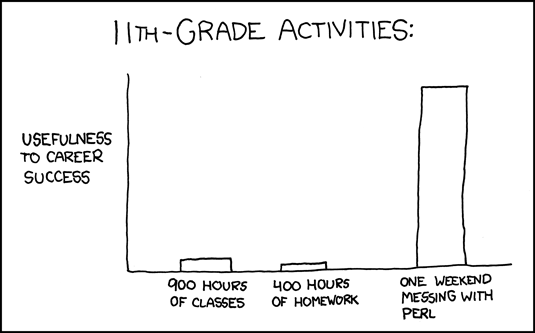
The short version is to read researcher Peter Gray's The Seven Sins of Our Forced Educational System. Exactly the sort of article I would have described as nutty 10-20 years ago, but now think has many good points.
The long version is to read the rest of this post first, warming you up to the idea that radical educational ideas may not be insane, then reading Gray's article.
It used to be, the only tension was between public schools and religious schools. Prep schools were there, but only for the rich and few. They knew who they were, and their worlds did not touch ours, except when they wanted to rule us.
Radical voices came onto the fringes in the 60's. American education was designed by rich industrialists to create useful cogs for their corporate machines. Which always struck me as a textbook example of stretching reality to an insane degree, highlighting some aspects while downplaying others in order to make some political point. Grading destroys love of learning...rote learning destroys real understanding...competition destroys cooperation... Each of these had enough truth to limp along to the next decade, but obscured more than they explained. Montessori schools were there for those who were determined to go that route, and those were okay, but given the population they drew from, never seemed to provide the value-added for education that was hoped for. (I still like 'em, though.)
Over the last two decades the clamoring for education change has grown more frantic. Conservatives have a lot of people who think that if we just went back to the good old days, even the strict back-to-basics days if not the one-room school, all would be good in the garden. The idea is insane, based on nostalgia rather than true recall and certainly not real data, and I am frankly sick of the argument on conservative sites. It morphs over into core curriculum ideas for highschool and college, which is a quite different subject. (And even that is not quite an honest argument. It is easy to find bad examples in modern course and texts and pretend that things were never like that in the old days. Nonsense.) It starts from a selection bias of the better friends and relatives of online commenters who liked school and like writing about it now. Why, my grandfather had only borrowed chalk, a compass, and two desks for twelve students in their little town, but by golly they worked hard and all of them went on to become civil engineers or neurosurgeons. It's rubbish, every bit of it.
Liberals have their own idiocies, which I'm sure you've seen enough of that I can skip it here. Homeschooling has been a real change, and they have done well at undermining many myths of what is necessary for schooling. Special Ed has been enormously expensive but the old system was to put children away in institutions and just let them waste. I suppose if we don't really value independence and consider relative physical comfort to be a good life, that could be our goal again. Yet now that the mask is off I don't think we could look it in the eye again.
Bigger changes are brewing. Distance learning is growing. Ooh, those awful for-profit schools! Like your school wasn't out to make a nice living for a lot of people off you, just because it had ivy-covered professors? Khan Academy hopes to "flip" middle school and high school, so that the video lectures are the homework and the working of problems with a teacher are the in-class part. The TED lectures in general are filling up with new models for education. We hang back from trying any - we have so much invested in the current model and fear to be wrong - not with our children!
You would think that one such as myself, who values the wisdom of other eras, hates educational fads, and is married to a school librarian would be the last of the big experimenters. But school librarians are often the front edge of cooperative and experimental methods in a school. Plus, adopting Romanians, then acquiring Kyle, has given us a different look at our system in the US. Things at school that only annoy you when you have children able to dazzle with brilliance and adapt out of, become problems requiring solution when that advantage is not there.
But what hit me hardest about Grey's essay was what it described about me. I really was one of those who thought my role was to be amazingly brilliant and wait for someone to discover me. I really did think I was better than most of the rest of you. To see in print that this is what our current system encourages in the personalities of some bright students - and to be ready to hear that - was unpleasant. I use my education to entertain myself and others. The only direct application to my job or any useful activities is my ability to string sentences together - which may come more from reading rather than going to school.
In fairness, I am very entertaining. There is that.

As recently as 15 years ago, Jonathan laughingly reassured me that Asbury looked like what I would consider a real college, because that was still important to me then. I now hope the opposite for most children - that they don't go anywhere near such a place, except for a season to absorb what school "used to be like." I hope Emily and Sarah have already carved out their first employment niche in their late teens and take formal training only as needed, such as for brain research or business Hungarian. With no ivy in sight.
Tuesday, March 01, 2011
Teenage Impulsivity
Anyone who has seen a teenager in the grip of an obsession knows that they can work harder than most people. Like a garage tinkerer who will spend hours refining an invention that will save him a few seconds a few dozen times in his life, a teenager can devote enormous persistence to a task that strikes his fancy. If the reward is visible. If the reward is not visible, they are easily distracted into one that is, even if it is a lesser reward.
I have no idea how you're going to use this information, BTW. I certainly haven't figured it out.
Why then, are they so lazy, so unconcerned, about tasks which need to be accomplished - even they know need to be accomplished eventually - but hold no charm?
Because our "achieve reward" and our "avoid discomfort" circuits are separate, and theirs haven't lined up yet. For adults, the connection between the two concepts has developed over time, so we can at least roughly estimate some balance between them. But for teenagers, these two items are still quite separate. Their "achieve reward" circuits are actually more active than an adult's. So active, in fact, that it kicks in for whatever crosses its path. Their energy goes to "the next visible reward." All others, take a number. Rather like the dog-man in the movie who turns his head and says "Squirrel!" Shiny, shiny.
Complicating this is the underdeveloped circuitry for avoiding discomfort. Because teenagers dawdle over anything unpleasant, you would think it would be the opposite - that they do little but avoiding discomfort. Yet it is the underdevelopment, the lack of ability to see that 10x discomfort will occur if you don't endure x comfort now that keeps them unmoved by consequences. 10x, x, it's all the same. My parents are mildly upset, my parents are very upset, it's all the same. I might be embarrassed for a few moments, I might lose my job - those are about equivalent to a teenager.
This is of course entirely understandable to adults, even as it is infuriating. We feel those same impulses on their separate circuits and get the point that one might not want to do something unpleasant. Why not put it off a few more minutes, hours, days? But adults have the better-developed pain avoidance, and can better foresee how painful this is going to be if it is postponed too long.
I have no idea how you're going to use this information, BTW. I certainly haven't figured it out.
Why then, are they so lazy, so unconcerned, about tasks which need to be accomplished - even they know need to be accomplished eventually - but hold no charm?
Because our "achieve reward" and our "avoid discomfort" circuits are separate, and theirs haven't lined up yet. For adults, the connection between the two concepts has developed over time, so we can at least roughly estimate some balance between them. But for teenagers, these two items are still quite separate. Their "achieve reward" circuits are actually more active than an adult's. So active, in fact, that it kicks in for whatever crosses its path. Their energy goes to "the next visible reward." All others, take a number. Rather like the dog-man in the movie who turns his head and says "Squirrel!" Shiny, shiny.
Complicating this is the underdeveloped circuitry for avoiding discomfort. Because teenagers dawdle over anything unpleasant, you would think it would be the opposite - that they do little but avoiding discomfort. Yet it is the underdevelopment, the lack of ability to see that 10x discomfort will occur if you don't endure x comfort now that keeps them unmoved by consequences. 10x, x, it's all the same. My parents are mildly upset, my parents are very upset, it's all the same. I might be embarrassed for a few moments, I might lose my job - those are about equivalent to a teenager.
This is of course entirely understandable to adults, even as it is infuriating. We feel those same impulses on their separate circuits and get the point that one might not want to do something unpleasant. Why not put it off a few more minutes, hours, days? But adults have the better-developed pain avoidance, and can better foresee how painful this is going to be if it is postponed too long.
Monday, February 21, 2011
Maggie's: Education Repost
Liberal Arts education, and Stanley Fish's essay excoriating UPhoenix, are under discussion over at Maggie's. I have only a half-formed thought, standing back from a more sociological (or even anthropological) view, which I am hoping folks can help me flesh out.
Any industry which regulates itself moves to a protectionism of the persons and values of its own elite.
Any industry regulated by the government moves to protect the persons and values of a different elite, sometimes overlapping, sometimes competitive.
Any industry regulated entirely by commercial concerns coarsens and adulterates its product, but is also the source for all innovation.
Regulation by church seems more varied and mixed, but includes a propensity to devoting enormous resources to wild geese that do not create the improvements hoped for.
There is considerable interpenetration of these in any complex society, and corruption or exploitation can come from many directions.
I frankly don't know what the proper balance of these is.
Any industry which regulates itself moves to a protectionism of the persons and values of its own elite.
Any industry regulated by the government moves to protect the persons and values of a different elite, sometimes overlapping, sometimes competitive.
Any industry regulated entirely by commercial concerns coarsens and adulterates its product, but is also the source for all innovation.
Regulation by church seems more varied and mixed, but includes a propensity to devoting enormous resources to wild geese that do not create the improvements hoped for.
There is considerable interpenetration of these in any complex society, and corruption or exploitation can come from many directions.
I frankly don't know what the proper balance of these is.
Friday, January 14, 2011
Boys In School
I know, I know, TED is so SWPL, but I do like it.
Bethany, who used to comment here as bsking and is personally known to some of you, sent this on today. This is particularly sporting of her, as she was a math/science girl who was on the receiving end of some gender stereotyping in school.
So, another feminist mother of boys, I'm guessing. Though to be fair, these ideas are starting to get out into wider educational culture, and are there for anyone who just looks at the numbers. But it is worth noting, there are still large sectors of the academy where these are very unpopular ideas, and a lot of energy put into declaring that A) it just isn't so, B) okay it is, but it's the boys' own fault, or C) if we pay any attention to this, we'll stop helping girls. The speaker may seem only a bit emphatic to you, but my reading of the subtler cues tells me she has toned it down greatly for her audience. I'll bet if you got a coupla drinks into her you'd get an earful. Good on her.
My observations:
1. What I've been saying for years
2. It has been this way for decades - read Tom Sawyer and Little House On The Prairie if you don't think so - though it may indeed be worse now, for reasons she touches on.
3. Her demurrers that yes, girls are still discriminated against fall into the pattern I described often in the past (one example): examples of how the wider culture discriminates against women, not how classrooms do that. (Larger school culture - student elections, popularity, awards - are closer to the norms of the wider culture. But not classrooms.)
4. And deriving from that, my noting that this is thus unfair to women later on, as they move from a culture where the rules are stacked in their favor to one where they aren't. The rug is pulled. Of course, we've already screwed over a lot of boys by that time, so it's not like this is something that evens out.
5. Those video education games can be done. My brother does something like that for Sky-Skan, which designs and installs those planetarium shows. But schools think of things like that as extras, that you might bring in a few times a year for fun. The idea of having screens and controllers as the foundation of your system is not quite conceivable to them.
6. Somebody's going to run a school like this - likely online - and change the world. If a guy has to give orders to his character in French to level up, he'll learn French. Videogame French, not Montaigne, but French. He won't like fake games where you have to label the parts of a cell to open a door, but he'll soak up what keeps cells nourished and alive if his character needs that knowledge to eat, or grow specialised poisons.
Bethany, who used to comment here as bsking and is personally known to some of you, sent this on today. This is particularly sporting of her, as she was a math/science girl who was on the receiving end of some gender stereotyping in school.
So, another feminist mother of boys, I'm guessing. Though to be fair, these ideas are starting to get out into wider educational culture, and are there for anyone who just looks at the numbers. But it is worth noting, there are still large sectors of the academy where these are very unpopular ideas, and a lot of energy put into declaring that A) it just isn't so, B) okay it is, but it's the boys' own fault, or C) if we pay any attention to this, we'll stop helping girls. The speaker may seem only a bit emphatic to you, but my reading of the subtler cues tells me she has toned it down greatly for her audience. I'll bet if you got a coupla drinks into her you'd get an earful. Good on her.
My observations:
1. What I've been saying for years
2. It has been this way for decades - read Tom Sawyer and Little House On The Prairie if you don't think so - though it may indeed be worse now, for reasons she touches on.
3. Her demurrers that yes, girls are still discriminated against fall into the pattern I described often in the past (one example): examples of how the wider culture discriminates against women, not how classrooms do that. (Larger school culture - student elections, popularity, awards - are closer to the norms of the wider culture. But not classrooms.)
4. And deriving from that, my noting that this is thus unfair to women later on, as they move from a culture where the rules are stacked in their favor to one where they aren't. The rug is pulled. Of course, we've already screwed over a lot of boys by that time, so it's not like this is something that evens out.
5. Those video education games can be done. My brother does something like that for Sky-Skan, which designs and installs those planetarium shows. But schools think of things like that as extras, that you might bring in a few times a year for fun. The idea of having screens and controllers as the foundation of your system is not quite conceivable to them.
6. Somebody's going to run a school like this - likely online - and change the world. If a guy has to give orders to his character in French to level up, he'll learn French. Videogame French, not Montaigne, but French. He won't like fake games where you have to label the parts of a cell to open a door, but he'll soak up what keeps cells nourished and alive if his character needs that knowledge to eat, or grow specialised poisons.
Subscribe to:
Posts (Atom)