Deaths are still high from covid, state after state.
But number of new cases are down, much better than previous spikes.
Hope.
Deaths are still high from covid, state after state.
But number of new cases are down, much better than previous spikes.
Hope.
Some discussion of "natural immunity." Not terrible news, but not what we have hoped.
Summary: (The longer reasoning is at the link.)
Ashish K. Jha, MD, MPH @ashishkjha.
So let's be clear about a few things
Is infection-induced immunity real?
Absolutely
Does it help prevent future infections/hospitalizations? Probably...for a while
For first 90 days or so? Almost surely. Beyond that? probably not that much.
Infection-induced immunity is helpful but really doesn't seem to last that long And as virus becomes endemic you are looking at constant reinfections.
Or you could just get vaccinated and avoid all the heartache and misery of having to get infected over and over again.
Among our friends who inform themselves, we have been hearing that vaccination immunity starts to slowly wane at about six months, which is twice as long, and also (probably) goes down more slowly. So somewhere between 2-4 times better, without having to risk the consequences of having the disease. But I defer to better information if you have got it.
Not all languages have words for "yes," and no," or if they have them, they are not used much. Latin was one. Mandarin is another. The rural Irish, even when speaking English tend to avoid them, because Gaelic does not use them and they seem to have just gotten into the habit. Whether it technically has those words I don't know. Consider this interview with a woman in New Zealand. The interviewer is setting up the questions intentionally, and I think the woman is in on it, particularly from her last two answers, yet I feel confident these are essentially natural answers for her.
Your name is Sharon?
It is.
And you're from Ireland?
I am.
You have been in New Zealand for ten years.
I have.
And you would like to be a psychologist.
I would.
And your favorite food - is ice cream.
It is.
And today is a beautiful day.
It is.
And you have never been to Iceland.
Never.
Can you tell me a three-letter word that means affirmative?
Aye.
I notice the Irish never say "yes" or "no."
To be sure.
You will notice that the most common version is to use a word the other speaker used, especially a form of the verb, either in positive or negative: Have, do, is, never. It is not that strange to English speakers as we would think at first, even though we use "yes" and "no" a lot. The Irish woman gives responses that we might also use to go through life without anyone ever noticing an idiosyncrasy. "Is that your car?" It sure is! "Do you ski?" Not anymore. Are you going to Florida for the winter? Absolutely. We use these other forms when we want to give our answer a special emphasis, but we do have midrange forms as well. "Can I borrow your sledgehammer?" Sure. Okay. Uh-huh. We could get by without yes and no if we needed to.
We have given the wrong advice to young people for two generations WRT having children. We have said "get to know your spouse, get settled, be more prepared for parenting." But children get by on what we feed them (within reason) and vegetables are cheap, and babies don't have any awareness of whether they have to share a room or even a bed with siblings - for years. We talk about wisdom in order to raise children, but really, I learned with my first foster child, who was eight when I was not yet 24 myself, that the job does not require much wisdom most of the time, it requires being present. A sandwich needs to be made, make it. A diaper needs to be changed, change it. This sort of crying means tiredness and you need to get this four-year-old home. That's it. What is needed when children are small is mostly energy, and at 38 you have less than you did at 18. The things that make parents feel more ready are largely irrelevant to the child, and by the time they are old enough to make comparisons, you are 10 years older and wiser yourself. And now you have experience to boot.
For a decade I have been telling young couples "Have more children and worry about them less." Because that seems a bit shocking I do expand on the topic and develop it. I think I will now amend that to "Have more children, have them younger when you have the energy, and worry about them less."
Within reason, of course, but people who are going to be decent parents anyway usually don't have any new magic they are going to learn by waiting an extra five years. The responsible ones are usually responsible already. And observing the little ones at church today, darn but you need energy as virtue #1. We have clearly underrated that, to the detriment of a lot of young moms.
I spoke with the worship leader today about the sparse attendance (and weak singing) of those at the first service, the traditional service, this morning. I felt for her deeply, as she tried to bring life and worship out of those mumbling along to a hymn they were not that familiar with, as it this experience was so familiar to me from the times I led worship* at our previous church. My eldest once joked "The classic Concord Covenant hymn is Kathy playing a great accompaniment while the congregation stands and reads silently from the hymnal. But all four verses, of course."
She did not seem to understand what I was saying and was even sensing a criticism on my part so I repeated myself, and she nodded in a cloudy way. She was not distressed at the weak participation, as compared to second service. She was grateful for any, as her experience has been leading the worship band before a camera with no congregation for almost two years.
Of course. My experience has been at the times when worship opened back up to in person for at least some people, and I was comparing that to my historical experiences over almost 69 years. She, still in her 20s and now tasked with the creation of the worship environment, is comparing to the two years in the wilderness of Covid. I have not been in attendance to experience those Sundays and didn't factor them in.
Related. Attendance is coming back up at second service, but volunteering is way down across the board in all ministries. People have gotten out of the habit, and we are creatures of what we see and hear. If we do not see the need, it does not occur to us.
*I noticed today that while some people, especially those like me who are very attentive to the letters on the page say "worship," the more usually pronunciation now is "worshup."
I mentioned a few weeks ago that because of new rules about what eggs could be sold, the supermarket we get the donations from for the halfway house downtown had boxes and boxes of eggs. Today when I brought them over to the loading door for the house kitchen, they said they didn't have room for so many eggs, they already have plenty. So I called Food For Children about a mile south, which hands out food to families every Saturday. Nope, they didn't need them. They got two pallets yesterday. My town's food pantry already had too many as well. I did find a taker in a neighboring food pantry, but they said what i brought would last them a month. It is likely more than a 150 cartons.
A month ago I was feeling uncomfortable about wasting a whole carton of eggs because of one cracked or broken one. Today I was wondering whether 150 cartons were doing to the dump. Starting next week, they probably will. The food charities only need a percentage of what is being donated, even when they push another carton on anyone who takes one. I notified a few other food pantries farther afield of the situation and the opportunity for eggs, but there are just going to be too many eggs for the foreseeable future. Very much a pity. I supposed it's a comfort that lots of families will at least have all the eggs they want if they can just get to one of the locations they are being given out, or can send a friend.
I suspect that because the stores are going to be taking more of a breakage loss on eggs, the price will go up. One of those imbalances that just happens in real life until everything in the system adjusts.
It is a defunct section of Manchester. No one calls it that anymore, and it is barely even there. It was even called just 'Skeg by old Manchesterites when I was young. Yet it was already on the way out then. The Everett Turnpike came in in the late 50s (I assume. Everyone still talked about it as this inconvenient new thing when I was a boy), pretty close to the Merrimack River on the west side, which was the bulk of what we called Amoskeag. In older times the eastern side for about a block or so away from the river was also called by that name, but that went away even earlier. For openers, the elementary school district only had kids from the West Side, as it just seemed wrong for little kids to be crossing the river to go to school, especially in bad weather, when Straw and Webster Schools were right nearby. Then the train stopped picking up and dropping off passengers at the Amoskeag Station on the east side after the war, and 'Skeg just became that narrow strip between the river and the highway right around the bridge. Pretty much "between the devil and the deep blue sea" and then the school soon closed as well. They didn't want kids going over the highway either. It was a nightmare to drive and still is, with the exits stuffed into small tight places. Still a terrible merge.


But for us the excitement as children was going across the "singing bridge" to the A&W, which my mother could seldom afford and was a big deal to get a Baby Burger. It was run by the Plourdes and like everyone else, it seems, my grandmother and her sisters could tell you their whole story. And later, when we were allowed to know the story, there was the abandoned store which we vaguely remembered being open, Hank's Sports Shop, with fishing and hunting gear. Hank was Henry Piasecny, known by many of my mother's friends, who shot his ex-wife and her boyfriend and was sent to the NH State Hospital as an NGRI, getting out three years later in the 1960s. It gets stranger, as he died suspiciously about a decade later, with his daughter Susan insisting he had been murdered. She was so persistent, and eventually provided such good details about where he was shot that they dug him up and by golly, the bullet holes were exactly where she predicted. She was eventually convicted of the murder and she was sent to the State Hospital.
Update: I had never known. Why was this not general information? His brother was Thaddeus Piaseczny, better known as Ted Hebert (their mother was born Karolina Herbut), who was a big band leader and ran a music store in Manchester, one of the two main ones, the other being Nuttings.
Of course I know more about the story over many years and many life changes of Susan's. She was a favorite topic of hospital staff for decades. But that's about all I can say. I believe she is still alive and living in NH, probably about 75. Calvin Trillin wrote up the story for the New Yorker in 1978, and a girl from a year behind me in school included other details in her book Kookooland, which I somehow have neglected to mention or review. The store stood empty for years, right next to the bridge and across from the Fishways and the Holiday Inn, just above the Amoskeag Falls and the power station.
There's an old cemetery and some houses up Front Street, but the highway, the expanded bridge, the decrepit store, the radio towers...not enticing real estate. There are some new apartments there, because it is waterfront, but people with children tend not to move in. Live next to a powerful river just above the dam, with no open areas to play in and an Interstate on the other side - what could possibly go wrong with that?
If you look up Amoskeag now you can find out about the Amoskeag Mills - a very big deal and employing 17,000 souls in its heyday making textiles and steam engines. I worked in one in its transition years of figuring out "who the hell can we sell this building to." Or the Amoskeag Falls, where the Penacooks used to fish and had part-time settlements on the bluffs on the east side, where the Straw Mansion was eventually built. You could still find arrowheads there when I was a boy, though I never did. Such things take patience. The article is by another person from a year behind me, John Clayton, who now runs the Millyard Museum for the historical society. I get mentioned in one of his books. Manchester metro area is 250,000 people, but Old Manchester is still a small town. John and I are both Old Manchester.
Or you might still find some Amoskeag rifles made for the Civil War on a Colt contract on your search. That's getting to be a stretch, though. Even we don't mention it anymore.
A few other businesses still cling to the name, but who cares, really? Amoskeag is gone, leaving only a few ghosts.
I had a pastor I dearly loved in the 1980s, and scheduled an appointment with him to discuss my spiritual discouragement. It didn't help. When I came home, my wife asked "How did it go?" and I answered "He drew three circles." She groaned and nodded. He was very bought into that model of the human of mind, soul, spirit in concentric circles. Maybe it was body, soul, spirit. Or maybe I have the order reversed. But it was the idea that it is our spirit that is in contact with God, so therefore we had to have that part penetrate our souls, and then our minds. Something like that. He was sure it was entirely scriptural.
I remember from going to the Y as a lad that triangle with Spirit, Mind, Body written on the three edges, and when they were really rolling they would bring out the Latin Mens sana in corpore sano*, "A healthy mind in a healthy body, apparently not noticing that they left out the spirit part. With my trusting nature, I just assumed that it was just part of a longer saying or quote. I couldn't imagine that grownups in charge of lots of things could get that wrong.
We have some mind/body dualism in our philosophy, and the MBTI goes with four parts or four axes, but we more often go for three parts. Id, ego, superego. There are three doshas in Hinduism, roughly corresponding to CS Lewis's image of the head ruling the belly via the chest, for cerebral/spirit, visceral/animal, and integrative or human function. Three parts is not obligatory and our minds don't insist on it, but we seem to like it.
Contrast this with how we divide types of personality, which is usually a set of four:
Earth, air, fire, water
Phlegmatic, sanguine, melancholic, choleric
Kretschmer gold, blue, green, red
Eysenck, which led to MBTI
JK Rowling was following this deep attractive tradition by having four houses and a Sorting Hat that just knew where you belonged.
Why three parts and four types? Do they reflect anything real, or are they just poetry? God is a Trinity, and you might make the argument that we are an echo or imitation of this if there are three parts of us, but it becomes hard to push the analogy further - is the Holy Spirit supposed to be the mind or the body? It therefore doesn't seem that useful.
*I think earlier, when I was just learning to read, I could tell it was in a foreign language and thought it had something to do with the Men's Sauna, but I could never find one. I figured they must mean the steam bath, where my mother had forbidden me to go. As for corpore sano, I don't think I thought anything about it. It was already too confusing.
Listening to a rock history podcast, one comes up on things barely remembered, or not at all, because after 1975 I didn't listen much until my oldest son started in in the 1990s. I almost skipped over some episodes because they were about people I didn't much care about. Learning more has given me at least some appreciation. All three of these were included because they not only had major hits, but because they worked in multiple styles. I grant that, though I am not particularly interested in any of those styles, no matter how well they are done. If you can do disco, funk, punk, and techno I might be impressed - I can't do any of them - but I'm still not likely to sign up. Yet over the course of the episode I learned that all three of these had done songs I had never attributed to them, especially if they had written them for others (all did). And in the mix there would be something that I did like, and along the way I would hear with new ears what they could do. All three are dead now.
There was a banner on Pilgrim Church in Dorchester, across from the Strand Theater where the Van Gogh exhibit was. It read "Jesus didn't reject anyone. Neither do we." I have seen similar sentiments many times over the last couple of decades, and not only on UCC churches. (I didn't even bother to look. I know it's UCC, partly from the sentiment, but also from the name and location.) I look at those and think What Bible are you reading? Jesus rejected people all the time, and rather forcefully. I know what they mean, and there is a truth in there. But it is less than half true. To recognise that Jesus did reject some people is to stumble upon the questions Who? and For What? My guess is they would be very happy with 50% of the real answers to those questions. But the other half would be unendurable. They sense the answer from afar, and don't want to hear it.
So are we all in our own ways, usually in groups.
Ben's podcast at his Methodist church was examining the question of blessing, and how to square some common Christian expressions of "God blessed us with..." with regard to some good news, or even some object, with other words of his that suggest getting good things here may make us less eligible for good in the Kingdom, especially as expressed in the Beatitudes.
I have given my thoughts about the common (partial) misinterpretation of the Beatitudes before, and still like what I wrote then. Briefly, suffering or oppression here does not makes us more eligible for blessings in the kingdom (though it very well might make us more willing to seek them), but Jesus was preaching to a people that did not much believe that the downtrodden were much eligible at all. Even his disciples were shocked that the rich were not those more favored by God. (Matthew 19:23-25)
But I think understanding the tension between these ideas, of God quite clearly saying many times he has blessed Israel with good things - protection, victory, harvests - and similar ideas throughout the NT, though less often, versus offering a type of blessing that seems quite different is to regard them as small-b blessing compared to Real Blessing. The former is a shadow of the latter, given to us to teach us what good things are in God. They are there to point the way, and they are many times describes as being worth more than all the small-b blessings combined.
A lot of energy is being spent on conservative sites, even more now than previously, when it was already considerable, in being skeptical of experts, especially those with any authority. It's a fine Western and especially American tradition, and we should all be ready to ask ourselves questions about what we are hearing, and sometimes - to ask those questions aloud. Notice, however, that I framed this as being around questions. These must precede the skepticism. Skepticism is not in and of itself a good thing. It is a tool, very useful at times. These days it seems to be prized for its own sake. I remember thinking years ago the more leftist bumper-sticker Question Authority, immediately wondering what the intended replacement would be. Because of course, it can only be a different authority, however disguised.
It's one of the reasons I so enjoy Razib Khan, who is a targeted rather than general skeptic. I listened today to his interview with Dr. William Gunn, a microbiologist who worked for Mendeley, then Elsevier, and is now Director of Communications at Quora. (The website says for paid subscribers only, but it popped up for free on the podcast app on the device I carry with me when I walk.) In reply to Razib's observation that it seemed that Indians were now the primary experts replying in many fields on Quora, Gunn noted that people were leaving Google and Microsoft to come work on the AI at Quora because it is so fascinating. I did not know this, not an inkling.
Gunn is thus clearly tuned in to the change over the last twenty years in how science information gets out. He gave very clear information about how peer-review was an excellent system in the 50s and 60s but is now overwhelmed. A million papers a year require peer review, and in some specialties, only 10-20 are qualified to review a new paper. He described his amusement at the first time one of his own papers was given to him to review - an accident that is not common but not at all unheard of. He knows the complaints from very close up at his previous jobs and observes how even those whose primary output is academic science publication do not entirely understand the system and make invalid complaints. He reviews some of the new media possibilities of how dissemination of science is to be done instead (including Quora), noting the immediate difficulties that many of the favorite panaceas present. Those of you familiar with academic publishing will likely appreciate the entire discussion.
The very last part of the interview will be of more general interest. Razib and Gunn discuss all the problems with covid information coming out. Gunn talked about the difficulties of knowing what to emphasise and how to frame things. Even when there is no particular political angle, only one person in a thousad will hear what you say directly in the moment. The rest will get their information second, third, fourth hand, and even if they go back to the original source, they will already have been influenced by the intermediary sources. The original sources try to anticipate the many ways that the information will be misheard and misunderstood, trying to head off potential very wrong criticisms, and highlighting what they believe to be the most important points. As that is something I find myself doing when I write - perhaps not very successfully - I understood the problem immediately. There are ways that people bend information other than partisan politics - and nearly all of them are wrong. I had thought it might be 90% of the skeptics that just didn't have a good understanding, with a hefty portion of those being flat-out loons, but Gunn thinks it's 99% of skeptics have no business weighing in on a subject. He says this while acknowledging that the 1% often have insights that are very helpful.
Our discussion can go in a few directions from here. Is Gunn's impression colored too much by his personal experience of being on the receiving end of skeptics and trying to solve that? I thought I was pretty skeptical of the skeptics by estimating 90% inaccuracy and have admonished folks here that we aren't being skeptically enough, moving to all manner of unstable watercraft if we believe the main vessel has a leak or steering problem. 99% would be an amazing number...and yet he is much closer to this than I am. This is how he makes his daily bread.
I thought next of the subjects that I weigh in on, here and elsewhere. If the true number is 90%, then I am reasonably qualified to weigh in on a few things. Yet even on those, I am always aware of aspects where I only know "much more than average," not an amount that I should be seriously questioning people who have clear expertise. Mental health treatment and mental health law would be good examples of that. In general, I can comment, even taking on experts, because I have known and worked with experts who were incompetent, or so tied to one belief or another that they could not see the rest of the questions clearly. Yet I am not a prescriber, and so comment only in general on medications and promising new treatments. I quote people who seem to me to make sense and have done their homework. That seems within my grasp. But if the real number is 99%, then maybe I'm one of those just-misses who also just doesn't get it and should shut up. Or on another topic, I read pastors and Christian writers who get things just wrong, sometimes badly, and will comment on interpretation. Mostly, I follow CS Lewis, who I regard as more trustworthy than most others writing. If the percentage of reasonable skeptics is 10%, I qualify, especially as I will defer to others in places where my knowledge is only approximate, as in translation. But if the number is only 1%, I may be less helpful than I thought.
And yet...my strength is usually in discerning who is showing motivated reasoning, who is fighting fair, who is listening to and processing pushback information versus seizing on small points and treating them as definitive, or worse, disregarding pushback altogether and just bulling forward, reciting their claim more loudly and angrily. Having knowledge in an area helps alert me to people doing that, as I can know they are likely flat wrong right out of the gate. Yet even in situations where I start out neutral because my knowledge is slight - epidemiology would be a good example - I can usually tell who is making the better case. All of this bears further thought.
On the other, other hand, I worked with doctors all my career, who had this voice they would adopt, clearly based on the attitude they had of "I'm a doctor." This was used not only in medicine outside their specialty - some justification there - but outside of medicine altogether. It roughly translates as "I'm one of the smart ones who has to know about a broad range of things." It ain't so. (There is a pattern of the demographics of who are the worst offenders in my own generation - males from anywhere, the older the worse - compared to the worst offenders among the younger doctors - American females. It's an amazing switch.) Pastors also have that tone, based on that attitude of "but it's my job and my training to understand and apply Biblical principals to society at large and the Real Lives that people live." And thus they speak as if they are at least semi-experts on sociology, economics, criminology, psychology, history, and everything else where they had some carefully curated academic instruction. Again, it ain't so. A few lecturers and professors I have known do the same, even outside their fields. They are usually smarter than the average bear. The often have read widely and their knowledge does extend beyond their specialty. But they overreach repeatedly, as I can plainly detect when they come into my territory. If I am harsh about them, how much more should I step back and ask "Do I know what I am talking about here?" William Gunn used the phrase epistemic humility.
Where Razib went was related to my thoughts about the validity of my own skeptical challenges, but I think he went one better. He asked if there was some difference when we had things like covid, where political considerations were pretty obviously coloring the views of the experts. Gunn had already dropped a few hints that suggested he is liberal, and his defense of experts did start out sounding like special pleading of the "they only made such a confusing mess of things because they were trying to steer around all the unreasonable skeptics" variety. Yet that did not last long, and he agreed pretty thoroughly with the idea that this had happened. Sidebar: Gunn mentioned the masking switch (I would add depressing the curve), which is a common complaint, but Razib hit a different moment. His recollection, following both conservative twitter and science twitter at the time, is that the health professionals endorsing the George Floyd protests was a tipping point. They aren't the CDC, so it's not entirely fair, but he thought people were willing to overlook the mistakes about masks and even the wrong predictions, because it was all uncharted. But for people to go out chanting in protest and getting applauded for it was a stark declaration of "We don't really mean what we are saying when push comes to shove." I had not thought of it that way, as people being jerks is a given in my book, and thus usually irrelevant. Yet I trust Razib's memory and Gunn agreed that this was very big. Huh. This is how history is remade in memory. Or my memory, anyway. Also, if health professionals were doing this, perhaps the CDC had the responsibility to call them out?
Ironically, outdoor transmission, even with chanting, turned out to be minimal, which is perhaps why the hypocrisy has receded in my memory. But we did not know that then, and were still encouraging people in all sorts of caution.
Gunn did not think this was a one-off, and thinks it will happen on political issues again, because all the things that bend experts remain stable: where their funding comes from, where professional status comes from, professional ideologies that they have built careers on, or defending those they trained under and their school of thought. String theory eating up funding or the professional danger of destruction for attacking Chomsky's Universal Grammar is real in all fields. Politics is merely one of those ever-recurring problems. However, Gunn still thinks that attending to the experts is a better bet than attending to the skeptics. Because the skeptics are mostly loons. He believes that the 1% of skeptics are usually the only ones who can bring down the Conventional Wisdom. The rest of us are just chirping. He thinks we should save our fire for targets we can hit. He may be trying to reduce the irritation of people who have to put up with nonsense. But he's got a solid point here, and he has seen the crap flow into question boxes or onto bulletin boards for quite some time.
I see his point and think I will shade in that direction, but I don't think it is going to turn me around. I might be more cautious. But I can still know an ad hominem argument when I see one, detect at least a possible conflict-of-interest in a person answering, or sniff out views that are more fashionable - or the delicious fashion of being anti-fashionable - than reasonable.
In a sociology experiment, eight people were dropped on a deserted island: two Danes, two Finns, two Swedes, and two Norskis. They were checked a year later to see what had happened.
The Norwegians had started a fishing company, the Finns had started a sauna company, the Danes had started a furniture company...
And the Swedes were still waiting to be introduced to each other.
The joke is founded on there being associations with the other three types of Scandis, which leaves the Swedes holding the bag, but the principle is true of all of them, especially the Finns. My habit of striking up conversations with strangers worked a little in Oslo, but otherwise only at the English-speaking Anglican church in Bergen. I am assured I would be a fish out of water in Finland.
This is important to remember when looking at what the Johns Hopkins study claims to be saying - not, and I cannot emphasise this strongly enough, even though it's useless, what people are saying that it's saying. What they are calling a "lockdown" varies from study to study, and they took no particular pains to correct for that. It seems to mean "whatever the hell this particular researcher wanted to call it." This is especially strange in that they started with over a thousand studies and screened out all but 34. I have not looked at what happened there, but how do you screen out 97% of the studies and still have this much variance? What in the world were they taking out?
I should feel some vindication here, because I have long been saying that mandated lockdowns are not the same as voluntary shutdowns are not the same as people individually modifying their behavior. Conservatives should be well-placed to understand this difference, because it is the same as their gun control argument: the law you pass doesn't influence behavior anywhere near as much as predicted. People's behavior depends much more on the people. That gun laws don't work doesn't mean that responsible behavior and gun safety aren't important. But I don't feel vindicated, I wish I were wrong and it was simpler and less prone to misinterpretation.
The Johns Hopkins study specifically notices some countries that have good covid mortality numbers, and these include Scandinavian countries. They go on to claim that these are generally not so much lockdown countries. Yeah? Tell that to my son in Tromsdalen. He did get to go back to work fairly soon in the process, but people are sharply segregated by building now, and there has been rescheduling so that only one or two people are in a location at a time. They still have two week quarantine if you return from another country, which is why he wasn't here for Christmas. Some restaurants have reopened, but there are not many people in them because Norskis don't go out to eat so much themselves, it's mostly the tourists - and there are no tourists. Norwegians get together, if at all, in small private groups. That's not Oslo telling them that, that's who they are plus company policy. As for the Swedes, they had terrible numbers at the start, seemingly related to the large number of older citizens in retirement homes. They have also argued a lot about what shall be mandated closed and what left to choice, sometimes doing one thing, then another. (As of a year ago they also had a problem with one of their immigrant groups, the Somalis, mostly ignoring all restrictions because they believed only white people could get covid. I don't know where that stands now.) But apparently, their open society looks more closed down then our locked down one, and their numbers are good. Because that's who Scandinavians are. They are civic-minded and will line up to do the right thing (even when it's the wrong thing), and they are comfortable mostly staying away from each other. Assuming that will translate to, oh, New Orleans or Nashville for examples, doesn't seem like a good bet.
Yet I am already seeing people saying "It proves that masks don't work, and lockdowns don't work, and distancing doesn't work" and even few saying "and vaccines don't work," though non-pharmalogical interventions were the specific focus of the study. Still a man hears what he wants to hear and disregards the rest. I haven't dared to go look at what is being said at other sites this morning. I suspect Zerohedge and Gateway Pundit will draw wildly overstated conclusions, because like Scandinavians and isolation, that's who they are and that's what they do.
If you want to say those things don't work, then you now have to come up with another explanation why Vermont and Mississippi have such different death numbers, or why Eastern Europe has most of the highest-death countries in the world at present. There ain't no free lunch here.
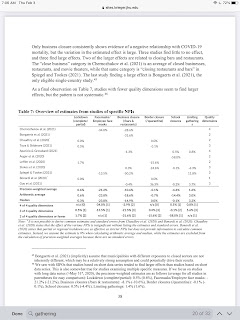
Not only that, but there is this chart from the meta-analysis, which for some reason only includes 11 studies, still with variation of meaning. The possible working definition of "lockdown = stay-at-home orders" was suggested to me this morning. Some studies show large effects, some show none. Everything has a study that shows it's important, everything has a study that shows it isn't. The other ill-defined category seems to be "business closing," which seems to mean bars and restaurants at minimum, but sometimes seems to mean more. I apologise for the poor quality. I'll try and find a better version.
I am looking at the ESPN Top 100 baseball players of all time articles (1-25 comes out tomorrow, and I am not even going to bother). And it is ludicrous. I am not linking. For a woke sports network, you have to wonder who in the world left all those Negro Leagues players off the list, and couldn't even get the easy ones right. Josh Gibson - my personal pick for #1 all time - at #35, and Oscar Charleston, my #4 all-time, at #53. I have to figure that being ESPN, they don't actually care about real racial issues, they care about what looks like a racial issue to a modern 25 year-old.
Not to mention not actually caring about who the best baseball players were.
Plus, when you look at Gibson at #35, you notice that Pete Rose is right above him at #34. Rose should not even be on the list, and it has nothing to do with gambling or otherwise being a jerk. He was good and lasted a long time. That's it. People who don't understand baseball statistics get all all excited because he "was the greatest leadoff hitter of all time," which he wasn't. Yet even if he was, that is no big deal. Until statistical understandings changed around twenty years ago, no one put their best hitter at leadoff. You put a certain type of hitter at leadoff. But your best overall hitter you had in the third or fourth spot. Like Johnny Bench, just ahead of him in the rankings even though he played a far more important position, catcher. I compared Rose to a player of his own era who is not as highly regarded now, but has credentials which far outstrip his as a leadoff hitter, even though he wasn't one. He finished at 61 on the list, BTW. But Rose was Charley Hustle! And he had a long hitting streak once! (Those tend to be guys who don't draw walks.) And he has more hits than anyone! Yeah, but see my comparison.
It's worth reviving my post on the Negro Leagues Baseball Museum in Kansas City over this. It will include a lot of the players I think should have been on the list.
City Journal has long published much of the excellent Theodore Dalrymple, and reprints older essays of his from time to time. This month they include "The Rage of Virginia Woolf," a review of her book Three Guineas.
The book, therefore, is truly a seminal text. In Three Guineas, Virginia Woolf lets us know without disguise what she really thinks: and what she thinks is by turns grandiose and trivial, resentful and fatuous. The book might be better titled: How to Be Privileged and Yet Feel Extremely Aggrieved.
I admit I know only a superficial amount about Woolf. Reading this, I wonder if she had Borderline Personality Disorder. Such women, because they give full-throated voice to their resentments, especially against men and the powerful in society, are often valorised by other women who wish to express resentment. Even if their complaints are entirely different or even in contradiction to the woman with BPD, they admire the rage itself, often declaring that women have not been allowed such things in the past, and the modern freedom to do so is refreshing. Hm. Well. I'm not sure many men were allowed to express rage that freely either, and at least in England, there are some striking recorded expressions of female rage in the legal records. There was likely some difference, but let's not overdo things here.
We went to the Van Gogh Immersive Experience exhibit at the Strand Theater in Boston today. I recommend it highly, including for children. It showed many works, and did some grouping of them, such as sunflowers, Japanese influenced, and last years, but only focused on a few in detail. I think that is the right approach.
One thing I had not known was about his impaired color sensitivity, which suggests that he used such bright colors in order to perceive them at all when painting. I had known about his epilepsy and psychosis, and the possible effect that the foxglove/digitalis used to treat his overexcitement might have contributed to his subsequent depression. Of course, enormous amounts of absinthe didn't help either.
Particularly poignant was "On The Threshold of Eternity," one of his last works before he committed suicide.

The Ruffian article linked over at Maggie's, The Banality of Genius reminds me much of Diana Pavlac Glyer's Bandersnatch, discussed here, about the mutual influence of the Inklings on each other. I like what I said about the book and about my own inability to persevere and write stemming largely from my personality WRT to criticism and groups. I can't imagine how I would have found or assembled a group here, nor how I would have listened to any of them. And that was the end of my writing fiction. It's on me.
Interestingly, I still liked Sarah Hoyt then, in 2016.
Glyer makes much of the importance of writers working in groups, started with her understanding of the Inklings, but also from practical experience. She teaches a college class on writing in which the whole point is to learn to work in groups.
I was on a highly creative neuropsych team at work, for one brief shining Camelot hour, from 1998-2001, and it was magnificent. I have also been on competitive puzzle teams, also peak experiences. Whether groups are such an enormous advantage when they work, that it is worth the risk of the enormous time-suck most groups when they don't I can't say. Yet I think more writers would do it if they thought there was no chance they were going anywhere without one, so they might as well.
I had an Inklings conference scheduled for mid-March at the Presbyterian Heritage Center in Montreat, NC but it has been postponed to September. Grim tells me that the area has been doing very well in terms of covid, but I imagine folks are still nervous about bringing in people from all over the world and putting them in the same room. I have been hoping - again - that things would be dropping off quickly and rather safe at that point, but it's not my call, is it?
What if there was a new disease that never killed you by itself, but undermined enough systems in your body that it made existing weaknesses worse, including those previously unknown to you? I am obviously taking some aspects of covid and expanding it to an extreme for my hypothetical, but it wouldn't have to be a virus. It could be a poison or a toxin that spreads throughout an area differently, something that is a common ingredient in the food, perhaps, as people speculate there already are ubiquitous toxins that kill us now. It would have to be speedier by far than those ingredients are supposed to poison us, but imagine it a bit. Either way. It doesn't kill you, but it attacks so many systems that it makes your heart and circulatory system a little worse, your breathing a little worse, your lymphatic system a little worse. Or it activates some of the bad cells already circulating in the body, setting off cancers or other hidden problems.
So heart attacks go up, and COPD and pneumonia go up, and cancers go up, some of them quickly, and they each kill some people. When this illness or toxin gets untracked, the death rate actually starts going up a lot, and we begin to look around wondering why it is that so many of us are dying of a variety of causes all of a sudden. It would be, as with covid, those who already had some compromise who are most vulnerable. If you had already had one heart attack, or already had COPD, when ten body systems were all weakened, you wouldn't get a chance to see what else the disease was going to do to you, because you'd already be dead of that first one. Or even if you recovered, you would now know you were really on the edge in that one spot, perhaps forever.
And as we learned more everyone would know that they had been weakened in some way, even if they had started out quite healthy and didn't feel so bad right then, and didn't feel so bad right now. Their heart and lungs had been taken down a peg. If you start from a good level, no biggie.
I haven't been able to think of a clever name for this illness or I would have already been using it throughout. Underminitis or something. If you can do better, please suggest.
Not a single death certificate would have the name of this disease on it. It would say Congestive Heart Failure or Pneumonia or Pancreatic Cancer. Nor would we be able to tell whether this particular heart attack was caused by underminitis or would have happened anyway. If there weren't cancer cells to activate, underminitis wouldn't create them (though we all have many cancers already growing in our bodies - it's just that nearly all of them are so slow that they won't take us out for another fifty years, making them ignorable for people like me. Tangent. Sorry.). We wouldn't even be able to say that these people died "with" underminitis, not "from" underminitis, because they would have already recovered a month or a year ago from it. No one dying from it, no one dying with it. All we would know is that this disease was weakening a lot of our people and we were dying more quickly, sometimes a lot more quickly.
We would then conclude that the distinction between from and with in this scenario was irrelevant. Were some doctors trying to cover up underminitis, making no reference to it in their notes? That would neither save nor kill a single person. Were some doctors trying to raise awareness about underminitis and working it into discussions anywhere they could shove it in? It would create no change in the death rate. Were hospitals getting paid more if someone had had underminitis along the line - was it this year's fashionable diagnosis that was getting stuck onto everything? It would not matter in the slightest. All that would matter was whether more people were dying, or not. What we called it would be irrelevant.
I hope this exaggeration illustrates why it doesn't matter in the least with covid either. I have gone so far as to call the distinction artificial, but it now occurs to me that it is not even that. Are people overattributing or underattributing covid in death diagnoses? Only the final number matters. The number of people more than expected that we lost tells us the death count for covid, even if the documentation of exactly where that is is shoddy. There are a couple of escape holes, of "maybe it's more suicide, maybe it's people who didn't get medical care because of lockdowns, maybe it's anxiety from being forced to wear masks, maybe it's loneliness from being isolated, maybe it's homicides from being cooped up together..." Yes, maybe. And we can measure those things to a near approximation as well, even if all the medical personnel in America were screwing up the paperwork, just by looking at the final numbers. In 2020, we can say with some certainty that only one of those things happened, the increase in drug OD's, which were a small part of the total and already on the rise beforehand. So nice theory, could have been true. The data did not support it. Some deaths might be debatable whether they were CHF or covid, but if we have thousands more of those overall, with no other possible explanation other than "covid either killed her directly or set of a chain of bad things happening to her heart, which killed her three days later" then you have to put the hospital count, the state count, the national count down to thousands more covid deaths.
As we go forward, covid will look more like underminitis every year, with people dying of heart disease or breathing difficulties months or even years later, but still sooner, on average, if they had covid at any time in their lives. Much worse if they were hospitalised with it or were in ICU, only a little if they had a mild case, but still measurable. The American life expectancy has gone down two years in 2020-2021. A million extra people died. They died of something. Discovering that covid tests sometimes can't tell the difference between colds, flu, and covid matters for treatment, but it doesn't matter for the death totals. Even if you want to sell the idea that hundreds of thousands of people are suddenly dying of colds and the flu, you have to have an explanation why these last two flu seasons were each 20x worse than average, back-to-back. Besides covid, what else have you got?
If you were a soldier in 1700, you were most likely a mercenary. So also in 1300, or 700, or 700 BC, and so on. When your own territory was under attack it might be all hands on deck, but even then, most of you were just cannon fodder or buffer. There were trained professionals who had the good weapons, the armor, the horses, and they were expected to carry the load. There is a long development of states in the Middle Ages refining their abilities to tax to raise money for wars, and ever-larger armies meant more and more citizens of each had some close connection to the military, current or previous, but even up until 1750, 1800, military service was not generalised in the population. The colonial experiences were an accelerant, in that many Americans participated in battle or support in some way leading up to and through the revolution, but that was still atypical. Most Frenchmen or English back in Europe did not have this. Only the peoples moving as groups, such as the Huguenots or the Scots-Irish, had generalised experience of military involvement, and this was often informal and intermittent.
Around 1800 this changed, and the change lasted until 1950 or so with the demobilisation from WWII. Since that time most places have gone back to professional armies. We didn't especially notice it in America because so many of one generation had been to a foreign war, part of a large invading force rather than the (at least potentially) defensive forces of Europe and the Far East, and we sent sizable armies to Korea and Vietnam after. It has been noted since then that the cultural expectations are different, with great swaths of the population giving little or no consideration to ever being in the military, while other sectors - southern, Hispanic, rural, western, dominating the subsequent military. (There are also difference among the various services, which I ignore for the general discussion.) There has been some wistfulness that perhaps it would be better if it were like the old days, when the army and navy included the sons - and now daughters - of everyone and we all felt more of a stake in that. The Israelis are pointed out as a good example of this, and the Scandinavians and Swiss, even though they don't go to war, have everyone take a turn in the military when young. I won't take a position on whether this would be good for us or not, I am simply noting that it was the years 1800-1950 that are historically unusual, not the norm. We think back to "the old days" and that's what we think of, but that was a particular moment in time, when nationalism and large set-piece battles were the norm, rather than skirmishes and professional armies.
We don't usually notice, in such a discussion, how much private contractors do the work of professional military these days. It's not that different than hiring Hessians - or Amorites, or Goths, or Saxons. We have returned to the practices of the even earlier eras, back in line with what has been the common experience for most of the civilised world for millennia - civilised in the sense of living in towns and cities.

