Showing posts with label prehistory. Show all posts

Friday, December 13, 2019

Wayfinding And Stonehenge - Fifth-Most Visited

Originally from 2007, republished in 2011. The search term "Stonehenge" likely drives the traffic. This was part of my larger wayfinding series.  I provide links to the whole series at the bottom, but the stone circles have their own fascination and I'll keep that focus here. There is new information about both Stonehenge and Avebury since I wrote this, but including that would make me look more knowledgeable and prescient than I can lay claim to.

******

Reading Hengeworld (four stars, review later) I learned the Negotiating Avebury project had a specific goal of (literal) POV variety in understanding the site from its outset. Archaeologists see sites in terms of overhead maps and cutaway views, while visitors navigate the megalithic sites largely by landmark. It dawned on current researchers that the builders and users of these sites had a perspective more similar to modern tourists than to modern archaeologists.

The exception of course would be during an actual dig, when the physical perspective of the excavators would be far more similar to their Neolithic ancestors. But digs are temporary and their participants few. So - now we can computer model them, creating virtual Aveburys and Newgranges, adjusting our size and perspective however we like. It should give us a picture more like the ancients saw.

Most people have a primary vision of Stonehenge that looks like this.
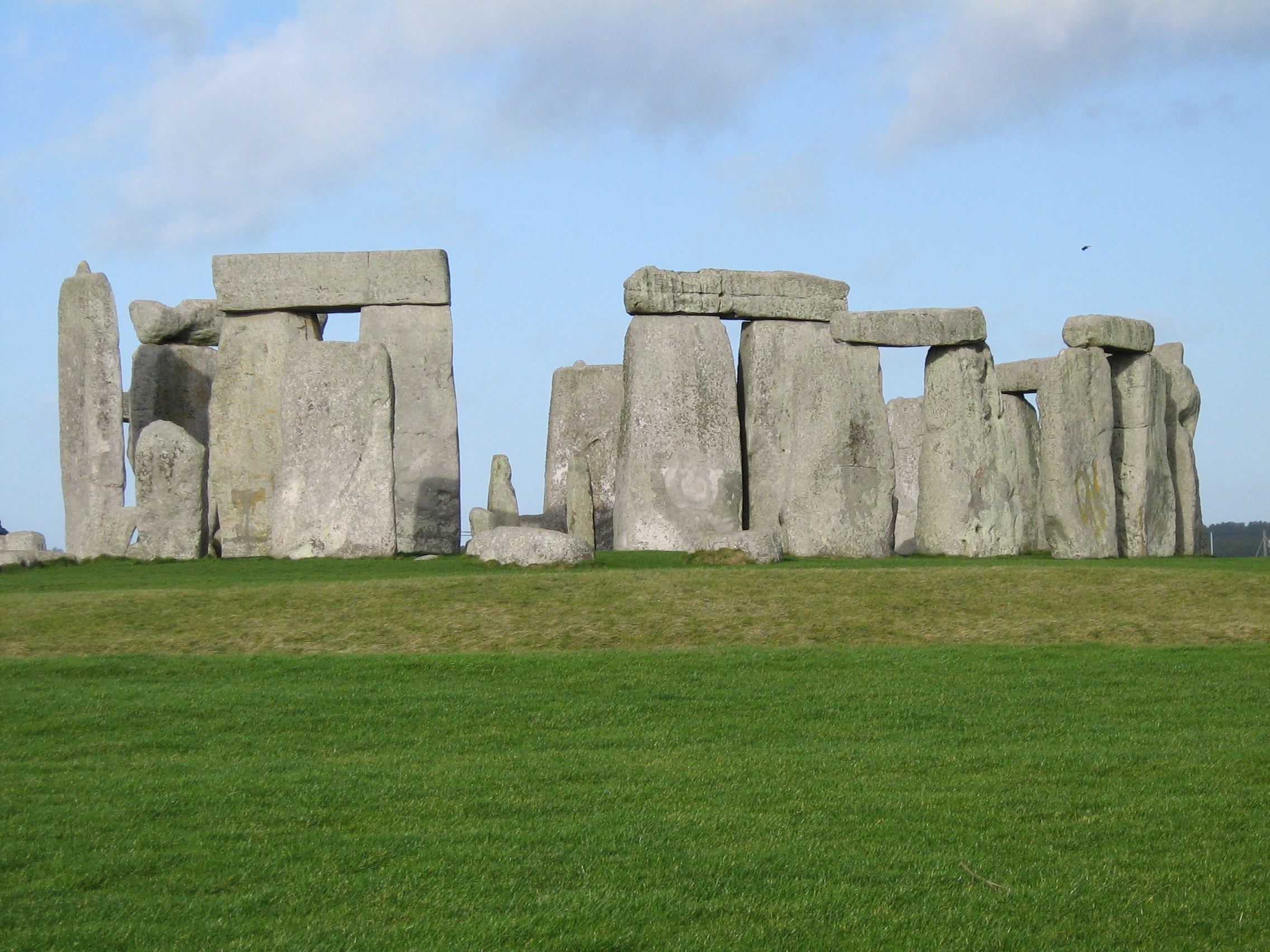


But our secondary views will be like this


Or even this, giving context.


Neither of which would have been known to Neolithic people. (But see discussion in the comments.)

Reading that convinced me immediately that the wayfinding researchers were correct in focusing on cardinal directions as opposed to overhead maps as the contrasting method to landmark navigation. I had been thinking vaguely that because one could draw an overhead map of an area in the dirt to explain it to someone else, it was therefore possible that even before maps, people had done so, perhaps mostly on a local scale. I see now this is ridiculously wrong on my part.

1) Yes, you can draw a map in the dirt, but you can't carry it with you. Carrying a map in your head only comes from frequent use of them and reference to them while navigating. Until paper and printing were common, that frequency of use was exceedingly rare.

2) Early maps were clumsy affairs, revealing that their drafters had difficulty moving entirely to the overhead position. At ambiguous areas they seem to resort to a mixed perspective.

3) Cardinal directions integrate much more readily with landmarks, the other navigational strategy.

4) The idea of overhead visualisation of an area likely increased because of long-distance sea trade (relatively recent), surveying (only common the last few centuries), and the airplane and motorcar coming into common use (very recent). What seems natural for me, born in 1953, is historically quite unnatural.

I focused on Stonehenge because is is familiar to more people, but we are partial to Avebury here. One can walk among the stones, and the bank-and-ditch are still quite prominent. I thought that gave us more of a sense of what the original observers saw, but that's untrue. The ditch was far deeper, the bank a bit higher, and it was chalk, not turf. Since 1500 BC, perhaps, the pastoral, inhabited scene of today may have been more common, but when it was first dug, Avebury was more like this.


The image is from this wonderful Avebury site, though it doesn't kick modern druids half enough on the subject. (Talk about an idea that won't die, regardless of the data.) I'll be writing more about the megaliths this week.

The entire Wayfinding Series from 2011.
Introduction, with Yankee humor. 
Update: A recent paper on spatial navigation.
More Wayfinding 2013 
Note on Wayfinding 2012
Mapmaking 
Spatial Memory 

Wednesday, August 03, 2011

Hengeworld

Hengeworld, by Michael Pitts.

Another book with good information that is slow to get airborne. Purporting to be a book about the Neolithic world in Britain, and the people who built the great henges – not only Stonehenge and Avebury but Durrington Walls, Stanton Drew, the Ring of Brodgar and dozens of others – Hengeworld is actually more about the history of the archaeological digs at these places, and the reasoning that goes into rejecting one theory and accepting another. Good for someone to know, and I’m sure academic archaeologists appreciate the idea that someone is going to care enough about their skill and personal idiosyncrasies to write them down for a popular audience someday. Yet I am…less than fascinated by that aspect. If it were just the reasoning bits, perhaps I’d do better. Or an abbreviated history of the archaeological organisations in England and their connection to the henge digs might have been fine enough.

But it does eventually get airborne. What are the probable dates? Were they built in stages or all at once? Do they have any connection to each other? What is the evidence for and against various uses of the enormous structures? And can you help us get rid of all these druids loitering about? (Just to state: 1.) All the hengeworks precede the druids by many centuries. 2) Modern neopagans are connected to ancient druids or to Stonehenge only in their imaginations. 3.) And that goes for their hooded robes, too.) Pitts gives a nice summary of some of the worse theories of what the megaliths were all about.

If you are a henge-fan, you hardly need me to summarise for you. For those who want a summary between Wikipedia size and book size, the National Geographic discussion of Stonehenge includes a good deal about the nearby sites. If there is some interest in discussion, have at it, and I will share what I know about why certain theories are considered likely and others are rejected. The worshipers-on-mushrooms (or henbane) idea is actually quite possible, BTW.

Just no druids. Not even later on. There is no evidence for the neopagan idea that Ancient Peoples, who understood these Mystical Things, recognised these as Holy Places, and held ceremonies there. That's an entirely modern idea, from people with vague spiritual ideas who want to assemble a religion which isn't too demanding from whatever elements come to hand. Added points for anything that predates Christianity - because that means that it's more...well, it means something important - or anything that can be tortured into being different from Christianity, because that also proves...something. I still grimly recall seeing an offering of flowers left inside at West Kennett Long Barrow, likely as inappropriate an offering as could be imagined. Except, I suppose, it does reflect a desire to honor and remain connected with The Ancestors, which is a fine neolithic tradition. Honoring and remaining connected to Mum and Dad is less spiritual, though.

Most people in history didn't have vague beliefs, but highly specific ones, with very clear ideas about what was, and what wasn't worship.

Tuesday, July 26, 2011

Wayfinding

I ran across a theory on the possible origin of gender differences in wayfinding. Hunter males, following game across landscape, needed a method that could adapt to changing circumstances, as their route home might be different each time. Landmarks would be an important supplement, so a percentage of them needed that skill in full blossom as well, but cardinal directions, orientation, ability to envision distal routes would be of primary importance.

Gatherer females would need to reliably know where fruit, medicines, supplies, could reliably be found, and so would need advanced landmark skills. The terrain or approach might be somewhat different each year, so both gestalt environments and chains of landmarks would be useful.

Like all evolutionary biology theories, plausibility is going to be easier to come by than proof. Though strong genetic evidence for these sorts of theories may not be that far away. We can sometimes determine when a trait came into being, and if it accords with the archaeological evidence of what was in fact in use behaviorally at the time, it's a good indicator.

Sunday, June 05, 2011

Tomte again

Those crazy little pagan house deities! Always looking for food. We've made both angels and demons cute, so that they are now indistinguishable.


I wondered what this was about. Even I think this is funny.