Tuesday, January 14, 2020
Political Temptation
When Christians become interested in politics, is it always too powerful a god that eventually overthrows them and takes over their religious belief?


Saved Links
Fake Noose! Steve Sailer February 2019
Votes by Non-citizens in 2016. It is soft evidence, yet it is some evidence. February 2019
No evidence people are born gay or transgender. I missed this research from Johns Hopkins when it came out in 2016. Partial evidence but good.
Votes by Non-citizens in 2016. It is soft evidence, yet it is some evidence. February 2019
No evidence people are born gay or transgender. I missed this research from Johns Hopkins when it came out in 2016. Partial evidence but good.
The Power of Bad
I have long thought this an interesting observation by Lewis's senior demon, that women are more geared toward doing for others while men are wired to think in terms of not interfering. It is true in many cases I can think of, but I don't know if it holds up generally, nor what percentage of men and women are exceptions to the general trend.
Behaviorists teach that positive reward is a more effective strategy than negative consequences, and this would seem to contradict that. Psychologists have also recently started to teach that resiliency is more a product of good childhood experiences than a lack of bad ones, which also seems the opposite. I don't know what the research resolution will eventually be. My initial thought is that there are contexts in which each is true.
The grand problem is that of "unselfishness". Note, once again, the admirable work of out Philological Arm in substituting the negative unselfishness for the Enemy's positive Charity. Thanks to this you can, from the very outset, teach a man to surrender benefits not that others may be happy in having them but that he may be unselfish in forgoing them. That is a great point gained. Another great help, where the parties concerned are male and female, is the divergence of view about Unselfishness which we have built up between the sexes. A woman means by Unselfishness chiefly taking trouble for others; a man means not giving trouble to others. As a result, a woman who is quite far gone in the Enemy's service will make a nuisance of herself on a larger scale than any man except those whom Our Father has dominated completely; and, conversely, a man will live long in the Enemy's camp before he undertakes as much spontaneous work to please others as a quite ordinary woman may do every day. Thus while the woman thinks of doing good offices and the man of respecting other people's rights, each sex, without any obvious unreason, can and does regard the other as radically selfish. Screwtape Letters, Chapter 26. CS Lewis.There was a joke long ago that Purgatory was a kitchen where things kept going wrong, and the women had to learn to calm down and ignore them, while the men had to learn to get up and deal with them. That section occurred to me today when I read the link about Roy Baumeister and John Tierney's The Power of Bad. Notice especially John Tierney's comment about the lack of gratitude for doing extra and extra censure for falling short.
There are lots of little surprising things to me—like the fact that you get almost no credit for doing more than you promised to do, for going beyond and doing extra, but you get penalized severely for what you don’t do. Researchers did experiments where students were given tickets by a ticket broker, and if the seats were better than expected, the students didn’t express any gratitude; but they were very upset if the seats were worse. In another experiment, someone came in to help participants do a task that involved solving puzzles, and if that person did 50 percent more than promised, participants gave him the same rating as if he’d just done the basic job. If he fell short, they really faulted him. We’re very upset when someone doesn’t fulfill a promise, but if they do extra, we’re not grateful enough for it.I would think that this would make those who more often do extra for others - likely women - to be especially vulnerable to resentment at being taken for granted. I know I have experienced this at work over the years, learning repeatedly that certain actions are done because they are the right thing to do and one wants to be a decent sort, not because anyone will ever notice or thank you. That is fairly easy to do for short periods, but gnaws at one over the long haul, and most especially when one is suddenly held to account for a small thing by one who has been a frequent offender.
Behaviorists teach that positive reward is a more effective strategy than negative consequences, and this would seem to contradict that. Psychologists have also recently started to teach that resiliency is more a product of good childhood experiences than a lack of bad ones, which also seems the opposite. I don't know what the research resolution will eventually be. My initial thought is that there are contexts in which each is true.
Monday, January 13, 2020
NT Wright on Gay Marriage
I will say this this accords strongly with my own approach. When someone is trying to change the meaning of words, I am already extremely suspicious that they are up to no good on that basis alone.
Sunday, January 12, 2020
More About License Plates
This is what I grew up with. "Scenic" New Hampshire. Neighboring Maine had "Vacationland." I thought I had detailed the historical differences among NH, VT, and ME tourism in a previous post, but I can't find one that includes it. I shall have to do that soon, as it is likely of interest to more than a few. From the first letter, you can tell that this plate was from Hillsborough County.
 NH was one of the early leaders in raising revenue via "Vanity" license plates. A man my mother was going with in the 1960's had an Austin Healey with plates that he wanted to be seen at Ski - NH. But only five characters were allowed in those days, challenging the creativity. It ended up as SKINH, which looks like nothing so much as the beginning of "Skinhead." This was merely an insult for bald mean at that point, not a political reference, but it still wasn't the look he was going for. Frustrated, he decided to get SIHUS for his two Siberian Huskies the next year, but it just looked like SINUS at first glance.
 My great-aunt had the number 673 until she finally gave up her Superbeetle when she went into a "women's home" around 1977. She had kept the first number she had gotten in the 1930's all along. As people waited in line to get those 3-digit plates as they uh, "became available," folks wondered how she had managed the political pull to nab one of those. It didn't seem possible that she could have had a car, all on her own, as a mere woman in the 1930's. She was a bit adventurous, that one.
 NH went to the "Live Free or Die" state motto while I was away at college. I suspect Governor Meldrim Thomson was behind that.
 My grandfather, a chicken-farmer/egg man in Westford, MA, had an old plate something like this up in his detached garage.
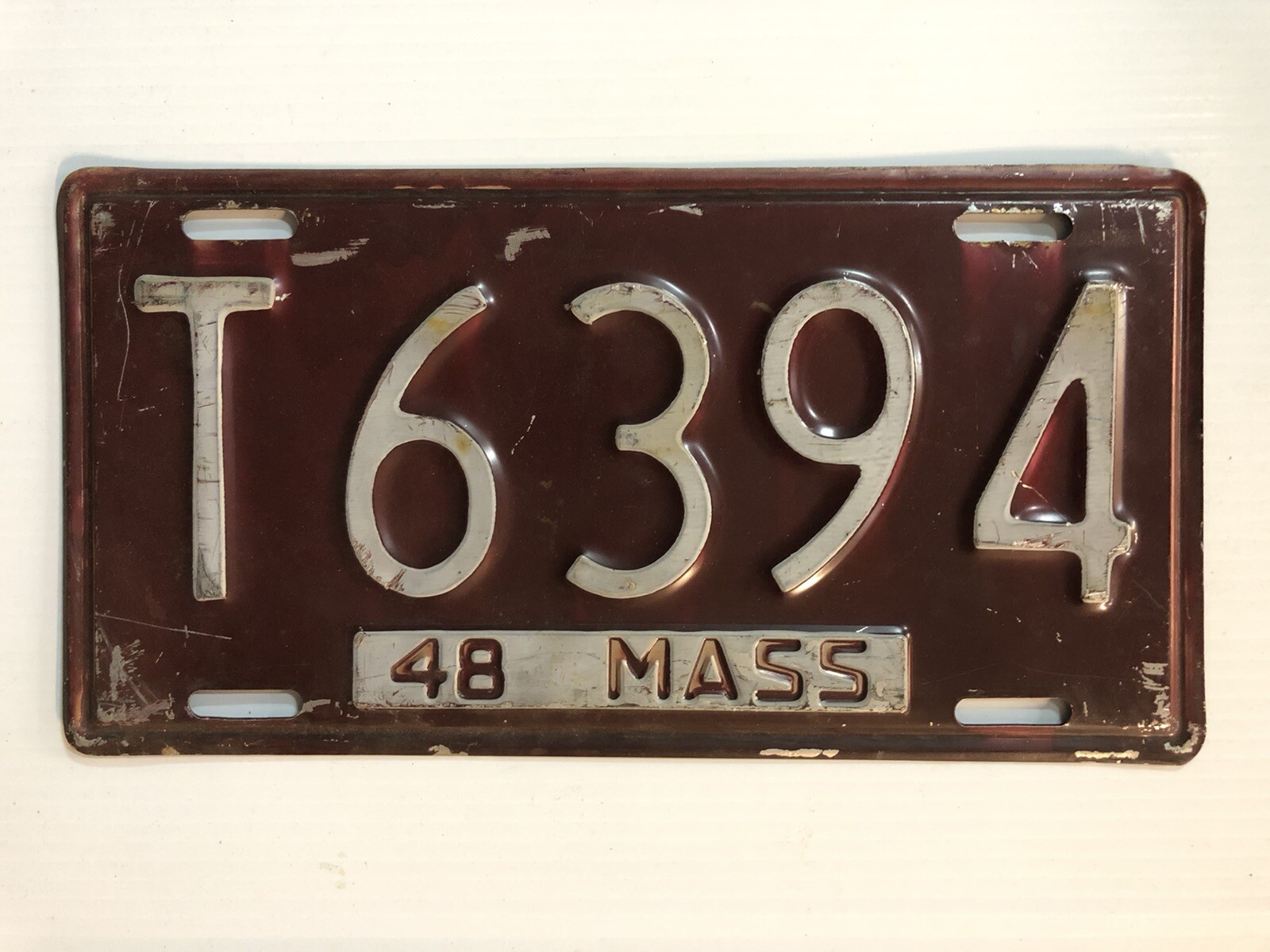 The site Great American Plates is a good resource if you want to know both current and historical plates. There may be an even better one somewhere. Browsing there, I realised I had forgotten that Alaska used to have "North To The Future," which is typical Alaska weird. The deeper you go, the more you can see how becoming an authority would take some time, like being a birdwatcher. If there are this many plates just for Montana, the sum total of all the American plates must be hard to keep in memory.

There is a danger in playing the license plate game, as people put frames around them to show their support for a college or a dealership or a joke - seldom a funny one - obscuring the state name. At this time of year, many plates are grey with grey letters also. Trying to see those while driving takes one's attention of the road. That would be hard to explain to the judge, I think. Or the insurance company.
There is a danger in playing the license plate game, as people put frames around them to show their support for a college or a dealership or a joke - seldom a funny one - obscuring the state name. At this time of year, many plates are grey with grey letters also. Trying to see those while driving takes one's attention of the road. That would be hard to explain to the judge, I think. Or the insurance company.
You Ungrateful Bastards #2
An ongoing collection of things you should have liked, but apparently didn't.
Energy. I needed an editor on this one, as I did many times even as late as November 2011. Hang in there. There are observations I still like, and good comments as well. Part of the "What else other than IQ?" discussions we have had over the years, that many of you have contributed to.
The Theater of Self-Congratulation. Feb 2008. Because theater liberals are my particular brand, even 33 years after my last play, I make a prediction and get it right.
Energy. I needed an editor on this one, as I did many times even as late as November 2011. Hang in there. There are observations I still like, and good comments as well. Part of the "What else other than IQ?" discussions we have had over the years, that many of you have contributed to.
The Theater of Self-Congratulation. Feb 2008. Because theater liberals are my particular brand, even 33 years after my last play, I make a prediction and get it right.
Friday, January 10, 2020
Abou ben Adhem
Abou Ben Adhem (may his tribe increase!)
Awoke one night from a deep dream of peace,
And saw, within the moonlight in his room,
Making it rich, and like a lily in bloom,
An angel writing in a book of gold:—
Exceeding peace had made Ben Adhem bold,
And to the presence in the room he said,
"What writest thou?"—The vision raised its head,
And with a look made of all sweet accord,
Answered, "The names of those who love the Lord."
"And is mine one?" said Abou. "Nay, not so,"
Replied the angel. Abou spoke more low,
But cheerly still; and said, "I pray thee, then,
Write me as one that loves his fellow men."
The angel wrote, and vanished. The next night
It came again with a great wakening light,
And showed the names whom love of God had blest,
And lo! Ben Adhem's name led all the rest.(Leigh Hunt)
This used to be a big deal, taught to schoolchildren and declaimed at competitions. For the latter, one was supposed to give a long, meaningful pause after "lo!"
A silly poem, one of the worst I have encountered. Another wonderful example of how much better education was in our grandparents' day.
Thursday, January 09, 2020
NH Primary
I should have thoughts. I should have observations not known to the rest of you, because here I am, on the scene. Everyone wants to know "What is happening there?"
I haven't gone to see anyone, and I know only two people who have. When our sons were young we took them to campaign events, and they got to shake hands with them. My oldest interviewed a Senator for his school newspaper, who was running in 1996. (Indiana, I think. Began with an L. Richard Lugar.) The next son covered a Bush event in 2000 that was three blocks from the school. Al Gore bought us dinner at the Alpine Club in 1988 (or 1992?) and cleverly mentioned on the West Side of Manchester that his mother was French. We saw Bob Kerrey at a house party, and I was part of an NPR focus group somewhere along the line. Everyone wanted to talk to my wife wherever we went once they found out she was undeclared in party.
The rest of the country resented us, but I had a decent intellectual defense for hosting the first primary. But events themselves have made us less of an influence. It still matters what happens here, but it is much more a reflection of what has happened nationally than how a candidate has impressed NH voters. I think. Maybe it's just that I don't bother to go to these things, so they seem less important. NH voters are still going to be somewhat different, and there will be some data that can be sifted to reveal how candidates are doing with various demographic groups. But the trend over the last few primaries has been that NH will illustrate, rather than influence how the rest of the country feels. Yes, a good showing here creates momentum, but that is a function of it being first, not a measurement of NH voters as opposed to any other states.
Even the Democrats used to have a libertarian streak in NH up until around 2000, but I think that is long gone now.
I haven't gone to see anyone, and I know only two people who have. When our sons were young we took them to campaign events, and they got to shake hands with them. My oldest interviewed a Senator for his school newspaper, who was running in 1996. (Indiana, I think. Began with an L. Richard Lugar.) The next son covered a Bush event in 2000 that was three blocks from the school. Al Gore bought us dinner at the Alpine Club in 1988 (or 1992?) and cleverly mentioned on the West Side of Manchester that his mother was French. We saw Bob Kerrey at a house party, and I was part of an NPR focus group somewhere along the line. Everyone wanted to talk to my wife wherever we went once they found out she was undeclared in party.
The rest of the country resented us, but I had a decent intellectual defense for hosting the first primary. But events themselves have made us less of an influence. It still matters what happens here, but it is much more a reflection of what has happened nationally than how a candidate has impressed NH voters. I think. Maybe it's just that I don't bother to go to these things, so they seem less important. NH voters are still going to be somewhat different, and there will be some data that can be sifted to reveal how candidates are doing with various demographic groups. But the trend over the last few primaries has been that NH will illustrate, rather than influence how the rest of the country feels. Yes, a good showing here creates momentum, but that is a function of it being first, not a measurement of NH voters as opposed to any other states.
Even the Democrats used to have a libertarian streak in NH up until around 2000, but I think that is long gone now.
Student Government
When I was at William and Mary, there was a debate in the student government about whether it should exist at all. One dormitory elected representatives for the specific purpose of introducing a resolution to disband the student government. It was introduced and debated throughout the year without resolution. By springtime, I believe the issue dominated the discussion at every meeting, with a lot of anger. At the time, it seemed to be the long-haired radicals who were trying to upend a (not really) revered institution, as the shorter-haired and dressier elected officials of that august institution fought back against the barbarian hordes.
The radicals did have a killer argument at the end of term. If the student government could go that many months without doing anything else, it was obviously useless. They were right, but the student government was not disbanded, merely starting again the next autumn with a partial change of characters. It was supposed to teach us about government, or something. I now see that it did, or should have, though not in the manner intended.
I read today about a student government wanting to ban cafeteria trays for environmental reasons. So they are still around, and therefore must occasionally succeed at things like this. It's a perfect spot for virtue-signalling, come to think of it. I don't recall what resolutions were passed and actions taken in my day. I do recall there being a lot of talk about voices being heard! but maybe that was somebody else. I'm guessing they don't provide any measurable benefit, and likely create mischief.
Update: So we have established that a common function is setting up student fees and free concerts. That sounds familiar - they also did free films when I was in school.
The radicals did have a killer argument at the end of term. If the student government could go that many months without doing anything else, it was obviously useless. They were right, but the student government was not disbanded, merely starting again the next autumn with a partial change of characters. It was supposed to teach us about government, or something. I now see that it did, or should have, though not in the manner intended.
I read today about a student government wanting to ban cafeteria trays for environmental reasons. So they are still around, and therefore must occasionally succeed at things like this. It's a perfect spot for virtue-signalling, come to think of it. I don't recall what resolutions were passed and actions taken in my day. I do recall there being a lot of talk about voices being heard! but maybe that was somebody else. I'm guessing they don't provide any measurable benefit, and likely create mischief.
Update: So we have established that a common function is setting up student fees and free concerts. That sounds familiar - they also did free films when I was in school.
Permanent Anger and Anxiety
I dropped off the truck to have some work done, and took a walk on the nearby Rail Trail. When I got back it still wasn't done, so I sat among the magazines and tried to nap a little. The TV was too loud, and I am too easily distracted by conversation anyway, so I heard about an hour of ABC, including the noontime news. I also caught a few minutes of The View, lots of presidential political ads, and promotions for ABC specials on Jeffrey Epstein and (everyone in NH groans) Pamela Smart.
Everyone's unhappy, everyone's complaining, everyone is accusing. If this is what people watch during the middle of the day, no wonder we're all so upset. I'm irritated just listening to it, with no visual whatsoever.
Note: I wondered if Tom Steyer was the type of liberal who is well-meaning but just misguided, until his ad said "I'll be honest with you..." Kiss of death.
Everyone's unhappy, everyone's complaining, everyone is accusing. If this is what people watch during the middle of the day, no wonder we're all so upset. I'm irritated just listening to it, with no visual whatsoever.
Note: I wondered if Tom Steyer was the type of liberal who is well-meaning but just misguided, until his ad said "I'll be honest with you..." Kiss of death.
Dragons
National Review has a reminder from Prof. Joseph Loconte about an episode early in WWII, shortly after the publication of The Hobbit. Tolkien spoke about dragons to an audience including children on the first day of 1938. He was in favor of teaching children about monsters, reasoning that they already had some idea of them and were afraid. The stories tell the other side, of heroes and of victories over monsters.
The relative lightness in tone of The Hobbit, compared to the deeper and wider dangers of The Lord of the Rings, which Tolkien began soon after, used to suggest to critics that LOTR was "about" WWII. That was easily enough shown to be false, given Tolkien's many other comments on the matter and the gradual revelation that the core story was begun during WWI. Yet it has never seemed much of a stretch that the tone of the latter work was influenced by the dark days England was going through at the time. Loconte brings out a quote I had not seen before, also from 1938 of Tolkien writing to his publisher about a possible "New Hobbit:" Tolkien confessed to his publisher that his new story was no bed-time fable: “The darkness of the present days has had some effect on it.”
The relative lightness in tone of The Hobbit, compared to the deeper and wider dangers of The Lord of the Rings, which Tolkien began soon after, used to suggest to critics that LOTR was "about" WWII. That was easily enough shown to be false, given Tolkien's many other comments on the matter and the gradual revelation that the core story was begun during WWI. Yet it has never seemed much of a stretch that the tone of the latter work was influenced by the dark days England was going through at the time. Loconte brings out a quote I had not seen before, also from 1938 of Tolkien writing to his publisher about a possible "New Hobbit:" Tolkien confessed to his publisher that his new story was no bed-time fable: “The darkness of the present days has had some effect on it.”
Untranslatable Words
Shariatmadari's article that "untranslatable words" actually aren't is related to the fallacy that what language you grew up with dictates how you think.
There is something deeply seductive about the idea that other languages contain codes that are impossible to crack, as I know from first-hand experience. When I was a kid, I used to sit in the hallway and listen to my dad speak Farsi on the phone to his relatives in Tehran. I had no idea what he was saying, and nor did my brother and sister. But we learned to recognize certain phrases, two in particular: tarjimmykonee and azbezutumkay. We used to repeat them, over and over. Like “abracadabra,” they seemed to be incantations. Dad was a magician. When, as an adult, I learned what these phrases actually were, I realized the extent to which we had filtered them through our English-attuned ears, distorting the sounds and syllables. And the meaning was more prosaic than I imagined, too. Tavajoh mikonee can be translated as “Are you paying attention?,” a conversational filler like “Do you see?” or “D’you know what I mean?” Arz be hozuretan ke is a polite stock phrase similar to “May I say, . . .”I was told in freshman German that gemutlichkeit was untranslatable. It isn't. Also fremdscham, which also turns out to be fairly easy to translate. As even words in English sometimes take a dozen words of explanation to differentiate them from near-synonyms, we should hardly be surprised when a foreign word does. Words crawl into their own little corners and set up meanings and associations in unpredictable ways, but it doesn't mean that people who speak another language cannot be quickly made to understand the idea.
Wednesday, January 08, 2020
Small Sample Size on Iran 1953
Reposted from 2016 because the myths are going to start up again. There are good comments, and a good internal link from Richard Johnson giving more detail about the "installation" of the Shah.
**********
The CIA-assisted coup in Iran in 1953 was referenced in Mistakes Were Made (but not by me). I hadn't thought about it in a long time, but I remembered something, and pointed out that it lacked a longer perspective and opposition context.
As an aside, commenter Richard Johnson provided a link that showed that narrative was even worse than deserved. Short version: The CIA certainly tried to assist, and loved to claim that they had indeed been key; also, the Muslim fundamentalist opposition loved to claim that it was the American CIA which had done them so wrong. But what spooks actually accomplished was probably not that decisive: some cartoons in newspapers, a few million dollars trying to gather some rent-a-mobs and another few million in bribes. I'm not sure you could turn a gubernatorial race in a small state with that, and you certainly couldn't count on it being permanent.
The same historical example just came up again in my reading of Chuck Klosterman's book But What If We're Wrong? (Quick Review: Great concept, great start, otherwise disappointing, with a few memorable lines per chapter. Browse the beginning if you find it. No more.) Klosterman used it as a Howard Zinn type of example of something that was previously denied and generally unknown, but now simply everyone knows is true. You know how I am about any claim that simply everyone knows is true.
Yesterday it showed up on the Wikipedia main page, as 8/19 is the anniversary of the coup. I admit that three occurrences is a small sample size, and there is a coincidental aspect to my encountering the first two examples now, neither of which were written this year. Yet I still think there is something afoot. As events play out in the Middle East, there is a type of mind that reflexively wants to instruct the common American opinion, always ready to say "Well, you know, the US bears some of the blame for this. You should remember what bad things we have done in the past." They just believe there is a lesson to be taught, and it should be taught at every opportunity. It is not the mere balancing act of trying to get some of both sides into a discussion, because there would then be statements inserted from time-to-time about benefits to the Middle East that have originated in the West, especially America. They believe that theirs is the minority view which they must valiantly proclaim against an oppressive majority culture, even though they are now the holders of power. Mere dominance is not enough, apparently. Opposers must be crushed.
All groups do this, of course, though not on this issue, where the sermonising comes only from one side. But I have certainly heard conservatives, including (especially?) religious conservatives do the same, reflexively lecturing on points of history. In accordance with the pattern I have often noted, liberals tend to fire the first shot, often not realising that they are igniting controversy, because they are just helpfully pointing out what they learned in freshman history. Conservatives are less likely to initiate, but they lie in wait for the unwary, prepared to escalate quickly.
**********
The CIA-assisted coup in Iran in 1953 was referenced in Mistakes Were Made (but not by me). I hadn't thought about it in a long time, but I remembered something, and pointed out that it lacked a longer perspective and opposition context.
As an aside, commenter Richard Johnson provided a link that showed that narrative was even worse than deserved. Short version: The CIA certainly tried to assist, and loved to claim that they had indeed been key; also, the Muslim fundamentalist opposition loved to claim that it was the American CIA which had done them so wrong. But what spooks actually accomplished was probably not that decisive: some cartoons in newspapers, a few million dollars trying to gather some rent-a-mobs and another few million in bribes. I'm not sure you could turn a gubernatorial race in a small state with that, and you certainly couldn't count on it being permanent.
The same historical example just came up again in my reading of Chuck Klosterman's book But What If We're Wrong? (Quick Review: Great concept, great start, otherwise disappointing, with a few memorable lines per chapter. Browse the beginning if you find it. No more.) Klosterman used it as a Howard Zinn type of example of something that was previously denied and generally unknown, but now simply everyone knows is true. You know how I am about any claim that simply everyone knows is true.
Yesterday it showed up on the Wikipedia main page, as 8/19 is the anniversary of the coup. I admit that three occurrences is a small sample size, and there is a coincidental aspect to my encountering the first two examples now, neither of which were written this year. Yet I still think there is something afoot. As events play out in the Middle East, there is a type of mind that reflexively wants to instruct the common American opinion, always ready to say "Well, you know, the US bears some of the blame for this. You should remember what bad things we have done in the past." They just believe there is a lesson to be taught, and it should be taught at every opportunity. It is not the mere balancing act of trying to get some of both sides into a discussion, because there would then be statements inserted from time-to-time about benefits to the Middle East that have originated in the West, especially America. They believe that theirs is the minority view which they must valiantly proclaim against an oppressive majority culture, even though they are now the holders of power. Mere dominance is not enough, apparently. Opposers must be crushed.
All groups do this, of course, though not on this issue, where the sermonising comes only from one side. But I have certainly heard conservatives, including (especially?) religious conservatives do the same, reflexively lecturing on points of history. In accordance with the pattern I have often noted, liberals tend to fire the first shot, often not realising that they are igniting controversy, because they are just helpfully pointing out what they learned in freshman history. Conservatives are less likely to initiate, but they lie in wait for the unwary, prepared to escalate quickly.
Saved Links
I stopped putting these up in September, waiting for the turning of the year. These are links I bookmarked for reference, but find I have not used. They deserve another look, so I am putting them out a few at a time.
There were three from Quillette all near each other in the pile.
What New York Public Schools Could Learn From Stuyvesant. April 2019
Public Education's Dirty Secret. February 2019
Liberal Orthodoxy and the New Heresy. January 2019. Also about education.
There were three from Quillette all near each other in the pile.
What New York Public Schools Could Learn From Stuyvesant. April 2019
Public Education's Dirty Secret. February 2019
Liberal Orthodoxy and the New Heresy. January 2019. Also about education.
Tuesday, January 07, 2020
License Plates
We play the license plate game every year - my wife pays more attention than I - and just started again January 1. We are familiar after all these years which ones are hardest to get: Hawaii, obviously, though we nearly always get Alaska. Montana, Idaho, the Dakotas, then Wyoming and Utah. Last year we didn't get New Mexico, which we always get, and had to have help to get West Virginia, which is not all that far. But we got Utah already this year. Whoohoo!
We go for Canadian provinces while we are at it, and got both Manitoba and Saskatchewan in 2019, which are rare for us. One year we did get the Yukon Territory plate in the shape of a polar bear, right out on Rt 93. We get Guam and American Samoa every few years.
I asked myself a different question this year. Which states are the easiest to get all the other states from, and which are the hardest? Hawaii hardly counts, it must be enormously more difficult. You wouldn't even teach you children to play the game there, just oohing and ahhing whenever you saw anything else. Fairbanks Alaska might not be so terrible, as adventurous sorts from all over like to take the ALCAN highway. I am betting that the states that are difficult for me to get, in the Mountain West and Upper West are the worst places to play the game, largely on account of the states around me here. Seeing a VT or RI plate in South Dakota must be unusual. We get a lot of states quickly when we start, and similarly, have a much better chance of getting New Brunswick, Nova Scotia, Newfoundland, and Prince Edward Island than people in Wyoming would. Probably more easily than people in British Columbia would. PEI and NL are rare even up here.
Tracy thought that Washington DC was probably the easiest place to play the game. I agreed, and thought that NYC and the immediate area was likely good as well. Orlando, maybe, even though most people going to the parks would fly. I don't know how much people in regions visit each other. Is Mississippi an easy get in South Carolina? Do experienced plate-spotting schoolchildren in Arizona immediately recognise Idaho? Do people even play this game outside of the Northeast and Mid-Atlantic?
We go for Canadian provinces while we are at it, and got both Manitoba and Saskatchewan in 2019, which are rare for us. One year we did get the Yukon Territory plate in the shape of a polar bear, right out on Rt 93. We get Guam and American Samoa every few years.
I asked myself a different question this year. Which states are the easiest to get all the other states from, and which are the hardest? Hawaii hardly counts, it must be enormously more difficult. You wouldn't even teach you children to play the game there, just oohing and ahhing whenever you saw anything else. Fairbanks Alaska might not be so terrible, as adventurous sorts from all over like to take the ALCAN highway. I am betting that the states that are difficult for me to get, in the Mountain West and Upper West are the worst places to play the game, largely on account of the states around me here. Seeing a VT or RI plate in South Dakota must be unusual. We get a lot of states quickly when we start, and similarly, have a much better chance of getting New Brunswick, Nova Scotia, Newfoundland, and Prince Edward Island than people in Wyoming would. Probably more easily than people in British Columbia would. PEI and NL are rare even up here.
Tracy thought that Washington DC was probably the easiest place to play the game. I agreed, and thought that NYC and the immediate area was likely good as well. Orlando, maybe, even though most people going to the parks would fly. I don't know how much people in regions visit each other. Is Mississippi an easy get in South Carolina? Do experienced plate-spotting schoolchildren in Arizona immediately recognise Idaho? Do people even play this game outside of the Northeast and Mid-Atlantic?
Choir
I sang with the choir for Advent and Christmas. I had not done so since high school, though I was in the men's chorus in the 80s and 90s. I like singing. I like harmony. I don't much like that style of music, but at Christmas I thought there would be enough that was based on things I like.
Many of the rules which choral singing stresses apply to all singing. Hitting the notes, getting the entrances and rhythm, certainly - though even these are played with creatively in other forms. Crisp consonants are nice, so that lyrics are understandable. But in choral singing they must be overcrisp, artificially pronounced, while vowels are butchered because some of them supposedly don't sound right when sung. E's are right out. R's after vowels are thought horrendous as well. I am not convinced of this. After years of training one's ear that way, I understand that r's sound as bad as flatted notes to them. Except they don't really sound as bad.
It's an artificiality, much like ballet vs. the rest of dance. Those who favor ballet look down on other forms of dance, not always in theory, but because other dancers so often get things "wrong," that are wrong only in ballet. More exactly, there are some rules which do apply all around. If a leg is supposed to be straight, getting it very straight is better than sloppily straight. If a leg is bent, it should be bent the same amount by all members of the company executing the step or pose, and the same amount each time. Precision is a good thing. Yet it is not the only thing. Following precise rules very exactly is something a lot of folks like in their art, whether it is music, dance, painting, or writing. They are welcome to it, and I see things that way myself. Sometimes.
Those who go to the ballet might find very subtle differences to be highly expressive. Well, fine, but they aren't really very expressive, they are only expressive in the context of ballet's subtlety. Just because it is difficult doesn't make it superior.
Yet even that is not what bothers me about choir. Forcing myself into that discipline was good for me, and I may seek more of it. I recaptured a little of my higher range that had been lost to ill-use and sloppiness over the decades. My breathing was better - another place where I had gotten sloppy (though it matters little in other forms). Yet the snippiness about other singing and forms of music got on my nerves quickly. I have heard it over the years, yes. Perhaps I hear more of it because I sing the bass lines to the old hymns and am old myself. Yet I think I have been hearing it ever since I was 14 in choir, the dismissive comments about drums and bass guitars being too loud, people not liking guitar accompaniment. The comments about the repetitive nature of lyrics make me smile wryly to myself, as we sang two pieces this year that had fewer words than praise choruses. The Hallelujah Chorus has rather repetitive lyrics - and let's hear the Sevenfold Amen again, shall we?
I never hear people in second service criticise the music at first service. The people at first service will mutter all the time how much better their music is, and what a shame it is that the children aren't taught the older music more. The thread over at Maggie's about what people did for services on Christmas brought out some Great Deplorers. They don't even go anymore, because they don't like the music now - uggh! They stay home and listen to something nostalgic instead. As an aside about praxis, that has never been the teaching of the church for two thousand years. "Forsake not the fellowship of the saints" is a command, not a sentiment. The community is the Body of Christ.
We love the music that was in the air when we became Christians, most usually, and find that holiest in some way. More solemn, more joyful, more intimate, or more edifying. I have a great advantage in that I came to Christ via more than one channel, so camp songs and five-verse overcomplicated hymns are both in my history and well-loved.
Many of the rules which choral singing stresses apply to all singing. Hitting the notes, getting the entrances and rhythm, certainly - though even these are played with creatively in other forms. Crisp consonants are nice, so that lyrics are understandable. But in choral singing they must be overcrisp, artificially pronounced, while vowels are butchered because some of them supposedly don't sound right when sung. E's are right out. R's after vowels are thought horrendous as well. I am not convinced of this. After years of training one's ear that way, I understand that r's sound as bad as flatted notes to them. Except they don't really sound as bad.
It's an artificiality, much like ballet vs. the rest of dance. Those who favor ballet look down on other forms of dance, not always in theory, but because other dancers so often get things "wrong," that are wrong only in ballet. More exactly, there are some rules which do apply all around. If a leg is supposed to be straight, getting it very straight is better than sloppily straight. If a leg is bent, it should be bent the same amount by all members of the company executing the step or pose, and the same amount each time. Precision is a good thing. Yet it is not the only thing. Following precise rules very exactly is something a lot of folks like in their art, whether it is music, dance, painting, or writing. They are welcome to it, and I see things that way myself. Sometimes.
Those who go to the ballet might find very subtle differences to be highly expressive. Well, fine, but they aren't really very expressive, they are only expressive in the context of ballet's subtlety. Just because it is difficult doesn't make it superior.
Yet even that is not what bothers me about choir. Forcing myself into that discipline was good for me, and I may seek more of it. I recaptured a little of my higher range that had been lost to ill-use and sloppiness over the decades. My breathing was better - another place where I had gotten sloppy (though it matters little in other forms). Yet the snippiness about other singing and forms of music got on my nerves quickly. I have heard it over the years, yes. Perhaps I hear more of it because I sing the bass lines to the old hymns and am old myself. Yet I think I have been hearing it ever since I was 14 in choir, the dismissive comments about drums and bass guitars being too loud, people not liking guitar accompaniment. The comments about the repetitive nature of lyrics make me smile wryly to myself, as we sang two pieces this year that had fewer words than praise choruses. The Hallelujah Chorus has rather repetitive lyrics - and let's hear the Sevenfold Amen again, shall we?
I never hear people in second service criticise the music at first service. The people at first service will mutter all the time how much better their music is, and what a shame it is that the children aren't taught the older music more. The thread over at Maggie's about what people did for services on Christmas brought out some Great Deplorers. They don't even go anymore, because they don't like the music now - uggh! They stay home and listen to something nostalgic instead. As an aside about praxis, that has never been the teaching of the church for two thousand years. "Forsake not the fellowship of the saints" is a command, not a sentiment. The community is the Body of Christ.
We love the music that was in the air when we became Christians, most usually, and find that holiest in some way. More solemn, more joyful, more intimate, or more edifying. I have a great advantage in that I came to Christ via more than one channel, so camp songs and five-verse overcomplicated hymns are both in my history and well-loved.
A Tolkien College
Granite Geek posts about Signum University, an online college offering Master's-level courses on Tolkien, Lewis, Beowulf, Eddic Saga and related material. It is seeking accreditation.
Do I want to put in the effort? the Assistant Village Idiot asks himself.
HT: commenter engineerlite
Do I want to put in the effort? the Assistant Village Idiot asks himself.
HT: commenter engineerlite
You Ungrateful Bastards
In creating my series of most-visited posts, I kept running across posts that I felt should have received more attention. It is perverse for me to yell at the people who actually do read my posts when my complaint is with all those others who have not, but I was so taken with the name "You Ungrateful Bastards" that I decided to keep it, unfairness and all.
This will be a series, likely one which will get away from me. A few at a time.
The Princess Bride December 2014
True Patriot -A Review March 2009
Media Bias August 2018. This is the magazine covers reference piece
No One Is Minding The Store June 2006
This will be a series, likely one which will get away from me. A few at a time.
The Princess Bride December 2014
True Patriot -A Review March 2009
Media Bias August 2018. This is the magazine covers reference piece
No One Is Minding The Store June 2006
Subscribe to:
Posts (Atom)