Thursday, January 20, 2022

Motte-and-Bailey Arguments

Once you know the principle behind it, you start to see the M&B fallacy everywhere. "Oh, so you're saying there's no racism in America anywhere and the schools should say nothing about it." I am trying to cast my mind back over the history I remember (reading history carries much more danger of receiving curated impressions) to see who used to use this in my formative years and how effective it was. I can't tell, but I think people use it more when they perceive themselves as in a position of power and are trying to discredit the attackers. Yet I can't be at all sure I am right about this.  The modern equivalents would be "So you think we should do everything the government says, no matter what? No? Well then, you have to see that this is tyranny" versus "I can't believe you are saying that the government is lying about everything and we don't have to do anything about covid at all!" Sigh.

It's just tiring, and I swear it isn't getting any better.

BTW, in terms of "Karens" I have about an equal number of people I run into who have to tell me in the first 30 seconds that either "well, Omicron is basically just like getting a cold" or "most of those people are dying with covid, not from covid," versus people who immediately equate carelessness or resistance about masking with refusing to be vaccinated. We are clearly in a world where people are unable to believe there is a continuum of belief among those they disagree with, and perhaps even more worrisome, no continuum of belief among the people who basically agree with them.  It is becoming a Marxist, or one-drop, or my sect-within-a-sect approach to all of life.

Resist this where you can, and please, not so much with the people opposed to you, because there are professional arguers who are making big money doing that. Apply it more to the people you generally agree with.

Some Longer Health Care Discussion - By Others

I have only small items to add, as the knowledge (and almost certainly wisdom) of these writers exceeds mine. Read through before clicking any link, because you might decide to go in a different order.  They are long and you might decide one or more is not worth your time, so wearr yourself out on the one you consider most important first.

This link from Random Critical Analysis, Why Conventional Wisdom on Health Care is Wrong (A Primer) was billed as the contrarian view on health spending as income increases in the third link of this post, which is where I originally started yesterday.  I like it better than the last analysis, at least on that narrow section of the discussion. Maybe more than that, eventually.  I am still thinking. Math is involved, including dealing with log-log scales, which give a different visual than what we are used to that might give you the wrong impression (even though they were a superior choice here).  If you don't frequently use them (I used to. Very little now) I don't recommend you spend much time trying to get your head into the new space.  Just be cautious about what you think your eyes are telling you about degree of differences. Similarly, if you aren't used to correlation coefficients, just pay attention to the relative numbers from -1.0 to 1.0, that 0.7 is a stronger correlation than 0.2, and the like. Getting close to 1.0 is a big deal, 0 is (heheh) nothing. It will do. In passing: it notes that when changes in income occur, the complex system takes 3-4 years to fully respond. This is something that is true of large mixed market systems in general.  While some things respond rapidly, others take time.  In America we ignore the latter because Elections, but that is a serious error on our part. 

Let me add once more that medical care is more expensive because it can do more every year, and that does distribute broadly, even if somewhat unevenly, to the population. The lovely image of the town doctor pre-1940,  making house calls and dispensing sage advice - and holding a ridiculously high status in the community compared to benefit given - misleads us. Doctors seem to have killed more patients than they saved until about 1940 when penicillin came in, which is even grimmer when we consider that germ theory and x-rays came in before those. So health care was cheap? It was also mostly useless. Whackadoodle theories, especially in Germany, sprang up at precisely the time that we were discovering that A) Science seems to work sometimes, and B) Doctors aren't doing any of that. So now we can do magic and it's expensive. You wouldn't pay a dollar now for what was top-of-the-line care in 1950.

From the later part of that article:

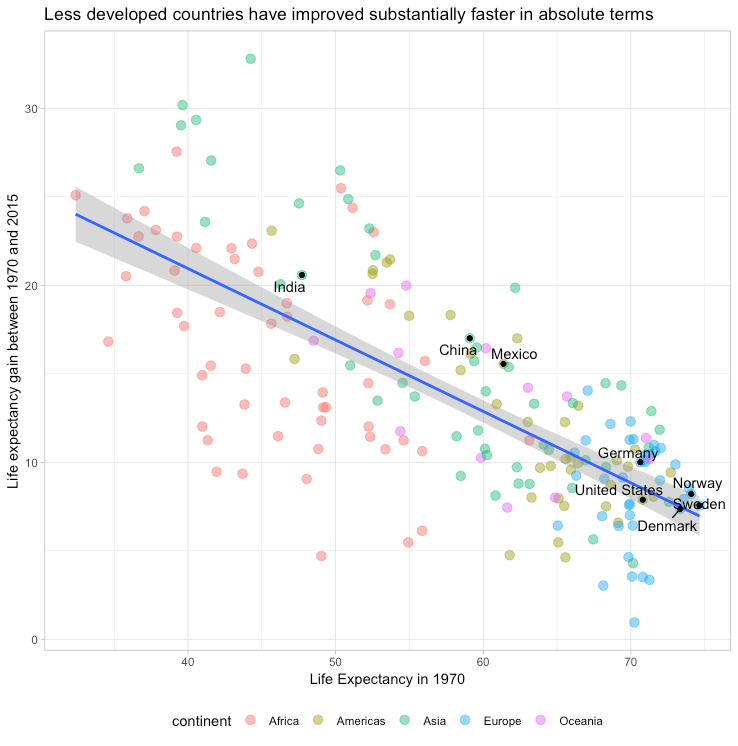
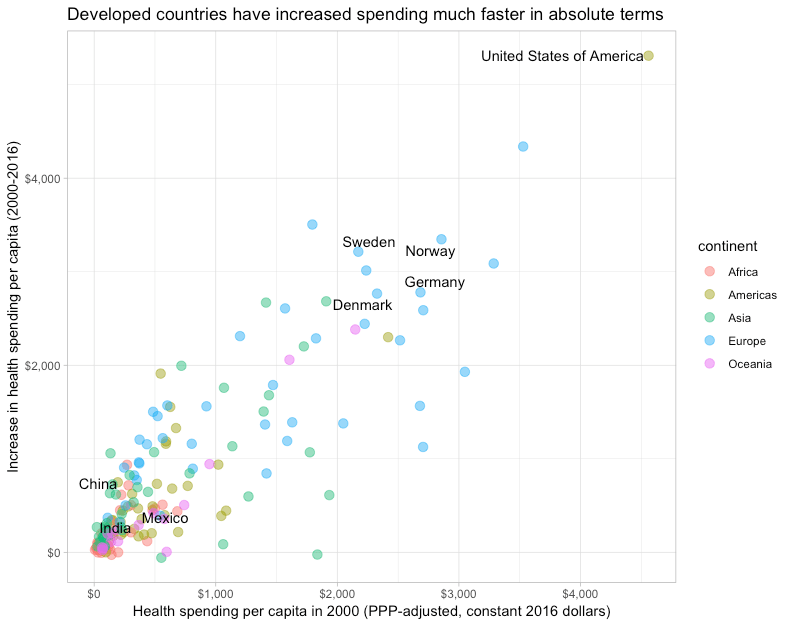
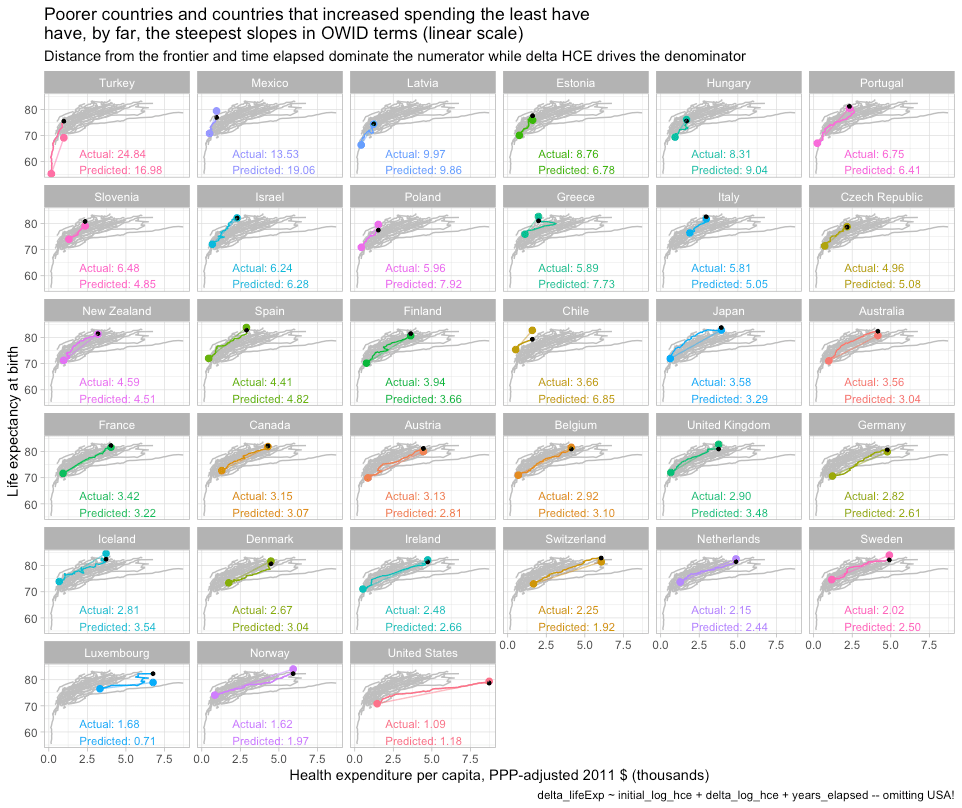
Likewise, the least developed parts of the world have converged rapidly on the most developed countries despite little-to-no convergence in income levels, health spending, and the like.   Controlling for the change in health spending does not appreciably change these results.  The supposedly radically divergent slope observed for the United States in widely circulated plots popularized by “Our World In Data” can be readily explained by distance from the frontier and the change in spending.  America’s long-run rate of improvement in outcomes can be readily predicted based on patterns observed in other high-income countries — the US doesn’t even need to be included in the model to obtain such results.

 Link to that whole final section, which is excellent.

Also it makes early reference to how GDP is not the best foundation for some of these analyses, though it is a very common one.  It reminded me of this recent Quillette article The Mismeasure and Misuse of GDP. Even though it is more general, not specific to health care spending, there is some value. 

The third link is where I started, from Astral Codex Ten Book Review: Which Country Has The World's Best Health Care? Excellent.  My comments. The quick chart includes some things that have some neglected data beneath them. Life Expectancy at Birth may not be as clean a comparison as implied here. Western European and Anglospheric countries score very well. Some Northeast Asian countries (or regions) score just as well, others not. African countries have lower life expectancies, as do the Southeast Asian. The first two regions are richer, and this is usually considered the overwhelming reason for this. We don't like thinking there could be any racial substrate to this. Yet I think life expectancy is somewhat influenced by race. Infant mortality in the US is worse for those of African descent, but not worse for Hispanics, even when they are just as poor. In the world chart above, Latin American countries show better results than equally poor countries. Some wealthy Middle-Eastern countries still don't show out that well. I am not in any way suggesting that race is the primary driver. But looking at the numbers for China and Taiwan, which look very close to America' 78 years, it is worth remembering that Japan and South Korea have world-best expectancies, and America is the most racially mixed of the developed countries. So hold those numbers lightly.  

Next, I can confirm that wait times for elective medicine are long in Norway, as one of my son's has had occasion to have to travel far with a two-night stay at a hotel to get elective surgery in eight months instead of 13 months. I hope they are otherwise as good as rated, as at the moment his girlfriend's son is in ICU there. Tom Bridgeland just reminded us of Canadians seeking care in America. Also, top US hospitals have Canadians seeking a second opinion coming down, even though they are paying out-of-pocket for this.

I also think that satisfaction is a slippery measure of a system. Americans complain about everything and find fault with it, even when it's basically fine. When things are deeply politicised, as they are in America as nowhere else on health care, this is even more pronounced. Whether you consider that valuable - always seeking improvement, or irritating - never happy with anything, is debatable. Scandis will always tell you how wonderful their countries are and how happy everyone is - but check the suicide rates. 

Fun quote from that last essay by Scott Alexander

I would have appreciated a book by a more economically-minded person explaining why things are like this. Or maybe not; maybe it’s like quantum physics, and the second someone looks at it too closely, the whole structure will collapse, every hospital in the world will go bankrupt, and we’ll have to get our medical problems treated by wolves.

He wonders why countries who do things very similarly to the US have better results - contrary to what is politically asserted, that the US does things differently (usually, oh we're much worse, though the opposite occurs as well)  from all other developed nations.  In my ignorance, I do not wonder. We have many more people who game the system here.  And that's not going away. Note also that AC10 has commenters from all over Europe and the Anglosphere who go into myths, advantages, and disadvantages of their own systems, which is valuable to those of us who are currently subjected to "Four legs good, two legs bad" in our debates here.

Wednesday, January 19, 2022

John-Adrian's Nostalgia Choice For Himself

This surprised me - he was not born until more than another decade after this came out and didn't come to America for fifteen years after that - but I certainly like it. Finest thing Joel ever wrote. Some of the lyrics to his other songs bother me, but my brother toured with him for six months decades ago. He was a lighting roadie then, became a lighting designer eventually.  He said that Joel was one of the best he had seen about being good to all the stage help and other support people for his concerts.  It's the sort of thing that matters to me and I mention it when I can. 


Mental Lexicon

Update: In response to a matter than came into our family - the Iditarod musher from NH who was going to be staying with my family in Nome had her dog team hit by a pickup in Willow - I dictated "This is not our usual sort of tragedy" when I meant to say charity, and changed it before sending.  Similar sound, with syllables and stress pattern the same, but not similar in appearance. It is interesting that the meanings do appear to be connected, as if the one word were hovering somewhere near my target word. So malapropism by sound, meaning, or both?

******

How we choose the words we speak is fascinating.  There are imbalances in the storage which creates mistakes. You know how it is when you are searching for a word. You rummage around in your brain looking for clues.  If you are with someone who might know the answer you say things out loud. "It's like decrepit but it's not so old-fashioned.  It's a newer word." That would be searching according to meaning. Or "It begins with a 't' and it's three or four syllables. I think it's a foreign word." That is searching according to sound and impression. In the category of sound are also those things like whether it is foreign, what feel it has, and we nearly always know exactly what part of speech it is as well.

We have a bias toward choosing by sound, which is how malapropisms and related mistakes happen. The malapropisms found in literature are not quite the ones we create in real life. Those are created slyly, with an eye to humor, as the original Mrs. Malaprop in Sheridan's 18th play "The Rivals" was, saying "allegory" instead of "alligator." In literature, or these days in the gotcha moments of social media, emphasis is placed on misuse of a similar sounding word, with the usual implication that "this stupid uneducated person is trying to hard to show off his/her vocabulary, with hysterical results which show that our opponents are stupid and we, by extension, are the Smart People." It is equal opportunity, anyone can play. The first example given is Archie Bunker saying "We need a few laughs to break up the monogamy." But the belief seems to come from the memorability of humorous mistakes plus our experience of people misusing words in general.  There actually doesn't seem to be evidence that these are people reaching to look smarter than they are. They are just mistakes, and four sentences later the person may use the word correctly. An exception would be people speaking English as a second language. All peoples have some tendency to regard those who speak their language less well as less intelligent and make fun of inaccuracies, but we mostly know this is not really the case, just an impression that should be overridden.

We like studying how things go wrong, because the suggest possibilities of how the whole operation works. There are other errors related to malapropisms, which also tell us something. There are are anticipation or perseveration errors, like saying "splacing from one tape" instead of splicing because your brain sees the important long "a" sound coming*, or "pale skay" instead of sky because you are residually stuck on the long "a." There is also an inadvertent mixing, such as being caught between saying jumping and leaping becoming "lumping," or for humorous effect such as Lewis Carrol's "Jabberwocky," where slither and slimy become "slithy." We see those for what they are, just stumbles from hurrying or half-thinking of something else. Sometimes they are funny, especially when the error is also a word, but we seldom think the person stupid, just inattentive. There are also spoonerisms, clearly a sound processing error not a misunderstanding of meaning. 

Freudian slips are not common. At most they may reveal a word we have hanging around too near the surface that we should stuff down a little better, but symbolic meanings are so often explained by other types of sound errors that we cannot rely on the psychoanalytic explanation as telling us much.  I would love to believe that Ted Kennedy's statement that"the purpose of education is to encourage the breast and the brightest," means he can't think of education without wanting to undress schoolgirls, but it is more likely he just has "breast" too close to the surface.

A study by David Fay and Anne Cutler,  Malapropisms and the Structure of the Mental Lexicon, shows how indirect evidence from speaking errors can reveal something about the structure of human communication. I should note that the study dates from 1977 and I don't know if it has been challenged, overturned, or replicated.

They use the phrase "Speech production device" to mean the part of the brain that organises this.  They are not speculating on what this "device" is in the brain. They say they are not taking sides, and the way linguistics arguments were going at the time, they perhaps worried that readers would get distracted by their apparent support for one model or another.  They are sidestepping that issue saying "Well, whatever it is up there, it has to be doing this in some way."  Good move, I think, especially as they say that transformational grammar has at least one problem as a full explanation.  that itself would have boiled some blood in those days.  Maybe now, too.

The analogy they come up with is that our lexicon is like a dictionary in one sense, organised by sound, which is similar to spelling. Yet we have other methods of organising in order to find the word we want. But even if we are able to find words by meaning when we want to say something - how else would we talk? - it does not follow that we have primarily organised them that way. It seems to be secondary.    "...a pairing of sound and meaning must be used in both production and comprehension of speech." Yet the retrieval of the word has to be reversed for production and comprehension.  We are trying to find the words to say according to meaning.  But we first hear the sound when we are retrieving. So the dictionary must work for both. A duplicate dictionary with every entry accessed in both ways would be evolutionarily inefficient. I suppose we would then not have the linguistic errors noted above, but they aren't that frequent anyway. One would think that assembling the dictionary, the lexicon of our communication, would be about equally dependent on sound and meaning, yet it appears that sound is deeply favored in how we create the lists. That the speech errors above are all sound errors is evidence of that. Errors in meaning are often nuanced or subtle, such as "I think uninformed would be a better word than ignorant there." 

It would seem intuitive that we would favor hearing and speaking equally, so the result is surprising. However, the sounds we hear are more likely to be interfered with, and we often need to sort between sounds, even competing conversations, as opposed to sorting between thoughts in our own head.  When that happens, we can make executive decisions to suppress one train of thought for a moment while we attend to another, even switching rapidly among a few conversations going on at the same time.  But we cannot enforce that on the sounds of the rest of the world. Sound is the more efficient storage.

We are storing by sound, so when we have a meaning we want to convey, we have to go to our lexicon, our dictionary, and pull something out we make a series of deeply-inspired guesses based on our history of word-choice since childhood. But if you are opening the dictionary and moving on you might choose an adjoining word. Malapropisms nearly always start with the same letters.  Interestingly, they are nearly always the same part of speech, have the same number of syllables, and even have the same stress pattern as the target word. So our storage by sound includes those other elements of structure. From the study:


we might expect that near neighbors in the dictionary might be very similar in sound;
we might expect that if the production device, homing in on a particular word in the
lexicon, were to err just a little and pick, instead of its target word, that word's ''next-
door neighbor", or a near neighbor, then the word it chose by mistake might sound
very similar to the target word, but would be unlikely to bear any relation to it in
meaning. We might expect, in other words, to find errors having exactly the
characteristics of malapropisms.

Further evidence would be that retain our comprehension of a language we once spoke (not a language we had to produce some phrases for because of school or travel) well after we can no longer speak it.  "I don't speak French anymore, but I still understand it when my mother gets together with her mother and her aunts." In learning to hear a language one of the primary things we do is divide the sounds correctly into words, even when we don't know all the words. Humans speak quickly and spoken language takes shortcuts all the time, so teasing out the pieces from the run-together sounds is difficult at first.

Even though we would not confuse Counting Crows with Casting Crowns by music, we might confuse them by sound. Notice, however, that they are similar in appearance and structure, which are not quite the same as sound,though related.

My primary mistakes are spoonerisms, which at times in my life I have generated automatically dozens of times a day. I keep them to myself unless they are humorous. Yet I find that I consider them funnier than others do, so I seldom mention them at all now. I thought it was hysterical to tell my sons to eat their keys and parrots.  They disagreed. My granddaughters are not any more impressed with that or other such things. Interestingly, the tendency disappeared decades ago when I was on an SSRI for OCD (I eventually decided the subtle side effects weren't worth it), but I didn't notice the lack.  I only noticed when I discontinued the medication and the spoonerisms returned.  "Huh. I haven't thought of those for years."  My wife makes semantic errors that are rather the reverse of a malapropism:- she will say "left" when she means "right," or "I will make hamburg with meat sauce for dinner," meaning spaghetti with hamburg in the sauce. She does not self-correct after hearing, because she does not hear herself.  If she says a sentence I didn't quite catch and I say "What was the first part of that again?" She will always give me a different set of words with the same or very similar meaning. Or again, if I ask "What is the high temperature supposed to be tomorrow?" She will say "I think it is supposed to rain." It would be a great comic character on a sitcom. We have commented over the years that her word-retrieval is different from other people's, but after enough tip-of-the-tongue plus the errors, we can see the pattern. Most of us have an automatic retrieval of the exact words we have just spoken which fades over time. There is a short-term memory mechanism that may be as much related to hearing our own voice as it does to memory of the words we chose for our meaning. She does not have this. I was quite amazed when I learned this, as I thought everyone had it.

My wife, without that reliance on sound (because part of the device is broken) compensates by storing primarily by meaning.  We previously described that with the analogy of "folders" in a file cabinet, as she often will pick something from the correct category, even if it is wrong, even an opposite. Which likely accounts for her astronomical scores on verbal analogies and inspired puzzle guessing by a letter or two of the word (because the sound does not distract her. She has stored by reading knowledge, not what she has heard). I think I have mentioned that we believe she was the record-holder on the Miller Analogies Test for many years. One more example of how compensating for a "disability" can result in a formidable strength. 

She does have other storage that is not sound but is related because it is the word's structure. She might say "cupboard" instead of "classroom" because they are both two words put together. She will store by number of syllables, but not, I don't think, by stress pattern. But even among the studies that show storage by number of syllables, there are enough exceptions to suggest that some of that may be storing by length - which would also show up in reading a word and storing it that way.

I have mentioned before that there is usually no shame in mispronouncing a word in a way that telegraphs that you have read a word but not heard it in conversation. It could even be something to be mildly proud of.  I seldom mispronounce anything, and our early courtship was marked by Tracy using a word, me gently correct the pronunciation, and then, a few beats later asking "what's it mean?" She still has things she never did learn the right pronunciation of, and I still have words I never have quite gotten the hang of, so it's not foolproof.  But it has been a benefit to both of us. However those mispronunciations can sometimes be revealing, as they demonstrate that you don't move in circles where the word is used, even if you have some idea what it means. There is no shame in a constitutional law professor saying corpse-man for corpsman, though others might roll their eyes as to what that signifies about social circles.  But a commander-in-chief should start hanging out with people who use the word regularly.  Though admittedly, the Joint Chiefs might not use it that much because it belongs to distant ranks and their distant past.

*This is an established principle in linguistics when it comes to pronunciation, that a sound will change because of its adjoining sounds, or even in anticipation of a sound a syllable away. The unvoiced "t" in later is surrounded by voiced sounds and becomes lay-der. But lasted holds its "t" better because the s is adjoining.  (In both cases you will note that this is not entire, and we often pronounce the word a bit more crisply as written when we are in more formal settings.)


Hip-Hop Origins

I have discovered, while looking for something else, that I was far afield in hip-hop/rap origins. If I had been more familiar with Jamaican music in general, which had far more influence in Great Britain than in the US, I would have known that "toasting," with African origins that are positively ancient, is a quite direct influence on the American forms that emerged 30 years ago. In the US we get brief fads of ska or reggae, but their popularity is more continuous in England. UB40 had a long string of British hits before we heard of them here, for example. There is lots of pre-rap there if you stop to listen.

For a sound that is quite clearly an influence on Rap, Count Matchuki from the 50s & 60s is usually credited as first, as here.

Tuesday, January 18, 2022

Ben's Nostalgia Choice for Himself

When he finally got to it, Ben had varied possibilities from his 8thG through Freshman college years, including several by Counting Crows during those years. But he put out an intriguing possibility that did not chart well but he loved - which he felt was appropriate for his personality as well as his music listening career.

Black Lab - Time Ago. The video is very 1997.

Eggs

I went to the supermarket to pick up the donated food for a local halfway house and they asked if we wanted eggs. I was sure they did so I took them, a whole heavy boxful.  It seems there is a new requirement that if there is a broken or cracked egg in a carton, they can no longer swap one out from another carton as of Jan 1. I don't know if this is general or just NH, but it seems wasteful to me.  It works out great for the halfway house, but that' going to be a lot of eggs over a whole chain.  The smaller markets might just send the carton home with someone at the end of the day.

It bothers me to participate in wasting that much food.  Eggs are cheap - like $0.15 or so - so I would just as soon absorb the cost myself if I pick up a carton with a cracked one. I'll take them home and throw one out.

Monday, January 17, 2022

Early Days

I got caught up in listening and reading about what people involved in related sciences are saying in retrospect about the early responses to covid. I am not sure how valuable this will be - you know the drill on the limitations, but let me review them, perhaps for myself more than for you.

These are retrospective, and we all color those very quickly. Well, not me, but everyone else. So while the people I am seeking out seem to be fair-minded, that is likely not quite as true as hoped.  Still some do better than others.

I have a bias toward those who say "Everyone was wrong on all sides" and am perhaps too willing to be swayed by their evaluations of who was more wrong. Even if people are working hard to not let their political and cultural beliefs sway their scientific assessments, they do have opinions. These matter. In this vein, most don't like Trump from the outset, believing he is not deeply understanding of both science and social norms.  But a surprising number were willing to note that his political opponents were worse in particular areas, and some of what went wrong was not especially political.

We should probably be focused forward not backward, because until we are clear we are not likely to learn lessons without blaming. But a few things were mentioned often enough that they deserve attention before the paint is dry.

First up, the Respiratory Virus Lab at the CDC screwed up making a covid test, so we all thought there were many fewer cases on than there actually were. If more people had had better numbers...well, we don't know. But it would at least not have been worse. There are complications in making tests, because you need both negative and positive controls.  You have to be able to check whether the test is lighting up for everything, or even just too often, but you also have to have controls that it will light up for something, not just give the result that no one, or almost no one, has the disease. Because they did these in-house, they were contaminated by those working in the labs. And useless. Worse, the Fred Hutch research lab at UWash had a working test, but did not have permission from the FDA to give the results to people and had to send results through the CDC, which was a delay that cost us a great deal. That was a simple fix, a mere wave of the hand.

Two researchers mentioned that it became a bigger deal when the vaccines came out so quickly. They had been shrugging that it didn't much matter, as we were not going to squash this thing, only slow it, and all we could do was manage hospital capacity.  But both mentioned that when the vaccine came on - which they were not expecting - the possibility that we could have had far fewer cases simply by intervening earlier distressed them.  I am taking their words for it that it mattered. It seems plausible. 

Several mentioned on this score that Donald Trump shut things down two or even three weeks too late. But most noted, some grudgingly, that Democrats caught on even later than that. And one mentioned one thing that distracted Trump and another that distracted the very people who could have informed him better - and both were highly political. He had just come out of the impeachment jockeying.  How's that look now? It was in my view politics as usual with Trump too clumsy to cover his tracks, but in a gotcha world where it's the power game, not the substance, that gave Democrats an opening. It's not much mentioned now, but it was a distraction at the worst possible moment. The second distraction was Richard Dawkins tweeting that "well, eugenics would actually sort of work in some ways," and everyone involved with genetic science, or indeed most of biological and social sciences, had to spend a few days showing off condemning that someone had supposedly encouraged eugenics, even though that is not what he said.  No matter, it was time for posing. This spread in concentric circles, though with less force to the wider society. I was surprised that people who clearly don't like Donald were so willing to grant him these considerations in the evaluation. So...Trump was terrible but he didn't screw up the CDC tests or make the FDA obstinate, and liberal showboating made things worse? Maybe that's a summary of the first few months? Well, that's the answer I wanted to hear, so maybe I should be more suspicious of it.

None praised Tom Cotton, which I think a serious omission. If only, if only. 

Some of you know more, or remember more about this than I do.  I am just copying the work of the kid next to me in class here.

Hospital Capacity


There is also capacity by state at the link.

Borrowed Nostalgia - Son #5 - We Can Work It Out

Son #5 is actually a nephew, though we became guardians until he was 18. He came to us at age 12, amidst a good deal of chaos and acrimony between his parents. He was a 60s-80s music fan already, likely reflecting what his father (King Crimson (?), etc fan) and mother (Josie and the Pussycats fan) had instilled in him. But the Beatles especially caught his imagination. He was also already talented at being hip, even then.  In uncertain times, being a Beatles fan has been a very stable coolness for teenagers the last 50+ years. Note: He made things up with his Mom before she died and seems to have a good relationship with his Dad now, so it all worked out.

He had an obsessive touch about it that I admired, even getting caught up in the conspiracy theory that Paul McCartney was dead and a replacement had been switched in.  It ran its course with only mild discouragement from me. He was more of a Sgt Pepper* era fan, but I think of Kyle and now wonder whenever a Beatles song is referenced what he thought of that song in particular. So that is his legacy to me.

I chose this one because it came up in an unrelated podcast when I was thinking which one to choose, and decided it is as good an example as any other. It has that common Beatles characteristic of being two songs put together. We call it a bridge now, but in their hands it was a chorus that was a change in music, but not jarring. Either piece could have been a more simple pop song in itself if expanded, but welding them together artfully was part of what set them apart.  All choruses are different from verses, but theirs were just a bit more different.  Think "Ticket to Ride," "Strawberry Fields," or "Elanor Rigby" for example. They didn't always do this, but it happened enough to be noticeable.

Linguistic note: It rapidly became common for some people to say "Sgt Peppers" as if the surname were a plural (as in the NFL player Julius Peppers rather than Floyd Pepper, the Muppet), even though it is a possessive. We work by hearing more than reading most of the time.  I don't know which I say when not thinking about it, though I am careful to write "Pepper." For that matter, is the above a Beatle song, or a Beatles Song? I don't think you could stretch to it being a Beatle's song, and no one would bother to write that it is a Beatles' song. Naming conventions were fluid at the time.  The Platters were not an assemblage of five singers who were each a Platter, but each of the TV boy band members could be referred to as "a Monkee" just as easily as "one of the Monkees." Jordanaires switched so often that they were more likely to be treated as singulars. In the 60s you could still call Ringo "a Beatle."  I come down on the preference for always using the plural, as the bands were entities in themselves. No Raiders or Pharoahs were used to make up a band. YMMV.


Saturday, January 15, 2022

1971 - The First Hip-Hop/Rap Song

It's always a fun game to play, of trying to push the timeline backwards, to "This was the beginning of Rock and Roll" by playing a 1939 Benny Goodman swing record and listing reasons why this was not merely a minor influence, a brook up near the source of the river that became rock farther* down, but an actual river of its own. What were the philosophical foundations of the American Revolution? The Glorious Revolution of 1688? Too easy. The Mayflower Compact?  Pshaw, it's been done. "My paper is going to be on tracing it back to the Elder Edda. Top that." The beginning of the Renaissance? Let me take it to double-entry bookkeeping, or Venetian mirrors and people being able to see themselves as individuals clearly in 1275. Whee, dogie! The trick is to go beyond what is ever going to be accepted a a legitimate answer but point out a few overlooked things to get people thinking.  And make you look smart.  As here. What the hell do I know about early Hip-Hop? And yet...

Listen to the Hi-Hat rhythm, very much verging into the mechanical, techno, and especially drum machine backing that fueled urban hip-hop. The bass line is not complicated, but a form of percussion. The lyrics are spoken, but not just one of those recited stories from earlier genres.  It is with the subtlety of a person who knows music (Isaac Hayes was a studio musician). Not much rhyme and no internal rhyme, which would make my case stronger, I admit. It is unashamedly, even aggressively black in its appeal, not "trying to fit in," but more "No, you fit in with us, thank you very much."


Yes, it looks at first like Soul Train, which was sort of a black version of the Joey Heatherton/ Hullabaloo Dancers choreography drawn from a million years of early TV. Such as...

Yet already there is more Alvin Ailey in this 1971 Academy Awards performance: more black than black version. And yes, there are still predominantly white dancers acting black, in contrast to hip-hop's "maybe you'll see a white person from time-to-time," but to the retrospective eye, you can already hear the words "last throes." If you protest that "Shaft" was the beginning of Blaxploitation and should be resolutely ignored I will see your point but reject it.  It was a necessary cultural step along the way at that stage and it made good money for some to boot. Much of the black popular entertainment for what, fifteen years? - until Spike Lee's "She's Gotta Have It" did not rise far above that until Hip-Hop - much hated but undeniably new and independent - came in. 

My knowledge of popular culture peaked mid-1971 when I entered the Williamsburg Bubble and received only curated versions, and declined rapidly thereafter, but I did know some things, especially about music and (ahem) significant movies, which seldom actually were, and underground comics and other humor. It was not only the year that Isaac went from studio and songwriting ("Soul Man," "Hold On" for Sam & Dave) to successful solo hits, but also for Carole King (who wrote everything in the 1960s that Neil Sedaka didn't) and "Tapestry."  The recording world seemed to switch overnight from focus on singles to focus on albums. There were early versions of that - it was one of the things that set the Beatles apart while even the Rolling Stones were still focused on chart singles (1971 was sort of the year for the Stones shift as well) - but mostly, you only bought the album if you liked the Top Forty single and didn't expect - or desire - any thread or continuity among the songs. The gradual increase in available money for young people hit the crossover point where no one owned "Suite: Judy Blue Eyes," but lots of people bought "Four Way Street."  I cannot recall ever seeing a single from The Who, but "Who's Next" played nonstop in my dorm freshman year.

By 1977 - I was already gone.  I was married, and by 1978 even my 8 y/o foster daughter knew the jukebox better than I did when we went out for pizza. (Including, unfortunately, all the lyrics to "Paradise By The Dashboard Light.") Sad, as Donald Trump would say. 

But prove me wrong.

*Is there a subtle preference in English for farther down but further up? Farther out but further in? It seems so to me at first glance, but these things do not always prove out. The two words are synonyms, yet not quite. And my impressions are going to be generational, with stronger-than-average British and literary biases.

Friday, January 14, 2022

YouTube Sidebar

Since I put up the video from the Ukranian Voice Contest, my sidebar has become 50% people dancing at Ukrainian Weddings. The dances are...vigorous. I am sure this only encourages the algorithm to send me more of those. I've about had it, now.  I wonder how long the site will continue to think I really want these.

Yogisms

Kyle ran across these and forwarded them to the family, which was fun, because I have always liked them and have a small collection off the top of my head. Good to see the lad taking an interest. Some are merely goofy, but the heart of a good Yogism is that it is not quite right - over-obvious or foolish, but almost immediately reveals itself as essentially correct, even profound.

Pair up by threes

Nobody goes to that restaurant anymore, it's too crowded

If you don't go to other people's funerals, they won't come to yours

You can observe a lot just by watching. I love, love that one. I have to remind myself of that.

Never answer an anonymous letter.

Borrowed Nostalgia - Mos Craciun

Mos Craciun, "Father Christmas," is a simple traditional song that my sons knew from being in a Transylvanian village in the 90s. I first saw it when a relative of theirs back in Oradea sent it to them on FB at Christmas and they began to reminisce a little - something neither of them does much. So I picked this as my nostalgia piece for Son #4. We'll see what he picks for himself.

We got the only two Romanians that can't sing, BTW.  Except that John-Adrian now parties with his wife's Filipino friends, which means karaoke - and he participates. I hope to see that someday.


Predictions, and Having Others Answer Some Questions

I looked over at my own predictions early in 2020 and also some others that I referred to then. The prize has to go to Greg Cochran over at West Hunter who said that because the R-value was not below 1, covid wasn't going away just yet, and the longer it hung on, the more chance for variants.  He mentioned that variants of a new virus were more likely to be significantly worse than variants of a long-established one. So, that is what happened, and what is still happening. Delta was more deadly, and a little more contagious.  Omicron is a lot more contagious, though it still looks less deadly. (Apparently that virus gets stuck in the nostrils and nasal passages more, going less often all the way to the lungs.)

Razib Khan and Spencer Wells both also said that R>1 meant continuing contagion.  I at least noted them and allowed those as "I hope this ain't true" possibilities, but I essentially dismissed them as overly pessimistic. When I accuse people of believing what they would prefer to be true rather than what is true, it's because I have had first-hand experience with this, namely myself. 

I was not completely dismissive of the disease by any means.  I was more on the side that the doomsayers were at least partly right, and there was a lot of death in the room already, and people dismissing this as "just the flu" were already wrong by April 2020, so why were we continuing to even listen to them anymore? I did say in May that we would have over 100,000 deaths by August 1, which was regarded rather skeptically here. I predicted that there would be both overcounts and undercounts of cases and deaths because of the newness. Different places would have different rules, and it would take a while to settle.  Did he die of covid, or of the pneumonia we are pretty sure was caused by covid even though we don't have a confirmed test? (Remembering also that the CDC screwed up some test design, and the FDA worsened that by insisting for a while that was the only one that could be reliably used. I didn't predict that, though.) What about the increase in heart attacks among people who have some of these other symptoms? And household members with covid-like symptoms? Such questions of causality are often present in cause of death, which is why we look at things like excess mortality to sort it out. So I got that one right. I was partly right in predicting that the more precautionary measures worked, the more some people would claim they had never been necessary. I had an early version of that all the way back to March 2020. The related thing that I did not see - largely because I was dismissing the importance of variants - was that many people would treat the variants as equivalents and dismiss differing results of interventions with a wave of the hand*. "Oh, they didn't work." It's infuriating crap, but I have to at least grant that people weren't told that possibility (even probability) very much.  I don't know that many people knew that was happening even as it emerged, nevermind beforehand, so I am not blaming anyone for not making that prediction and hammering it home right from the start. It's just that without that people were going to feel that the rug had been pulled. Rather like wartime. "You said the boys would be home by Christmas!" (Those often were not quite so. Presidents or generals might have said "We hope they'll be home by Christmas," or "We think they'll be home by Christmas." The public may have ignored such.  We should be smart enough to recognise at this point that 1. War is going to cost ten times as much and 2. However well we do at first, enemy is going to adjust, too. We aren't that smart after all. So too when the enemy is disease, apparently. It adjusts.)

I haven't looked at my further predictions as we went along.  I don't remember anything brilliant, and think I was usually overoptimistic but acknowledging caution, and being irritated with people who were entirely dismissive.  Not very helpful really. If any of you remember anything I said that was either prescient or horribly off it's okay to mention it.

Update: While looking for a link I did see some of what i have written over the last two years.  I have repeated myself, but I generally like what I was thinking.

*********

This goes to the problem I mentioned above that the variants changed the landscape dramatically, so treating the last two years as some sort of coherent whole is just wrong. To the people who say "See, the interventions didn't work," I will mention a post I put up last summer, in which someone commenting on a Twitter graph stated that it "proved" we had had this virus under control early, with the implied conclusion "except all those stupid governors opened up their states and created all this further mess." I rejected that logic as well.  While it is possible that this is what happened, it was neither obvious nor conclusive from that data. It was consistent with that data, but that's not the same.

The weakness of the "From covid vs with covid" position. From someone other than me.

Not jumping to conclusions from partial info and what you hope is true.

A suggestion at National Review that because we are all going to get covid anyway, we should abolish restrictions. Same as the previous about jumping to conclusions.

No, that does not follow.  It might be true, but you have to supply more evidence.  I can understand that people might not have the obvious counterarguments occur to them in the first 24 hours. Yet I think professional commenters on national affairs at NRO should do much, much better, but people miss things. Yet after the first responses are in, how do people keep thinking "Well, we don't have to answer that.  Those are just the opinions of silly people?" 

Note also the comment from Tom Bridgeland, a commenter who has more skin in the game than I do - or ever did - last in the thread at this point under the Jan 11 "Just Approximate Numbers" post.

I have mentioned before that people are seeing only a curated version of society because they aren't connected to hospitals. It's the same as not seeing so many things that are real but not out on Main Street: Prisons, the military, night shifts.  We have this tendency to view what we do as "real life," and not notice what we don't notice, even after reminders. I imagine this is a universal trait and long has been. It did occur to me that it's not just people in health care, it is anyone connected to staffing anything. Those may not see covid death much, but they certainly see lots of cases these days. They also have the frustration of not having people who can come in because of quarantine, but they at least see some if it, unlike many of the rest of us. I wondered why my wife and I hear about so many individual cases when we are both retired, and decided it is because we are on prayer chains and are deeply connect to congregational life in general. We hear about people we know, but also many at one remove, of someone's sister with covid in another state and she is carrying for an aged relative, etc. I wonder how much not having that has affected people's perceptions the last two years. 

I do also see the Main Street world and because of prayer chain, hear a lot of people losing jobs and other restriction effects.  I don't know why people would think otherwise. Actually, I do know why.

*Did anyone predict that? Given human nature about lack of effort in thinking and preference for tidy explanations it looks easy in retrospect that piling them all in the same basket for convenience would happen, but I don't recall anyone who actually put that on paper in advance. "Prediction is hard, especially about the future." Niels Bohr (not Yogi Berra)


Thursday, January 13, 2022

E.O Wilson Remembered

Selfishness beats altruism within groups; altruistic groups beat selfish groups.  Everything else is commentary. David Sloane Wilson and E.O. Wilson "Rethinking the Theoretical Foundation of Sociobiology" (2007)

Wednesday, January 12, 2022

Borrowed Nostalgia - Dragostea Din Tei

Okay, now I have to include this one.  I wondered what to put up for my own nostalgia about  JA and Chris, who came to America in 2001, when they were 16 and 14. The original of this song didn't come out until 2003, but we had connections with it because three sons worked in Beius, Romania in the summer of 2005, and one developed a minor obsession with the song. In the US we knew it as "The Numa-Numa Song" and it tended to get sung at sporting events, but it was a big deal worldwide, not just Romania.  From the Wikipedia page. "Overall, the single reached number one in over 27 countries and went on to sell upwards of 12 million copies worldwide." Not bad for a country no one cares about and is the size of Oregon.

Looking for a nostalgia song for the two Romanians I thought of this immediately (there were other possibilities, such as Mos Craciun, "Father Christmas") and was planning to use the original Moldovan boy-band version by O-Zone. Which looks pretty much like you would expect a Romanian boy-band in 2004 to look like.  But it was great fun, which is why it caught on absolutely everywhere.

This version seems to come from something like Ukraine's Got Talent, but they are speaking some Romanian here, so frankly, I don't know what is up. It fits that voice-competition genre, somewhat overdone, but for me it was charming that the song has gone on to be recognised by the next generation as some sort of traditional oldie. I am picking it up at about the 2.30 mark.  I didn't realise until later that one of the judges, Dan Balan, was part of the band that did the original years ago. He is the one who joins her for the second time singing it. Great to watch.


My translation of the original; she does a little different version of it here (because female), and starts with the second verse.


Hello? Greetings.  It's me, an outlaw.

And I ask you my love to receive happiness.

Hello, Hello, it is me, Picasso!

I sent you a beep (message) and I am masculine,

But you know I do not ask anything of you.


You are going away, but

You won't take, won't take me. (Nu ma, nu ma iei= not me, not me, take)

Won't take, won't take me,

Won't take, won't take, won't take me.

Your face and the love under the lindens

Remind me of your eyes.


I call you to tell you now

Hello, my love, it's me, your happiness.

Hello, hello, It is me again, Picasso.

I sent you a message and I am masculine,

But you know I don't ask anything of you.