Everyone is trying to explain to the rest of us who the Trump voters are and what motivates them. Fine. I believe some of them. Yet I see lots of assumptions, but very little actual data, about who the Bernie Sanders voters are. Apparently the narrative is satisfactory enough that actual facts aren't necessary, as in: Sanders voters are farther-left, OWS voters who really, really dislike the system, plus those who distrust Hillary.
Well, sez who?
I no longer trust polls because of the cultural changes in telephone use. However, I trust airy generalisations by people who "follow the news a lot and are locked in to the vox populi" even less. I have a little theory about who the Sanders voters are, in three camps. The last three times I had such a theory (2004, and 2008x2) I was spot on once, ridiculously wrong once, and I still go back-and-forth on the third one.
Anyway, I'm going to try. It is in NH that Sanders has leapt forward and leads Hillary in the polls. And as irritating as it is to remind you of this, our votes, which count for little, at least count ten times as much as yours. Concord NH, where I work, is Arts&Humanities, government-loving liberal central for NH. I know lots of Sanders supporters - even when they don't say it in the building I see their bumper stickers in the parking lot and I know whose Prius is whose. (Partly from which dog breed they also have on their decals, which they talk about constantly.) Yet I also have a quiet underside of Sanders supporters that I know, who are not the social workers, psychologists, and occupational therapists you would expect. A Silent Majority of liberals, perhaps, though they would be horrified at the reference, if they were old enough to know what it referred to.
I think there is a third camp, beyond the a) socialist lite and b) don't trust Hillary camps, who are driving the Sanders Surge. I'm going to manipulate the conversations at work over the next week and report back.
Tuesday, August 18, 2015


Monday, August 17, 2015
National Socialism
Glenn Reynolds has had fun poking at Bernie Sanders and
others that the socialism they are advocating isn’t the international version put forward by the PRC or USSR (or CPUSA),
but a national socialism. The point
being to create an association in the reader’s mind between their philosophy
and National Socialists. Nazis. The echoes of Jonah Goldberg’s Liberal Fascism have been explicitly
noted in a few spots.
In a purely intellect sense this is entirely reasonable. A
philosophy of Socialism In One Country, though it is completely at odds with
Marx and Engels, was established as a practical alternative among prominent
communists a century ago. The more successful versions of socialism now, as I
have noted before, tend strongly to be in homogeneous nations – Switzerland,
Scandinavian – which maintain a robust and even severe free-market attitude in
their relations with other nations. No one is giving away Volvos, nor even
Volvo technology, to the oppressed masses.
But the popular imagination does not separate arid economic
discussions from the historical reality of death camps, gulags, and invasion of
neighboring countries. Whatever else Bernie and the Debts are about, they
aren’t strong advocates for invasions, torture, and mass extermination.
Comparing the smell wafting from their kitchen to Auschwitz, even playfully,
isn’t fair.
I suppose it might be fair, if it could be established that
national socialism and fascism are similar enough to be spoken of as much the
same thing at all points, and inevitably led to such abuses. I doubt we can get
that far.
However, we may be able to get further down that road than
is popularly supposed.
Hitler used right-wing imagery and appeals, but much of the
program was left-wing. Not fully, as
there was no push that the workers might own their means of production, nor
that a levelling of income was the goal. But it was explicitly clear that no
industry, no sector, no estate was to exist for its own good, but "for the
good of all." Profit motive and rights of the individual went quickly by
the wayside. Perhaps we should consider it the parent of corporatism today,
that unholy mix of the worst of left and right.
As to imagery and appeals, I grant there was often some nod
leftward in fascist appeals, but in the main, it was the standard stuff one
finds in culture after culture. The
Right usually promises to get the young people working and talking respectfully,
not swearing in the streets or hanging around uselessly and getting into
trouble; to honor in art, and music, and rhetoric the inner nobility of The Tribe,
stretched as far into the past as is dared; to have flags and parades and
displays. For all these things the blessing from the military and religious
cultures is important, if not essential (though they can be easily infiltrated
and disempowered later). Evangelical
Christians ate this stuff up in Germany and Catholics did the same in Italy,
the Orthodox in Slav states, only to be betrayed a few short years later.
By the way, why is it that conservatives and gays both like
parades? Is this a subtle key to understanding conflict?
Are the two parts easily separable? The central idea behind fascism is the all-stick-together advice known as far back as Aesop. One can see that this might put people who didn't sign on with full force a bit under suspicion, and immediately recall that this is exactly what did happen in Germany. It happens in gentler and lesser ways in all human groups. So already in National Socialism we have the potential for the government (because it's national) lean on people to get with the program, either with carrots or sticks. Still, even though the Swedes all decorate their houses exactly the same at Christmas and are pretty insistent telling even other Scandinavians how wrong they are, they seem fairly happy with it. No one breaks their arms to make them do this. It is unraveling badly in Malmo and even Stockholm now, but perhaps they can out-nice their new immigrants and get them to buy in.
But so far, no. And the Swedes seem to have forgotten how to make citizens do things they should.
My overarching picture is that sharing within the tribe is
the human norm. Even among the smallest bands this is seldom entirely
egalitarian, as some members are considered more valuable and get greater
resources, but all are provided for in some way. Those outside the tribe are entitled to nothing and are regarded as
less-than-human. As organization of population increases, the number of people
considered to be “in the tribe” increases.
There is always a balancing act, for having a large cooperative clan
means improved ability to command resources in the environment and defend
oneself. OTOH, it means more people to
provide for, and more conflict of needs. In the age of empires many peoples
could be brought under one banner, but it was still clearly many peoples. A select few of each could be tapped for leadership or citizenship, but people
otherwise kept their clan status.
The coalescing of clans into larger tribes, and tribes into
nation- states is more recent. Only in the last few centuries has come the idea
that a nation is "really" all one people. The United Kingdom has had to straddle that
divide, regarding themselves as separate nations in some instances, a single
force in others. The US has come closer
to being United but separate states,
but still has clear regional divisions. We also continue to define
ourselves quite emphatically along racial lines, though ethnic and religious
differences are getting washed out. If anything, racial identification is
getting stronger, a dangerous trend. When we were at least in theory attempting
to be a melting pot, we could also at least attempt to see ourselves as
all-in-this-together. If the goal is to be multi,
I fear increasing numbers of people will buy out, saying "What's my
motivation? If you don't want to be part
of me, why should I care?" Other
dividing lines may occur to you.
I see no evidence that human beings are currently equipped
to go farther down the road of expanding their de facto definitions of "who is my neighbor," whatever
their ideals. Those who profess to be
the most international turn out to be deeply identified with some citizens of other (usually western
European and Anglospheric*) countries, of similar class, outlook, and
profession to themselves. They become
just as "nationalist" in some sense - just defining it differently.
Christians have a responsibility to get there somehow.
Whether it comes naturally to us by upbringing and personality or whether it
comes only by grace, we are under orders that our tribe is the Christian tribe,
regardless of what original tribe each of us came from. I don't see that as the same thing as what is
happening politically. I think
"national" is as far as we can go in the flesh - indeed, that seems
too far most days, as the nationals who accomplish it all come from places
where everyone looks the same - and "international" is a dangerous
illusion. I hear that independent evangelical churches are showing the best integration we've ever seen in some locations, and I hope it's true. Up here in NH, you'd never know. Our evangelical church has many more African Americans than usual, but it's still a small number, and there are reasons peculiar to our congregation for that. We'll see where it goes.
*They also like various Asians while they are here. I get to see a lot of international students
and internationally-trained doctors coming through. When they go back to Korea or India they must
somehow become less important, as the internationalist Americans I work with have almost no understanding what various
factions in those countries of origin think. They take it as given that the internationals
hated George Bush and love Barack Obama. It is an amazing thing to behold when the
actual furriners politely or even timidly contradict that notion. It has almost zero effect.
Friday, August 14, 2015
Tired Of Nostalgia
Back from vacation. Walked in the woods of Swanzey, and will start on a new section next year.
Tracy and I discussed many things on the way home: how our vacation activities are different with grandchildren than with children, why our church plant failed but another type is doing well, what things we can leave behind when we downsize from this house, whether we want to put any more energy at all into genealogy when we retire - great topics for a 39th anniversary. In the midst of it, I realised that I am no longer so very nostalgic about much of anything.
This is a sea-change. I have been nostalgic as long as I can remember remembering. I wrote a song of nostalgic about my childhood when I was fifteen, for pity's sake. Later in life people like to revisit the places they once lived or went to school, dabbing at their eyes and humming half-remembered songs. I was doing that at twenty. Garrison Keillor struck a chord in me when he came upon the scene in the 80's, and I clearly wasn't the only one.
Starting years ago, I've been to all the places I once lived, and the second time one goes it seems rather a waste. I've gone out of my way to visit the schools, camps, places of employment, ice cream stands. I've reread my childhood and young adult favorites, relistened to a lot of the music, browsed the magazines still available in leftovers bins, bought local history calendars, and looked up a lot of folks I knew.
It gets old after awhile.
Tracy and I discussed many things on the way home: how our vacation activities are different with grandchildren than with children, why our church plant failed but another type is doing well, what things we can leave behind when we downsize from this house, whether we want to put any more energy at all into genealogy when we retire - great topics for a 39th anniversary. In the midst of it, I realised that I am no longer so very nostalgic about much of anything.
This is a sea-change. I have been nostalgic as long as I can remember remembering. I wrote a song of nostalgic about my childhood when I was fifteen, for pity's sake. Later in life people like to revisit the places they once lived or went to school, dabbing at their eyes and humming half-remembered songs. I was doing that at twenty. Garrison Keillor struck a chord in me when he came upon the scene in the 80's, and I clearly wasn't the only one.
Starting years ago, I've been to all the places I once lived, and the second time one goes it seems rather a waste. I've gone out of my way to visit the schools, camps, places of employment, ice cream stands. I've reread my childhood and young adult favorites, relistened to a lot of the music, browsed the magazines still available in leftovers bins, bought local history calendars, and looked up a lot of folks I knew.
It gets old after awhile.
Family Stabbing
My eldest son sent along this background to a family stabbing months ago, noting that this seemed reasonable to him. My second son noted that the story did not say which of them was right - a detail everyone in our family would have considered important.
Tuesday, August 11, 2015
Saturday, August 08, 2015
New and Improved Jonathan Haidt
I have been a big fan of Haidt's truly original research for years, but have had two large objections. Apparently I'm not the only one, because Haidt has co-authored a paper based on challenges to his ideas. Megan McArdle sums it up better than I could, and gives better examples.
Friday, August 07, 2015
Jaed's comment
Jaed commented on the previous post, and her response and T99's is worth burrowing down to. I know some of you only read the original post.
A sample: "...men and women alike look to more primitive social behaviors and repurpose them for this need." I had never quite thought of the idea of "repurposing" all that primitive stuff we've got on disk. It seems true.
A sample: "...men and women alike look to more primitive social behaviors and repurpose them for this need." I had never quite thought of the idea of "repurposing" all that primitive stuff we've got on disk. It seems true.
Wednesday, August 05, 2015
Post 4700 Offended/Not Offended
A nurse practitioner
was describing her interaction with the attorney of one of our patients.
“I’ve known Dan a long time. We have a good rapport. He’s an alpha male, so if you just stroke his
ego, you can wrap him around your finger and get him to do whatever you want.”
The women present at the table – that is, everyone but me – smiled and laughed
just a bit. Additional context may be pertinent: she ranks the other females,
is older, and presides over them to a certain extent. The man she was speaking
about is younger than her as well. A younger woman might be more reluctant to
make the statement.
I reflected that a male could not make any similar statement
about a female coworker* without getting in big trouble, perhaps even fired. On
that basis, it seemed I should be offended by the statement.
But I’m not. I might be offended if he had been someone I
know and like, but the offense taken would be more a product of believing that
it was unfair to put him in that category, not that such things should never be
said in professional company. Paradoxically, I think that license to insult is
a statement of continuing male power**. Punching up is allowed, and it’s a
statement of up-ness.
*Males may be able to say such things about other males,
females about females, though I think the rules are tricky and the whole thing
best avoided. There are also context rules about what you can say at meeting
versus what you might say privately to each individual one-on-one.
**Not so complimentary that it was said in my presence
though. Ouch. As Wally says in “Dilbert,” trying to get out
of the line of Alice’s fire on the topic of men having all the power in the
company “Those are other men.”
Related: as OT’s, social workers, and nurses are large
categories of my co-workers, I am very used to being in largely female
environments. Doctors, psychologists, and MHW’s are more 50/50. Having worked
more regularly on a geriatric unit this past year has been a bit surprising.
The staff is even more predominantly female. The greater intensity of female
culture is more than I expected. Looking back, I have been in such situations a
few times over my career, where the ratio of females to males around the table
is more like 5:1 than 2:1. I have seen very occasional situations where the men
slightly outnumbered the women on a team, up to a max of 2:1. I have not been
on a team that was consistently 5:1 male. When people are sick or on vacation
the coverage might make the table that uneven for a few days, but not more.
Based on that small sample size, I suggest that teams that
are 2:1 female are only a bit different from teams that are 50/50 or 2:1 male.
It’s noticeable, but not obvious. The
differences in individual personalities rather than category differences are much more meaningful. But a team that is 5:1 female is very different from one
that is 2:1. The light conversation is very different, the style of argument
and advocacy for one decision over another is different. Things that should be
reported are more likely to not be formally acknowledged, but become topics for
gossip instead.
I suspect that teams which are 5:1 male may also be quite different
from those that are 2:1.
Tuesday, August 04, 2015
Many Things Are Partly True
The violent crime rate is higher among African-Americans. That is simply a statistical fact. People who write or comment about racism, police violence, or state-by-state differences who don't know that are not much worth reading. Also, there are many who know this somewhere in their brains, but forget it when they try to convince others of their narrative. People like to talk about root causes, or education, or gun control or whatever and blithely ignore that particular elephant in the room. We are, all of us, able to hold completely contradictory thoughts in our heads for long periods.
OTOH, the false detention, false arrest, and false conviction rates are higher for African-Americans. They get worse attorneys, they get longer sentences for the same offense, they get released on parole less quickly. That is also a matter of simple statistics. Ignoring that is not so much a matter of ignoring an elephant as ignoring many hyenas in the room.
If you favor one set of narratives, you believe that the former fact is the dominant one, a big enough elephant to render hyenas irrelevant. If you favor a second set of narrative, you are sure that the hyenas, collectively, balance out the elephant.
Hyenas balancing an elephant. There's an image, eh? Okay, this metaphor has gone significantly awry, but I'm betting you are still understanding exactly what I mean.
Back to the second narrative, those people believe that the combination of poverty, unemployment, discouragement, lack of fathers/role models, poor policing, rotten public defenders, racist individuals, and institutional racism explain the racial disparity in violence. If you want to throw lead consumption, nutrition, prenatal vitamins, and head injuries in there they wouldn't necessary object. What is important to them is the faith that there are no intrinsic differences among the races. They take it as an article of faith that this must be true.
Therefore, when there is a noticeable difference in the reporting of crime, the people of the second narrative immediately conclude that this can only be due to racism and ill-will. Cries of double-standard arise immediately, and in attempting to discuss the issue one quickly realises that there is not going to be any discussion taking place. You are going to have to remove, or at least significantly undermine, an idea that has considerable emotional importance to them. It looks like you are going to have to kick them.
Yet you don't know why they hold that idea. Perhaps there have black cousins or best friends and you didn't know. Perhaps they work in an urban literacy program and need all the myth they can hold just to get through the day. (And you really want them to be able to continue doing that, whatever the logical cost.)
This set of convenient beliefs also reverses.
Oh, you didn't see that coming?
This tends to be subtler. *********
Important sidenote, before I proceed on what are the majority of the cases. There is an important minority view. It might be blatant, not subtle, in that you or a close family member has been victimised, even repeatedly victimised, by a black person and deeply resent that African-Americans get to claim trauma or prejudice by whites while you get dismissed as unimportant. (Let me assure you that white rape victims of black rapists resent this with unimagined fury, that they are not allowed to react badly to the presence of aggressive black males - in a club, on the street, on an acute psychiatric unit where they cannot get away - but have to put up with Whoopi Goldberg or MSNBC or Salon telling them they are racists, while earnest young black writers get to lecture white people how they just don't know what it's like, and they simply must start listening. Relevant Magazine and Sojourners just had such articles. Ta-Nehisi Coates has made a career of it.)
*********
The desire to ignore continuing racism also has its psychological origins. We like to think we have earned what we have achieved. And that may be largely true. But our long diligent trail of earning things often includes two sets of advantages: first, an accumulation of 1% gifts from teachers who liked you better, networks of friends whose parents owned businesses, increased confidence from moving safely in the world, an availability of an extra $200 at key juncture that the kid downtown didn't have, on and on...; second, a better likelihood of avoiding a catastrophic loss: your pot-dealing charge was reduced to possession; your Mom's job-loss resulted in a worse job, not APTD. White people, especially those who legitimately rose from difficult situations, don't like to admit that others had it even harder.
Example: You won't find many Americans who had a worse start than my two Romanian sons. Lived on lard and stolen fruit when young; didn't go to school because they had to work as shepherds/goatherds at age six; physical abuse routine, and moving to a state orphanage - yeah, those ones you saw on 60 Minutes - was an improvement; a private Christian orphanage later an unimaginable improvement. Yet even in Romania, they weren't as despised as gypsies, and when they got here as teenagers, they were white and had some automatic advantages. Obama writes about dissembling and telling white people what they want to hear - sorry, not all people have that skill, and they're screwed. (Though maybe more honorable.)
To those believers in the second narrative, who prefer to think their opponents must be racists and evil, because really what else could it be? You assume they don't think, just don't get it. Oh they get it. A few of them rejoice, because they are indeed exultant racists. But most know exactly what you feel, exactly why you don't like this, exactly why it seems unAmerican and unChristian and unrighteous to even think such things. Which is why, incidentally, why we react badly to your self-righteous posing as a better person because you prefer a different reality. We all prefer that reality. In fact, a lot of conservatives do hold to it, because they want to believe if those black people just tried harder it would work. For most people, that may be true. But the small minority of pathological people in all races seems to be higher in African Americans.
So here's the hard truth: our present understanding is that the environmental factors are not so important as both liberals (poverty! racism! opportunity!) and conservatives (fathers! expectations! accountability!) keep saying. The hyenas do not defeat the elephant. Not even a baby elephant. Not even if there were more hyenas. (I really wish I had picked a better metaphor.) The dial is pointing hugely to genetics at this point. That could change, science always does. But science is not mere fashion, there is some cumulative gain. All the root causes and racist legal institutions only explain about 25% of the discrepancy between white/asian crime and black crime (native and hispanic in between). You might stretch to 50%, if you squint hard. And that's all.
Is the rest genetic? Looks like, but as I said, science changes. I know of no set of facts that has undermined my faith in the goodness of God more than these.
As Francis Schaeffer asked years ago, in a series my two oldest sons grew tired of in Men's (11th-12th grade) Bible at Concord Christian School, How Should We Then Live? I don't know. I don't know what to tell you. I do know many of the voices that are not heard here are the older black people who want to live in safety, and the poor black parents who want to raise their children in a decent neighborhood. They don't hate strict policing, thank you very much, they like it. The people who hate it are young black males ( not often criminals, remember), noisy expressive black people (also not often criminals), and white people who want to show how really, really, not racist they are.
If you want to read how decent people live in fear in the ghetto, and desperately wish that the police could wrest control from the gangs, you have to balance your reading of Just Mercy - a description fo several of the hyenas currently very popular and deservedly so - with Ghettoside: Investigating a Homicide Epidemic. The latter tells the story of the real black victims, whose daughters get raped and sons shot in the crossfire, rather than the incendiary stories that make it to the news. You can read a review of it at one of those horrible racist sites that of course couldn't possibly have anything important to say.
It's not a choice between the blue pill and the red pill. Try both pills.
OTOH, the false detention, false arrest, and false conviction rates are higher for African-Americans. They get worse attorneys, they get longer sentences for the same offense, they get released on parole less quickly. That is also a matter of simple statistics. Ignoring that is not so much a matter of ignoring an elephant as ignoring many hyenas in the room.
If you favor one set of narratives, you believe that the former fact is the dominant one, a big enough elephant to render hyenas irrelevant. If you favor a second set of narrative, you are sure that the hyenas, collectively, balance out the elephant.
Hyenas balancing an elephant. There's an image, eh? Okay, this metaphor has gone significantly awry, but I'm betting you are still understanding exactly what I mean.
Back to the second narrative, those people believe that the combination of poverty, unemployment, discouragement, lack of fathers/role models, poor policing, rotten public defenders, racist individuals, and institutional racism explain the racial disparity in violence. If you want to throw lead consumption, nutrition, prenatal vitamins, and head injuries in there they wouldn't necessary object. What is important to them is the faith that there are no intrinsic differences among the races. They take it as an article of faith that this must be true.
Therefore, when there is a noticeable difference in the reporting of crime, the people of the second narrative immediately conclude that this can only be due to racism and ill-will. Cries of double-standard arise immediately, and in attempting to discuss the issue one quickly realises that there is not going to be any discussion taking place. You are going to have to remove, or at least significantly undermine, an idea that has considerable emotional importance to them. It looks like you are going to have to kick them.
Yet you don't know why they hold that idea. Perhaps there have black cousins or best friends and you didn't know. Perhaps they work in an urban literacy program and need all the myth they can hold just to get through the day. (And you really want them to be able to continue doing that, whatever the logical cost.)
This set of convenient beliefs also reverses.
Oh, you didn't see that coming?
This tends to be subtler. *********
Important sidenote, before I proceed on what are the majority of the cases. There is an important minority view. It might be blatant, not subtle, in that you or a close family member has been victimised, even repeatedly victimised, by a black person and deeply resent that African-Americans get to claim trauma or prejudice by whites while you get dismissed as unimportant. (Let me assure you that white rape victims of black rapists resent this with unimagined fury, that they are not allowed to react badly to the presence of aggressive black males - in a club, on the street, on an acute psychiatric unit where they cannot get away - but have to put up with Whoopi Goldberg or MSNBC or Salon telling them they are racists, while earnest young black writers get to lecture white people how they just don't know what it's like, and they simply must start listening. Relevant Magazine and Sojourners just had such articles. Ta-Nehisi Coates has made a career of it.)
*********
The desire to ignore continuing racism also has its psychological origins. We like to think we have earned what we have achieved. And that may be largely true. But our long diligent trail of earning things often includes two sets of advantages: first, an accumulation of 1% gifts from teachers who liked you better, networks of friends whose parents owned businesses, increased confidence from moving safely in the world, an availability of an extra $200 at key juncture that the kid downtown didn't have, on and on...; second, a better likelihood of avoiding a catastrophic loss: your pot-dealing charge was reduced to possession; your Mom's job-loss resulted in a worse job, not APTD. White people, especially those who legitimately rose from difficult situations, don't like to admit that others had it even harder.
Example: You won't find many Americans who had a worse start than my two Romanian sons. Lived on lard and stolen fruit when young; didn't go to school because they had to work as shepherds/goatherds at age six; physical abuse routine, and moving to a state orphanage - yeah, those ones you saw on 60 Minutes - was an improvement; a private Christian orphanage later an unimaginable improvement. Yet even in Romania, they weren't as despised as gypsies, and when they got here as teenagers, they were white and had some automatic advantages. Obama writes about dissembling and telling white people what they want to hear - sorry, not all people have that skill, and they're screwed. (Though maybe more honorable.)
To those believers in the second narrative, who prefer to think their opponents must be racists and evil, because really what else could it be? You assume they don't think, just don't get it. Oh they get it. A few of them rejoice, because they are indeed exultant racists. But most know exactly what you feel, exactly why you don't like this, exactly why it seems unAmerican and unChristian and unrighteous to even think such things. Which is why, incidentally, why we react badly to your self-righteous posing as a better person because you prefer a different reality. We all prefer that reality. In fact, a lot of conservatives do hold to it, because they want to believe if those black people just tried harder it would work. For most people, that may be true. But the small minority of pathological people in all races seems to be higher in African Americans.
So here's the hard truth: our present understanding is that the environmental factors are not so important as both liberals (poverty! racism! opportunity!) and conservatives (fathers! expectations! accountability!) keep saying. The hyenas do not defeat the elephant. Not even a baby elephant. Not even if there were more hyenas. (I really wish I had picked a better metaphor.) The dial is pointing hugely to genetics at this point. That could change, science always does. But science is not mere fashion, there is some cumulative gain. All the root causes and racist legal institutions only explain about 25% of the discrepancy between white/asian crime and black crime (native and hispanic in between). You might stretch to 50%, if you squint hard. And that's all.
Is the rest genetic? Looks like, but as I said, science changes. I know of no set of facts that has undermined my faith in the goodness of God more than these.
As Francis Schaeffer asked years ago, in a series my two oldest sons grew tired of in Men's (11th-12th grade) Bible at Concord Christian School, How Should We Then Live? I don't know. I don't know what to tell you. I do know many of the voices that are not heard here are the older black people who want to live in safety, and the poor black parents who want to raise their children in a decent neighborhood. They don't hate strict policing, thank you very much, they like it. The people who hate it are young black males ( not often criminals, remember), noisy expressive black people (also not often criminals), and white people who want to show how really, really, not racist they are.
If you want to read how decent people live in fear in the ghetto, and desperately wish that the police could wrest control from the gangs, you have to balance your reading of Just Mercy - a description fo several of the hyenas currently very popular and deservedly so - with Ghettoside: Investigating a Homicide Epidemic. The latter tells the story of the real black victims, whose daughters get raped and sons shot in the crossfire, rather than the incendiary stories that make it to the news. You can read a review of it at one of those horrible racist sites that of course couldn't possibly have anything important to say.
It's not a choice between the blue pill and the red pill. Try both pills.
Monday, August 03, 2015
Repost 60's Sitcoms
Looking for something else, I decided I liked my 2011 post about 60's sitcoms and a possible meaning behind the unusual number of aliens (space variety) and other, well, unusual folk. There is an internal link to an older post about why they killed off parents, especially mom, to set up the plots of 50's sitcoms.
Friday, July 31, 2015
Please Exercise Caution
A reader asked about my pronouncements on the Second
Commandment. It started with the
discussion of the numbering, because different traditions do divide them differently, and I use the Lutheran numbering just from habit. I think my children use the
numbering common to the Reformed churches.
He wondered about my sources for the ideas, as it has some
bearing on a related discussion he is involved in. That set me back. I can usually identify where I first
encountered such ideas, but could not think of anything. It seemed to have been
part of the furniture for a long time. Here is the more difficult part of this:
therefore, I don’t know who else teaches this.
I still assert it. I consider the main idea behind the
command not to take the Lord’s name in vain to be a warning against false
teaching, claiming that God said something that he actually didn’t. “Don’t put God’s signature under your ideas,”
is my favorite metaphor for that. However, I think the common interpretation has some
value. Most cultures, and certainly Hebrew culture, placed a lot of importance
on words as words, and even more on names as names. To treat God’s name(s) with reverence is
consonant with the whole style of taking off your shoes on holy ground, or not
touching the Ark of the Covenant. I think that is also a meaning. The set of ideas around vows and swearing by
what is on the altar is referenced by Jesus and is also part of the
commandment, though it doesn’t seem to have much utility in our culture now. I
see this teaching as related to idolatry and graven images, of confusing in our
minds (or misleading others) who God actually is and the importance of his
voice as opposed to his appearance.
I can’t imagine I’m the first person to come up with this
idea. If I am, then I would have to
declare it wrong. It is beyond credibility that God would leave an important
main idea lying around for a few thousand years without poking someone to pick
up the threads. We can safely assume that the collective wisdom of the church
exceeds the wisdom of an assistant village idiot. I have thought of this as a
neglected interpretation, which people have avoided because it is uncomfortable
to the point of being frightening. But if it’s new, then it’s invalid.
I have certainly thought it for many years. My associations
with the idea are from Genesis and Exodus, from the first chapters of the
prophet Isaiah, from the Revelation to John, and from the words of Jesus. Those
are also the areas I would point to as evidence for the idea that the
commandment focuses on not misrepresenting God. The idea shows up at the beginning
of Scripture and the founding of Israel - it is prominent right out of the
gate; neither adding nor subtracting from the scripture is also one of the last
things said in the Bible; when Jesus comes on the scene we would expect him to
focus on main points, and he does devote a lot of energy to criticising scribes
and Pharisees not so much for their personal behavior (though that is there),
but for misleading others about what God is telling them to do. Blind guides,
weightier matters of the law, millstones around the neck
and all that. As for Isaiah, I think I take that as a synecdoche of all those
discussions in the prophets of “Thus saith The Lord.”
So be cautious. I think it’s valid, but it’s not common, and
people aren’t going to recognize it when you bring it up at Bible study.
Two For Ben
I finally finished and sent along books for my second son. 
The daily strip has its home over at Radio Free Babylon. This is a collection of the first year or so.
The Amazon reviews are almost uniformly five-star. I'm only going to four. The old Sunday-School art works wonderfully in the context, and I did laugh out loud every few pages. Wilkie does a wonderful send-up of dumb things Christians say, and keep saying. They occasionally sting, as they should. My only objection is that one can tell after a while who is not going to be teased/accused. The cartoonist makes an effort to poke fun at everyone in some strips, but it rings a little false. He knows he should be evenhanded, but really, he has his favorite targets. There is some tendency to go after the easy targets as well - in a daily strip, that seems usual. Sometimes he hits it spot on - funny, critical, and not unkind.

Bayard is clearly sending up literary culture with this, but it is underplayed enough that you find yourself thinking "Wait, maybe he's serious about this after all." He is a professor of French Literature, and thus is breezily at home talking about "texts," and "words failing to communicate meaning and all that." However, he seems to have had about enough of it when taken to extremes, and it is his own field he is satirising.
Each chapter starts off reasonably, asking if we can count a book as "read" if we have forgotten it, or how much of a book we must read before commenting on it knowledgeably. There are ways of not reading a book, and they are not all the same. He identifies prominent critics who clearly have not read the works they are commenting on, with no apparent damage to their wisdom or reputation. If a book is terrible, must we read it all to know this? Is it not enough to know its place in the network of writing and ideas? As all texts are experienced differently by the reader, is it perhaps enough to have merely heard of a book? Might reading actually bog one down in unnecessary details?
I loved it. It actually is thought-provoking on how far we might let out the kite strings of modern criticism and still know there is a kite at the other end. But it tackles the serious questions only to leap past to the more important task of reducing them to comic absurdity.

The daily strip has its home over at Radio Free Babylon. This is a collection of the first year or so.
The Amazon reviews are almost uniformly five-star. I'm only going to four. The old Sunday-School art works wonderfully in the context, and I did laugh out loud every few pages. Wilkie does a wonderful send-up of dumb things Christians say, and keep saying. They occasionally sting, as they should. My only objection is that one can tell after a while who is not going to be teased/accused. The cartoonist makes an effort to poke fun at everyone in some strips, but it rings a little false. He knows he should be evenhanded, but really, he has his favorite targets. There is some tendency to go after the easy targets as well - in a daily strip, that seems usual. Sometimes he hits it spot on - funny, critical, and not unkind.
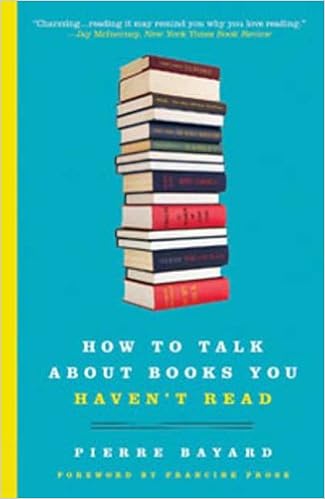
Bayard is clearly sending up literary culture with this, but it is underplayed enough that you find yourself thinking "Wait, maybe he's serious about this after all." He is a professor of French Literature, and thus is breezily at home talking about "texts," and "words failing to communicate meaning and all that." However, he seems to have had about enough of it when taken to extremes, and it is his own field he is satirising.
Each chapter starts off reasonably, asking if we can count a book as "read" if we have forgotten it, or how much of a book we must read before commenting on it knowledgeably. There are ways of not reading a book, and they are not all the same. He identifies prominent critics who clearly have not read the works they are commenting on, with no apparent damage to their wisdom or reputation. If a book is terrible, must we read it all to know this? Is it not enough to know its place in the network of writing and ideas? As all texts are experienced differently by the reader, is it perhaps enough to have merely heard of a book? Might reading actually bog one down in unnecessary details?
I loved it. It actually is thought-provoking on how far we might let out the kite strings of modern criticism and still know there is a kite at the other end. But it tackles the serious questions only to leap past to the more important task of reducing them to comic absurdity.
Wednesday, July 29, 2015
Derbyshire, Putnam, Murray
I have neglected John Derbyshire since he got himself in trouble with his too-gleeful observations of recorded African-American pathology. He still writes well and has important things to say.
Here’s a suggestion to sociologists writing books for the general-interest public: Drop the last chapter. You know, the chapter where, after 200 pages of describing some social problem or other, you offer solutions to the problem....is the opening paragraph to his essay The Prescriptive Poverty of the Social Sciences, which reviews Robert Putnam's new Our Kids, with significant reference to Charles Murray's Coming Apart. Derb doesn't dislike either book, but finds serious flaws in both.
Tuesday, July 28, 2015
Malware Warning?
A reader got a malware warning when going to one of the posts in my archive. My guess is that my wife has been right all along and I should have deleted all those cheap diablo gold comments and the like.
Please tell me if you have the least problem.
Please tell me if you have the least problem.
Monday, July 27, 2015
Social Media Signalling
I happened upon this article from the British magazine The New Statesman, The Echo Chamber of Social Media, etc. It's good right the way down, well written, and several of the other articles there were good as well. One of the early quotes is not far from things we have discussed here.
The site is useful because it discusses many political issues that are similar in the UK to US discussions but have a completely different cast of characters, and slightly different alignments.
*And authority driven, another trait supposedly more common among conservatives. The imprimatur of Roberth Reich or Paul Krugman is enough in economics; climate change catastrophe is based on choice of authorities.
A lot of what happens on Facebook, as with Twitter, is “virtue signalling” – showing off to your friends about how right on you are.and
When purity leftists do actions and organising, their interest is not in reducing oppression as much as it is in reducing their own participation in it. Above all else, they want to be able to say that they are not oppressing, not that oppression has ended.I mentioned this long ago in terms of Not In Our Name, and also suggested that Jonathan Haidt overlooks those places where liberals are just as purity vs. disgust* concerned as conservatives. (See also environmentalism, vegetarianism, NASCAR and a host of other disgust issues, including, I think wealth - though that is more ambiguous in both camps.
The site is useful because it discusses many political issues that are similar in the UK to US discussions but have a completely different cast of characters, and slightly different alignments.
*And authority driven, another trait supposedly more common among conservatives. The imprimatur of Roberth Reich or Paul Krugman is enough in economics; climate change catastrophe is based on choice of authorities.
Saturday, July 25, 2015
Projection
I have been reading conservatives who insist that the left is eating its own, the conflicts among the coalition parts is just too enormous to continue, the center cannot hold...
I think I have been hearing this for a long time. the closest thing to it actually happening was Ralph Nader in 2000 likely costing Al Gore the election by drawing 2% of the vote. Republicans think this level of hostility must signal imminent breakup, because among them, it would. This much accusation, and someone's going third party. Maybe 2016 will be the year it happens to Democrats again, but I'm suspicious. They do this all the time.
On the other side, Democrats assume that whenever Republicans oppose redistribution, it can only be because of greed and selfishness. After all, if Democrats opposed any such program it would be for that reason, so that must be true for others. That we might not be getting a lot of bang for or buck, or that there were unfortunate unintended consequences does not occur to them, therefore, it cannot be occurring to their opponents.
I think I have been hearing this for a long time. the closest thing to it actually happening was Ralph Nader in 2000 likely costing Al Gore the election by drawing 2% of the vote. Republicans think this level of hostility must signal imminent breakup, because among them, it would. This much accusation, and someone's going third party. Maybe 2016 will be the year it happens to Democrats again, but I'm suspicious. They do this all the time.
On the other side, Democrats assume that whenever Republicans oppose redistribution, it can only be because of greed and selfishness. After all, if Democrats opposed any such program it would be for that reason, so that must be true for others. That we might not be getting a lot of bang for or buck, or that there were unfortunate unintended consequences does not occur to them, therefore, it cannot be occurring to their opponents.
Church Music II
Texan99's comment reminds me: participation in worship by th3e congregation is worth pursuing. I heartily disliked screens with song lyrics projected when they first came on the scene. As a book person, and a music-reading person, I liked having my Gestalt verses and my bass lines in focus as I sang. Leading worship in a painfully small congregation I learned a different lesson: people looking down and singing into a book do not build that sense of soaring elevation with their neighbors which leads to community worship; people looking up at screens do. It's just the physics of sound waves.
In an earlier era, when people had a limited repertoire - 100 hymns out of a hymnal of 250 - which did not change much over their lifetimes, they could sing up and out, using the hymnal only as an aid. Those days are gone. If you want people to sing together, they either have to all know it ( a very small number these days), learn it on the spot (call-and-response or extremely simple), or put it up on the screen so they raise their heads.
In an earlier era, when people had a limited repertoire - 100 hymns out of a hymnal of 250 - which did not change much over their lifetimes, they could sing up and out, using the hymnal only as an aid. Those days are gone. If you want people to sing together, they either have to all know it ( a very small number these days), learn it on the spot (call-and-response or extremely simple), or put it up on the screen so they raise their heads.
Wednesday, July 22, 2015
Church Music
So again, another evangelical writes with dismay about the superficiality of praise songs, with the usual complaints about "happy-clappy" and limited theology. Heck, I've done it myself years ago. But I am minded that better Christians than I sometimes think differently, and remember Retriever's comments years ago.
Yes, of course. Trained musicians are going to find it too simple, and word-people are going to want something more substantial. So what? Do you not realise that you are putting outsize importance on the music portion of worship? Sing the songs. It's not all of worship. The old style of five verses of complicated imagery carried its own death in its obscure references. "Here I build my ebenezer..." always made me think of Mr. Magoo.
Yes, of course. Trained musicians are going to find it too simple, and word-people are going to want something more substantial. So what? Do you not realise that you are putting outsize importance on the music portion of worship? Sing the songs. It's not all of worship. The old style of five verses of complicated imagery carried its own death in its obscure references. "Here I build my ebenezer..." always made me think of Mr. Magoo.
Tuesday, July 21, 2015
The Flexibility of Morality
Going about our daily affairs and being exposed to the depressing news of the evils that people gradually learn to put up with, we comfort ourselves with the thought that there is a limit. There are things up with which we will not put, to paraphrase a great man.
I am not so sure. There are things we would not put up with today, that we would riot in the streets against. I have seen people who I hadn't thought had much moral backbone at all suddenly rise up and say "No. You shall not pass." But ten years later, twenty years later, I don't know.
Some of us are entirely influenced by the current fashions in morality, though we don't perceive that. We would take to the streets for certain causes, without realising that those causes are the ones on their way in, the ones where any inconvenience would be quite temporary, and the payback in self-righteousness great. There is a vast pool of folks for whom the popular morality is the only real morality, though we don't see that.
Beyond that, there is a greater pool who are partly influenced by the trends of the day. I am certainly one. I have reflexive suspicion of This Tuesday's Great Cause; yet I also have a reflexive suspicion of those who still cling to causes from the immediate preceding era that are no longer much noticed. Dead-enders, we call them. Why die on that hill? Why beat a dead horse?
I have near-certainty that God takes his measure of real goodness entirely separately from either consideration, and I can't find strongholds in myself to dig in with Him. He may take such extenuating circumstances into account in judging us, but I doubt they are even a feather's weight in his scales of what is good and what is evil. When I wake in the middle of the night and cannot get back to sleep, and worry that I have lost moral determination rather than gained it over the decades, it is very disquieting.
*** ***
My wife's prayer at church this week reminds me: we blithely talk about "God's Promises," often quoting partial verses that are general wise observations (Wisdom Literature) or promises to the Nation of Israel alone, without certain individual application. Yet God absolutely promises in several places that if we pray for wisdom, that he will give. Pray for wisdom.
I am not so sure. There are things we would not put up with today, that we would riot in the streets against. I have seen people who I hadn't thought had much moral backbone at all suddenly rise up and say "No. You shall not pass." But ten years later, twenty years later, I don't know.
Some of us are entirely influenced by the current fashions in morality, though we don't perceive that. We would take to the streets for certain causes, without realising that those causes are the ones on their way in, the ones where any inconvenience would be quite temporary, and the payback in self-righteousness great. There is a vast pool of folks for whom the popular morality is the only real morality, though we don't see that.
Beyond that, there is a greater pool who are partly influenced by the trends of the day. I am certainly one. I have reflexive suspicion of This Tuesday's Great Cause; yet I also have a reflexive suspicion of those who still cling to causes from the immediate preceding era that are no longer much noticed. Dead-enders, we call them. Why die on that hill? Why beat a dead horse?
I have near-certainty that God takes his measure of real goodness entirely separately from either consideration, and I can't find strongholds in myself to dig in with Him. He may take such extenuating circumstances into account in judging us, but I doubt they are even a feather's weight in his scales of what is good and what is evil. When I wake in the middle of the night and cannot get back to sleep, and worry that I have lost moral determination rather than gained it over the decades, it is very disquieting.
*** ***
My wife's prayer at church this week reminds me: we blithely talk about "God's Promises," often quoting partial verses that are general wise observations (Wisdom Literature) or promises to the Nation of Israel alone, without certain individual application. Yet God absolutely promises in several places that if we pray for wisdom, that he will give. Pray for wisdom.
Improving The Criminal Justice System
Volokh Conspiracy is publishing an interesting series by Judge Alex Kosinski on improving the criminal justice system. It exploded a few of my myths pretty rapidly. Much of the basic message is A lot of what we "know," we have no evidence for. The actual evidence about prosecutions, criminals, and trials points in a different direction.
When I served on jury duty, I felt we had eventually reached the right conclusion, but it was a near thing. Three things needed to be proven, and I believed the prosecution had established two of them clearly, but not the third. The rest of the jury believed that none of the three items had been proven, though I can't imagine how. Their reasons were worrisome, including one woman who said "even the prosecuting attorney admitted the boy might not have been there at the time," when it was in fact the defense attorney who had said that. There was no need to make a stand, because I also thought Point #3 was insufficiently supported, so the boy was getting off anyway. At the time, I rationalised that maybe this was how the system did indeed "usually get the right answer." I am now not so convinced, especially after reading Kosinski.
It was personally valuable to me to read it as well. I was quite depressed about uncovering a significant betrayal by a friend at work, only now revealed a few years later, after he has moved on to a job elsewhere in the system. Reading about the false incarcerations reminded me that my problems are small potatoes. Pray for those who are innocent but behind bars.
When I served on jury duty, I felt we had eventually reached the right conclusion, but it was a near thing. Three things needed to be proven, and I believed the prosecution had established two of them clearly, but not the third. The rest of the jury believed that none of the three items had been proven, though I can't imagine how. Their reasons were worrisome, including one woman who said "even the prosecuting attorney admitted the boy might not have been there at the time," when it was in fact the defense attorney who had said that. There was no need to make a stand, because I also thought Point #3 was insufficiently supported, so the boy was getting off anyway. At the time, I rationalised that maybe this was how the system did indeed "usually get the right answer." I am now not so convinced, especially after reading Kosinski.
It was personally valuable to me to read it as well. I was quite depressed about uncovering a significant betrayal by a friend at work, only now revealed a few years later, after he has moved on to a job elsewhere in the system. Reading about the false incarcerations reminded me that my problems are small potatoes. Pray for those who are innocent but behind bars.
Monday, July 20, 2015
Poll-Driven Understanding
Wuthnow has an interesting article over at First Things how polling about religion has changed the way Christians understand themselves. It is an angle that never crossed my mind before. It includes an overview of the history of religious polling, pointing out that we don't know what we think we know.
Subscribe to:
Posts (Atom)