Wednesday, October 13, 2021

Covid Updates

I stayed at the home of a college friend for a night after the reunion.  He had worked for the College of William and Mary for decades, retiring last year as a senior VP. All his work on the financial, budget, properties side of things. I asked his wife - because I didn't want Sam to have to brag on himself - why they had named a building after him. "Guilt.  His last job was as direct of operations during covid.  He had to deal with all the government agencies, politicians, interest groups, media, and factions within the college itself.  Not the job I would want.

I picked up some bits of info while I was away which I pass on to you. 

A researcher's claim that "Every randomised trial (of Ivermectin) that found a statistically significant benefit for survival was fake or did not happen as described." People quote studies they read in good faith and I am not being hugely critical of any of us when we weren't quite diligent enough or cautious enough in what we passed along. But be skeptical of the skeptics, and skeptical even of your own self.

The spread of covid visualised. I will take him at his word on the data.  His first conclusion, that "We had this thing beat in the spring of 2021" is weaker.  It is of course possible that we reopened too soon, leading to the summer spike in the South especially. This would be evidence in favor of that.  However, as further spikes were predicted even absent reopening, we don't know what the severity of those would be.  Then there was an immediate comment that "this shows that covid is an indoor phenomenon."  That is also defensible, and this would be evidence for the proposition. But... If you keep going in the comments, you will find that everyone seems to think that this proves what they already thought going in.  Even if they are correct in their conclusion - and I have considerable agreement with them - it is nothing near proof in any case.  I say this to highlight how easy it is to see what we want.

Every time I look at the death numbers I either think "Finally.  That's three days in a row now that are low.  We may be coming to the end," or "Damnit! Well over a thousand for a couple of days again. I hope we aren't looking at a spike in the North again this year as we go back inside." It is too easy to be swayed by short-term numbers when we are hoping for a particular result.

As usual, it is the bad reasoning, clearly motivated reasoning, more than the conclusions themselves that irritate me. If it were my business that had gone under I would be daily on the alert for claims that we overreacted and never needed lockdowns (The recent study showing lockdowns useless again made the error of equating what the government said to do with what people actually did.  I have related this to gun control, sex education, condom use, driver's ed and driver safety, etc previously and still think those analogies good.) If I had had a close relative die of covid I would be looking for evidence that we had underreacted and not acted safely enough. You selfish bastards. I think I fully get why people bring extra energy to the issue.  But all I can do is keep coming back to what actually seems to be so. 

Governments and skeptics might each have terrible motives but turn out to be correct.  Or people might have nothing but the best motives and get it wrong.  Motive is only a clue after the fact as to how things went wrong, not evidence in advance that they did.

I will now go on to more interesting and less infuriating posts about archaeology and stone circles (including beer and axe heads), liberal hereditarians,  (not) understanding Shakespeare, the privileging of current historians - especially WRT the Cold War, and the growing reversion to the primitive ideas about language that strings of phonemes - not even "words" - (like pronouns, insults) cause actual damage by their mere utterance.  And I'll bet I remember some other things on the way.


There and Back Again

But Sam turned to Bywater, and so came back up the Hill, as day was ending once more. And he went on, and there was yellow light, and fire within; and the evening meal was ready, and he was expected. And Rose drew him in, and set him in his chair, and put little Elanor upon his lap.

He drew a deep breath. ‘Well, I’m back,’ he said.

Wednesday, October 06, 2021

Tryggare Kan Ingen Vara

One more before I go.

"Children of the Heavenly Father," an old Swedish hymn that still hangs on in some Lutheran and Covenant churches. In those places, it is mostly sung in English with only the last verse being in Swedish. Usually phonetic Swedish, with most of the children's choir having little idea what is being said. It looks like some Methodists have found it as well.

We are singing this version for the memorial service of Swede Nelson in a couple of weeks, who sang with the choir and directed the Men's Chorus for many years. Loved the man. Lots of fun to be with and still kept people focused on rehearsing. I think the church could bring in a bundle auctioning off the use of his nickname at this point. I, for one, have always coveted it, though "Swede Wyman" just doesn't work as well.

Interestingly, many of the old Swedes in the congregation say they did not hear the song as children, and it only started to become popular in the 1960s. Something similar was said at my last Swedish congregation. It does not seem to be regional, either, as both the Swedes who grew up in New England and those who grew up in the Midwest said the same. It must have been traditional somewhere, and then in the 50s someone started hitting it repeatedly and hard in children's choirs or Luciafest or something. 

I sang it at my Great Aunt Selma's and then my mother's funeral, so I can get a bit weepy at the "Though He giveth or He taketh..." part.. I didn't put it on the list for my own memorial service, not because i don't like it, but because other things pushed it out.

Reunions

I had lunch with two friends from St Paul's ASP (51st anniversary) on Friday, leave today for Williamsburg for my 46th reunion (the 45th was cancelled), and come home to a Central High School 50th on the 16th. We've had the yearbooks out, looking at old photos. I have not been to a college one before. For highschool, I went to the 5th and hated it, didn't get back until the 20th, and have been a regular since. The displays of envy and one-upmanship started receding around the 30th and I hope are finally gone this time.  We'll see.

Tuesday, October 05, 2021

Regional Vaccination Rates

I have been nibbling at this Nine Nations cultural background to vaccination rates, but Colin Woodard, using his similar (11)American Nations schema, puts numbers to it and gives his interpretation why this is according to those cultural traits that go back to colonial times. You can detect his bias easily, but I don't think he gets it wrong. (Click to enlarge.)


Durham Indictment

I have been quite cynical that anything would come of this, as have others.  It seemed to be dragging out, I thought it could just be defunded and buried anyway, and despite the good reports everyone was giving about Durham, I felt I had heard all this many times before, that this guy was not like the others, this guy was a straight shooter, this guy was going to get it right.  And then those guys were like all the rest. 

I also hold the Epoch Times at arm's length, because they have such a clear bias. That's not to say they are inaccurate in any way - I really don't know much about that.  But they're only going to give you one side, so I don't tend to go there.

All that said, this was the most encouraging thing I have read since the first accusations against Trump being in cahoots with the Russians surfaced five years ago. (Hat tip: Maggie's Farm.) Durham is not going slowly, he just came on late and is doing his own work.  According to Patel, it's actually a little quick. Patel also sounds well-placed to understand these things.

For the record, when the accusations came out I thought it probable that Trump had some connections to some unsavory Russians, because in his development business he dealt with bad guys all the time, and those bad guys likely dealt with even worse guys. But I didn't think there was anything that looked at all convincing about him screwing with the election with Putin's help.  Even the allegations were a lot of hand-waving about BAD PEOPLE and DISINFORMATION without much substance. I thought it unfortunate that we might have a president who had worked with a fair number of crooks, including Russian crooks, but I worried also that a lot of exaggeration and insinuation was happening. That my cynical impression of Donnie from Queens turned out to itself be an exaggeration was good to learn as we went forward.

Incidentally, remember my repeated objection to Jonathan Haidt's assertion that conservatives use purity/degradation as a moral axis, but liberals tend not to?  Think about the Steele Dossier, and the attempt to disgust people, especially liberals, with a story that has both Obama and urine in it. Saint Barack should never be degraded in that way.  The type of accusation was carefully crafted to not only make Trump look like a bad man, but bad in a particular way. Liberals very much use the purity/degradation scale in their moral reasoning.

Monday, October 04, 2021

Louis Jordan

It is always perilous to try and suss out the origins of Rock 'N Roll.  If you say some aspect was first - first electric guitar or first back-beat - or pivotally influential, someone is sure to immediately find an earlier example, or lengthy interviews with early rockers who all point to a particular artist as an influence. The discussions can deteriorate into vagueness, or one-upmanship, or both. "Well, what about jump music?" "Well, what about Dixieland/jive/boogie/jug band?" 

Andrew Hickey is reportedly writing a five-volume history of R&R and I wish him well. It must be a labor of love, because he is going to have to spend the entire time talking with posers who are trying to prove him wrong and showing off the stray facts that they know, claiming them as authoritative proofs. Not me. I know my stray facts are just that and others know much more. 

However, being the Assistant Village Idiot, I do have some observations that I think helpful so long as you don't regard them as full explanations of...well, of anything.  

Rock descends from many ancestors, including some surprises.  I once looked with some disdain at a person who told me that polka music influenced rock-n-roll. Yet he made a clear case quickly.  Did I think that Western Swing influenced rock?  Well, yes, there's that whole Bill Haley/Buddy Holly strain, sure. Did I hear how polka influenced Western Swing? Okayyyy...sure...but was the influence the part that went on into rock?  Yes, he asserted.  It's the back-beat, hitting the 2nd and 4th beats of the measure.  Very polka. I also thought but didn't want to say aloud because I thought this was already out of hand, also very oompah band. I read once that it was the sound of trains on tracks, the sound of freedom and adventure, that resonated with so many people.  Could be.  But with a train, how the hell do you know where the beginning of the measure is?

The back beat was in many styles growing up in the early to mid 20th C. The lines between genres were porous, and musicians would play a wide variety of songs.  A guy's gotta make a living, and it was the 60s kids who got into being purist and authentic about whatever style they favored. What we perceive in our day as a very different style might only be a difference in instrumentation.  The song is very much the same, but this one has a fiddle and that one has horns and that one has an accordion. Rock music doesn't have accordions, and yet...sometimes you can make the switch in your head and hear the lack of difference. Drum/no drum.  Electric bass/upright. Steel guitar/accordion. The feel is different, but...

So there are rabbit holes everywhere.  I reject few or none, but do think it is worth having perspective.  Bob Wills might say what he was playing in 1957 wasn't any different than what he was playing in 1937, and there are some "truth elements" as we say about that, he was mostly just being a prick and it's not true.

The lead-in influences were themselves hybrids, more often based on marketing than on similarity. Country music and Western music had some mutual influence, but it was mostly a product of record labels and the effect of the early 40s ASCAP/BMI conflict. They were different. Country (and folk) did not influence rock all that much. Western Swing a whole lot. Rhythm & Blues became a style of mutual influence, but it got its name because people were no longer comfortable calling it "race music." Record labeling and concert venues again.  "Rhythm" was a catch-all for all those jives and jumps and hokum and "blues" was - it's own history, maybe as complicated as rock's. Not the same, but the same people produced their records, because those were the folks who would touch that.

So R&B&Western Swing all together here each of those based on other styles in their turn, performed about four years earlier than this (1946) at minimum. But Rock 'N Roll supposedly didn't come along until 1952, 1954. Sometimes it's not just the musical style solidifying, it is our understanding of the style that lags behind the innovation.

Don't believe me? After you pick up the beat and the tune, start humming "When the clock strikes two, three, and four, If the band slows down we'll yell for more."

Saturday, October 02, 2021

207, 603, 802 Vacations

A repost from almost two years ago.  I saw a woman at the supermarket today who had a shirt with a NH outline, inside of which was the single word "home."  She told me where i could find them, and we had a l9vely conversation.  It reminded me of my theory of what LL Bean should have marketed decades ago.  If i could go back, I would tell them.  Time travel shouldn't only be about getting Grady Little to take Pedro Martinez out in Game 7 of the ALCS in 2003 or buying Intel stock in 1972.  You have to help other folks as well.

****

There was a New Yorker cartoon in the 1980's of one telephone operator telling another "We're going to vacation in 802, 603, and 207 this year." LL Bean missed a trick back then when they didn't start with a line of shirts that had "207" to replace the Izod alligator or the Polo player. Alternatively, they could have had the numbers running down the sleeve.  It would be a minor in joke that people could wear outside of New England, with only those in the know getting the reference.  They could have broken out a new one every year or so, adding 802, then moving on to 603. After that it would have gotten more debatable.  You could have 508 and 413 (Cape Cod and the Berkshires) in Massachusetts, but even though there are some legit New England boatsy places in 978 - Gloucester, Cape Ann - or 781- Scituate, Hingham - the entirety of those areas would not be very LL Bean in image. They would be very LL Bean in market, though. You could get away with 401, Rhode Island, I think. Maybe it should harm the brand, but it wouldn't have. After a long wait and making them suffer for it, they could have let Connecticut, 203, into the club. 518 because of the Adirondacks?  Maybe.

Along the way they could have gone for a real inside reference by coming out with 709, then 902, then 506 emblems on the shirts.  These are the original area codes of the Canadian Maritimes, reinforcing Maine's otherness and connection to them.  I would have loved to have had a shirt with a little 902 over the breast, watching people squint and scowl trying to figure that one out.  I would have bought them for the whole family. When the boys went south to go to college, new 603 shirts would have to be packed. 418, the original area code for eastern Quebec could have been used, but none of the others in that province.  Mainers wouldn't want to hurt their feelings though, as half of Quebec drives down to vacation at York Beach every summer, and they need the money. That would have to be the end of it.  The authorities in Freeport would have to freeze the list at that point.

Yes NH does have beaches along that small stretch, and quite important to us because there are only a few miles of good sand.  But the water is cold, cold, even in August.  No one (well, Canadians, but please) comes to NH or Maine for the beaches.  To get warmer water and a lot of beach you have to get to the southern side of Cape Cod. That's not what LL Bean is selling. They do sell "swimwear," but it's not the tanning and eye-catching variety. This follows their marketing pattern.  They also sell underwear, but the category is called "base layers."

Vacationing in northern New England is almost year 'round, leaving out April and May, but there are differences that stretch back over a century which are still influences.  All three have skiing, snowshoeing, snowmobiling, skating and ice fishing. NH gets the bulk of winter climbers and ice climbers, but Maine and Vermont have them also. All of those activities support breakfast restaurants, and you can still get baked beans at a lot of them.* That's all very similar. But Vermont has Inns, New Hampshire has grand hotels, Maine has remote hunting camps and big summer houses along the rocky coast. Those are very different flavors. Lakes houses took off in all three after the war, yet still haven't made everything the same. The big hotels had full restaurants, with wine lists and 3-5 courses, and many still operate.  The Vermont Inns had smaller dining rooms and menus, even fixed menus until recently, when that would be unsustainable. The Maine coastal mansions had their own kitchens and even servants to make the meals.  Restaurants would still spring up around town, because not everyone was going to entertain for twelve, but these were lunchier, beachier affairs. Lobster rolls, clams, hot dogs.  For remote hunting camps, those big spenders were hiring pilots, guides, and cooks.  Those places needed a fair number of maintenance men as well.  Each of those different summer and fall vacations provides a different array of jobs for the locals. Outsiders bring in money, but it's different money.

*Baked beans are traditional since colonial days. That's what "pease porridge" was, nine days old. But they were also a staple of logging camps, where workers could burn through 9000 calories a day.  The theory was that the flapjacks and syrup were good for immediate energy, eggs started to feed you in the late morning, meat got you through most of the afternoon, and the slow-digesting beans were needed to keep you on your feet in the late afternoon. Hikers will still order them. If you are up here visiting, you should have the beans for breakfast at least once, just for bragging.

Was She Prettier Than I?

The cast albums do not capture the poignancy necessary for this song.

A second listening might be even better than the first.

Memory Tricks

I have discussed memory a bit, that we do not remember remote events anywhere near as well has we think we do and some of the reasons for that, but i don't think I have ever shared my little tricks on the matter.

When you can't find something and have looked in all the good places, do not then proceed to the medium-good possibilities.  It won't be there, and that method will simply reinforce the incorrect memory tracks that didn't work the first time.  You will find yourself looking at those "really good places" six or seven times while you are checking the medium good ones.  Look in the utterly stupid places instead.  Look under the car.  Look in the refrigerator.  Pull out the paper slips for your financial records this year. Those will break the seal and allow your brain to remember the unusual answer.  "Oh yeah, I put it in the pocket of that light jacket I never wear but threw on yesterday to go to the store when it was raining." If a half a dozen stupid places don't work, you likely have to stop and do something different for a half-hour.  But I usually find that the stupid places do reveal the true answer. 

This is explained by what is called state-dependent learning, related to the idea that if you learned to play darts drunk and became good, you should always be drunk when playing a game you really need to win; or that if you stayed up late and were angry studying for a final exam, you should make sure you are angry and tired when you go into the exam. It works in the negative as well, that your imagined "best state" for remembering probably isn't and you need to switch lanes.  Obviously, if you have a routine for exams that has worked in the past you keep rolling with that, because that itself has a state-dependent quality.  Yet in the absence of that, revert to the learning environment.

Secondly, once you have found your lost item, make sure you start storing it in the first place you looked, because that is where your brain thinks it should have been.


Left Wing Authoritarianism

I have certainly written about it for years, having LWA extended family, Arts & Humanities training, and a career as a social worker. Despite the denials, I think LWA is not only real but obvious.  Perhaps that is related to the denials.

James has uncovered a recent study that puts some flesh on those bones.  I think the contrasts and comparisons to Right-Wing Authoritarianism are fair, even when I wish the data had shown something a bit different.

Restoring An Antique Commercial Cheese Cutter

 I was captivated in spite of my complete disinterest in the item or restorations in general


Thursday, September 30, 2021

Anxiety and Ideology

A popular psychology article about a recent study on anxiety and political beliefs The Unexpected Relationship Between Ideology and Anxiety.  With Ann Althouse, I ask "Why unexpected?" I have been saying this since the 90s, that despite the  accusations that conservatives are afraid and anxious and just can't handle all the changes and the modern world in general that it is actually the opposite: liberals cannot endure people not doing things the way they should given this frightening world that is falling apart and are just so anxious about that - and they project.  I exaggerate unfairly, but the core point remains.  The conventional wisdom is backward in this case - as it often is. The correlations of Big Five personality characteristics with ideology were also interesting. Not shocking to me at all, frankly.

The results are also consistent with another study using American data ... that found that people on the extreme political left reported higher rates of having mental disorders than people on the right. As I noted, research on the “Big Five” traits of extraversion, agreeableness, conscientiousness, neuroticism, and openness to experience has found that people identifying as politically liberal tend to be higher on openness to experience and neuroticism and lower on conscientiousness than their conservative counterparts (Fatke, 2017; Gerber et al., 2011). Additionally, surveys find that neuroticism is more strongly related to economic than social liberalism (Gerber et al., 2009).

The actual Finnish study based on British data is here. The data set is people who were all born in the same week in 1958, who have been followed over the years on a variety of measures. This particular study was a subset of 7,000 members of that group.

Looney Tunes Complexity

Warner Brothers introduced us to some varied and complex music with Looney Tunes, from Wagnerian opera to revived obscure minstrel show pieces. The music they had specifically done for their cartoons was often surprisingly complicated for pieces whose presumed audience averaged about ten years old.  This was composed by Mack David and Jerry Livingston, who also wrote Disney intros (Cinderella, Alice in Wonderland) and popular songs (The Twelfth of Never). 


Most of Daffy's harmony is pretty standard here, but a few bits are surprising, and the sudden syncopation as the whole cast parades in is a nice touch.

#70 - Conspiracy And Paranoia

Repost from 2019, and includes links from much earlier.  I may comment further, but there's already enough here to keep people busy for a few days.

*******

Well, this got out of hand.  I thought I had written about conspiracy and paranoia a fair bit, but after reviewing the search bar results, I wonder if I have written about anything else. I gave up.  I may have missed the best ones.  Here is the original, 70th-most popular post that kicked it all off. As it concerns Lee Harvey Oswald and the KGB, it is likely that some of the traffic was driven by people search about the topic, not my friends and other sites telling everyone what a great post AVI had today. I wrote about that aspect at least one more time. Okay, two.

What has been more usual for me is writing that paranoia and belief in conspiracy theories precede an actual formed theory or focus. We do not become paranoid because of our experiences.  We interpret our experiences in a paranoid way after developing the tendency.  (I am willing to discuss this in the context of people under tyrannies if someone wants to go there.  I think that is somewhat, but not entirely different.) I did find some posts about that. Categories of Paranoia, Conspiracy and Blue Hats, Paranoia FYI'

The principle applies even when it is mild paranoia or mere suspiciousness. Distributed power. Suspicion and the Liberal Mind. Yet if people really believed even that much, wouldn't they take up arms?  Or leave the country?  No, that pretend paranoia is merely there for signalling, a Poetic essence.

Ted Goretzel talks about who believes in conspiracy theories. It can include PhD's. I discussed why it is hard to convince people Conspiracy theories are unlikely and unnecessary.They are too easy. The truth is harder to fix.

The object of Paranoia can change over time. You can ascribe your troubles to different conspiracies. (Yes, she has now included the Jews.) There are whole lots of these theories, pick one. Sometimes they actually are ture: Journolist. People try to create conspiracies all the time, but the more people you have, the quicker it is going to become public. Daily Kos noticed that George Bush quietly changed a law in 2007 so that he could declare martial law in 2009 and not step down.

Does our style of paranoia choose our politics for us, rather than the other way around? Does the mechanism for accepting blame and responsibility in our brains break before the paranoia? Do fiction or film increase our vulnerability to paranoia or belief in conspiracies?

I'm sure I've said other brilliant things elsewhere, but this is already well more than enough.

Wednesday, September 29, 2021

Paranoia Repost

I had already been looking at some older posts about paranoia for other reasons when I saw Mike Guenther's approval of my posts on mental health issues, so I browsed through the list and thought this one might serve as a good introduction. Paranoia, Another Thought from earlier this year.  I started in writing on the topic in 2006, and even categorised myself as a "psychblogger" then.  I have not seen that term in a decade, so I think it just never caught on. I have written many times on this over the years and will put up at least one more, one that includes many internal links and references so you can have something close to one-stop shopping on my thoughts about this. I think I will touch on the related topic of Conspiracy theories as well.

Quick summary on paranoia: The paranoid mind-set occurs first, the targets are flexible and come later. 

Less quick summary on conspiracies:  Conspiracies are attempted all the time.  It is not crazy to believe that people are trying to do these things. But secrecy and cooperation are hard among the ultra-suspicious, and most conspiracies fall apart quickly. It is good to ask yourself how many people would have to be in on the secrets, and how much they would have to get along. 

Chesterton noted "The madman is not the man who has lost his reason. The madman is the man who has lost everything except his reason," going on to describe that such a one has lost proportion, and humor, and faith, just for starters.  Or, more fully in the same work:

I mean that if you or I were dealing with a mind that was growing morbid, we should be chiefly concerned not so much to give it arguments as to give it air, to convince it that there was something cleaner and cooler outside the suffocation of a single argument. Suppose, for instance, it were the first case that I took as typical; suppose it were the case of a man who accused everybody of conspiring against him. If we could express our deepest feelings of protest and appeal against this obsession, I suppose we should say something like this: "Oh, I admit that you have your case and have it by heart, and that many things do fit into other things as you say. I admit that your explanation explains a great deal; but what a great deal it leaves out! Are there no other stories in the world except yours; and are all men busy with your business? (GK Chesterton, Orthodoxy, Chapter II: The Maniac.)

Tuesday, September 28, 2021

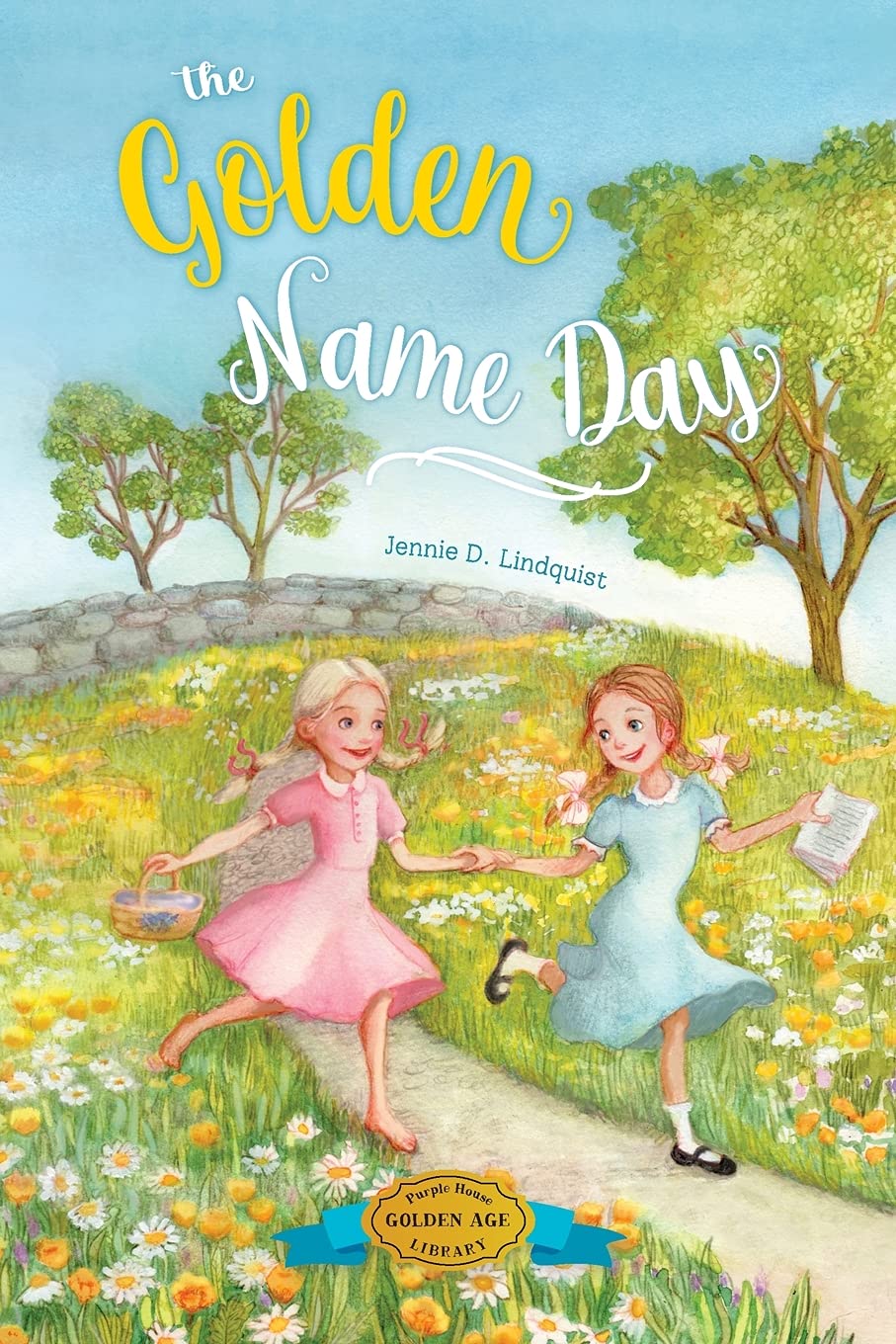
The Golden Name Day

My Aunt Jennie's book about Swedish-American girls, The Golden Name Day, a 1956 Newbery runner-up, has been reissued after many years. I have written about it a few times over the years, most recently in 2019. I had not heard that is was coming out again. The last paperback edition was 1971, I think. 

It's a charming girl book, recommended for 8-12, and my wife has read it aloud to our two oldest granddaughters. Her grave is in the Lindquist family plot in the Swedish section of Pine Grove in Manchester, next to her favorite cousin (and everyone's else's favorite aunt), Selma.  They both died decades ago, but we still go to the site every year.

I certainly like the old Garth Williams cover much better than the new one, but none of the family was consulted about any of this.  The copyright has long since expired, but perhaps the illustrations have not.  She donated her children's literature collection (she had been editor of The Horn Book as well) and many of her personal papers to White Pines College, which later became Chester College.  I had the rest but could think of nothing to do with them and eventually donated those to the college as well.  The school went under about a decade ago, and I imagine they are all long gone now, scattered or even destroyed.  I keep thinking I should put in the effort to do a Wikipedia page on Jennie, but have never gotten around to it.

Archaeological Quotes

I listened to an interview with Dr. Lee Bray, lead archaeologist for Dartmoor National Park, and he turned out to be remarkably quotable.

"Looking into the prehistoric past is like looking into a well. It's dark and indistinct and sometimes all we can see is our own reflection." If one reads popular accounts of archaeological finds, this is recognisable. When something is found, the journalist - and sometimes the science writers and even the researchers spin a tale of what they think was happening and what the people must have been like. Somehow, they always seem to be like us, and the speculations of a century ago are noticeably different than what we guess today.  It is rather like looking at episodes of The Flintstones or The Jetsons now, when the 1960s cultural assumptions are glaringly obviously projected onto both the past and the future. Not that we do that anymore...

"It's not true that they were just like us in many ways.  The farther back you go the weirder they get."

"Artist's renditions of prehistoric people all look like attendees at a 1970s Glastonbury festival." He also wonders why we insist that their clothing must have been brown, given that we know they had vegetable dyes, cosmetics, piercings, and tattoos. They loved decoration. We even apply this dullness to recent historical eras when we have a wealth of data contradicting it. James had a recent post that classical statues were not actually white and unpainted.

"The sharp breaks in eras and cultural changes are almost surely wrong, even in the case of one population completely displacing another. It's not as if someone looked up one day and said 'Right, it's the neolithic now, we'll have to start farming.'  We make categories in order to break them."

That last sentiment applies to a great many fields.  Biology, where our definitions of species are increasingly discarded; medicine, where diagnoses are sometimes neither fish nor fowl; all social sciences, and all types of history, where eras are created in retrospect in order to clarify some aspects, yet necessarily obscure others.  I don't recall ever being taught this, not only in introductory courses, but neither in more advanced courses.  We were required to learn categories. That isn't a terrible approach in any field, for without something of that nature there can be no organising of the material into schema nor discussion about it. But I think warning the student that the boundaries are mere conventions and soft at best should be inserted into learning.

It might even make journalists and other dilettantes wary of thinking they know everything.

Natural Immunity Vs Vaccination

Update:  I may have spoken too soon about the number of deaths receding. 

My usual brilliant source knew of this one and I pass it along.  Getting covid-19 is much less effective than being vaccinated.

  • More than a third of COVID-19 infections result in zero protective antibodies
  • Natural immunity fades faster than vaccine immunity
  • Natural immunity alone is less than half as effective than natural immunity plus vaccination

The part about one-third of infections resulting in zero protective antibodies was quite discouraging. 

Deaths are receding nationwide, and even though they are still high in Texas and the lower Mississippi states, they are lower than they were a month ago. Last year the spike in cases moved north in late fall and winter, but that was before widespread vaccination. Perhaps it will not happen again this year, as a one-year event is still just a one-year event, not necessarily a pattern. I would express cautious optimism, but I have done so a few times during the pandemic and been wrong, so I will not do so at this time.

Sunday, September 26, 2021

By the Numbers

I have seen the argument advanced in a few places that getting lots of people vaccinated is actually more dangerous, because it creates a more likely opportunity for a super-variant of Covid to arise, one that overwhelms even vaccinated immune systems. While this is not so, it does have an element of truth in it that deserves refutation rather than mere dismissal.

Let us look for a moment at winning a lottery.  A person who has bought a million tickets has a much better chance of winning than a person who bought only one, so his average expected winnings is a million times higher.  But there aren't really "average" winnings in a lottery (a pure lottery.  I am excluding the actual money-raising games that give lesser prizes for getting some of the numbers right). If you win the 10 million dollars, you win it, and if you don't you get nothing.  The idea of average winnings is something of a statistical trick.

The rise of a supervariant is like a lottery in reverse, an enormous single bad-luck outcome. If everyone but one person were vaccinated, there would still be a chance, however minuscule, that the last person who contracted the disease carried a mutation that turned out to be the supervariant that overwhelmed everyone else. You can see how that might happen in theory, but no one is losing sleep over that possibility.  Much more worrisome is the situation where there are many, many people carrying the virus.  It's like millions of lottery tickets for that ugly reverse lottery. Even though the chance of a supervariant mutation is extremely low for each of those "tickets," in aggregate the odds are much greater.  It is still small.  There have been millions and millions with the virus, and only a couple of variants that have been problems.  It may be that only the Delta is a big deal.There are likely many mutations out there already, but as well all know, most mutations make things work worse, not better.  The many mutations simply sink beneath the waves.

But if there are a bunch of these mutations around, they have an enormous number of vaccinated targets.  I am going to describe the situation as if the virus is "trying" to outwit the potential hosts, even though it is not sentient and trying to do anything.  It's just with such enormous numbers it has that appearance, of an organism trying to get through defenses, like a hundred million squirrels trying to get through to the bird feeder by indefatigable persistence. When there are only a small number of variants, it's like there are fewer squirrels trying their hand at the obstacles.  The odds of the squirrels in general succeeding and coming up with a strategy is low.  But when there's lots of squirrels, the possibility that one might hit upon the one brilliant strategy is increased.

I don't know what the worst ratio is for that possible development of a supervariant is, but I have to think 50% vaccination - right about where we are now - might be close.  With 95% vaccination, there just wouldn't be enough squirrels working at the feeder puzzle.  But with 50%, there are a huge number of people carrying the virus, and they have a huge number of targets - both the easier targets of the unvaccinated and the hardened targets of the vaccinated. Or if you prefer, while one of the few unvaccinated in the 95% scenario might develop the winning ticket variant that is actually the losing ticket variant for us all, such a variant is more likely to arise in the scenario of only 50% vaccinated, because that would be like buying ten times more tickets for that lottery.

Even with all the unvaccinated counted together a supervariant might not arise. Even though it's ten times worse than the 95% vaccinated scenario it's still low.  But remember, the original predictions months ago were that more powerful variants were unlikely - and we've already had one.  Worse, the one we've got is still spreading, so a variant of that would only have to be a little worse to be a heightened risk. We don't actually know the likelihood.  No one does. It may be unfortunate bad luck that we got even one Delta variant.  Or we may have gotten lucky with ten almosts that just missed, with no reason to expect such good luck in the future.

It has some importance because of the insistence of the unvaccinated that they represent no danger to the vaccinated, and so should be left alone by all the busybodies. It is true in the limited sense that the potential danger of each unvaccinated person is low. Like lottery ticket low. Though someone does eventually win lotteries, and if you buy millions of tickets the aggregate danger is higher. At minimum, they increase the risk of danger for us all.

If someone has better math on this, let me know.