Friday, February 22, 2019

Crypt, and an "Aha" Moment


I find all the embedded links fascinating – that’s why they’re there – but understand that not everyone will.  I will notify you when the one you absolutely have to follow to get the point comes up, near the end.

I had a sudden curiosity about the word encryption and how it might be related to “crypt.”  I could see the connection with cryptic and crypto-, and the idea of disguised or hidden.  That didn’t seem far from the idea of a crypt, but it wasn’t precisely on point either.  Crypt is indeed a bit of a detour,  being a short form of Greek krypte kamara, with a similar word in Latin and in Middle English. “Hidden room” is the literal – kamara like camera , as in Camera Obscura – used for vault or chamber, then grotto or cavern, and much later, a burial place beneath a church.

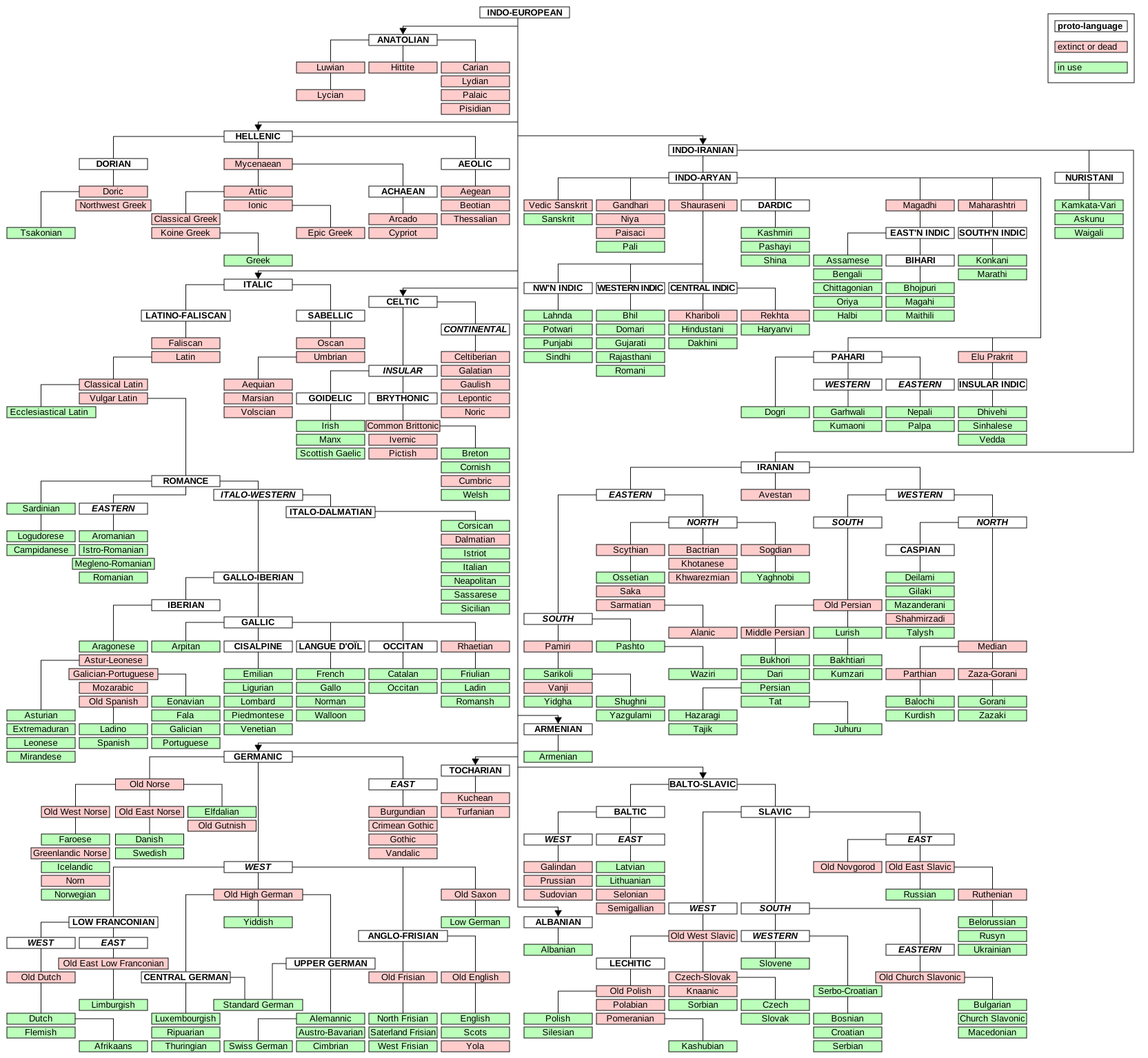
Along the way one notices other curiosities. There are related words from Old Church Slavonic (kryti “to hide”) and Lithuanian (krauti “to pile up”).  There was an “aha” in that latter one, which I will come back to.  Even though those languages might seem to us to be related because they are Eastern European, they are not that close and are even less close to Greek and Latin.  They had been separated three thousand years and more. “To pile up”…now, that’s odd…

It is thought to be related to calypto- meaning hidden or covered, which in turn is related to a very old root – and this is the one link you need to check out - kel-     

kel(1) meaning cover, save, conceal, part of helmet, ceiling, cell and a flock of other English words. Including “hell” the place of the dead. 

kel(2) meaning "to be prominent," or “a hill” which goes into our words for excellent, culmination, and hill.

Identical primitive roots usually have common origins*, yet the connection between the two forms of kel- might not be immediately apparent.  Unless one has been reading about kurgans  for forty years, especially the last two months.  Kurgans were hills that were built as burial mounds for prominent people – by exactly the ancient tribe which is the ancestor to those languages using kel-, calypto- crypt- , above. Greek, Latin, the Slavic, Baltic, and Germanic languages have a common ancestor.  They built kurgans to honor their prominent dead, beginning just before they moved in many directions to become dominant from Iceland to India.  To hide/ cover/ conceal/ bury, related to "to make prominent"/ pile up/ hill.  No obvious connection until, as Paul Harvey used to say, you know the rest of the story.

*Keyword: usually

Triggered


The overuse of the psychological term “triggered” is yet one more example of a legitimate term being ruined by people who are trying to overdramatize either their own discomfort, or the evil of persons they dislike.  The idea of a trigger for PTSD symptoms is quite real. People who have been near many explosions in a war zone may have exaggerated startle reflexes to explosions or even very loud sounds when they get to safe places, and this can persist for years. Others do not find their nervous systems responding that way at all, even after repeated exposures. Responses vary. People who were beaten or molested, especially as children, may overreact, either in fight or in flight, to people shoving them or threatening to them years later.  Yet while no one would find such memories pleasant, others are not so viscerally affected.  Smells can be triggering, and actually provoke flashbacks.  Come to think of it, “flashback” is another word that has been cheapened.  It originally referred to more than just being reminded of something and thinking about it. A flashback is an involuntary reliving of a situation in which it seems real. While this PTSD symptom can diminish in both frequency and intensity over time without treatment, it sometimes requires training and effort to minimize its effect.

Music can quickly and effectively bring us back to a time or an event.  Usually the effect is mild and pleasurable – or pain-pleasurable about nostalgia* or a lost love – but sometimes it can be more intense and unpleasant.

Triggered was a well-chosen term, conveying both the automaticity and the intensity of the effect. When I encounter the term in modern usage is seems to be no more than a synonym for “bothered,” or “reminds me of something I don’t like.” One cannot be “triggered” by a MAGA hat. A claim to being triggered by a KuKluxKlan hood would require exposure to an actual traumatic event, such as having a cross burned on your lawn when you were little. Not common. Mere exposure to something that one disagrees with is not a trauma, and it is a terrible disservice to those who have actual trauma still circulating in their brains.  Not only does it dilute compassion for those who deserve it more, it may actually make their lives worse by expanding the situations which provoke the response.  Imagine a young woman who has been seriously sexually assaulted in high school and has flashbacks of the event in limited situations, such as someone shoving her against a wall. To be surrounded in college by those who frequently refer to less intense, perhaps even very minor events as being rape-equivalent is to reduce her threshold for being reminded of her serious event. Young and vulnerable people will sometimes even seek out such pathological companions in the hope of finding those who will be sympathetic and understand.

I actually do find an event that was ridiculed as a possible trigger to be at least possible.  Rapes are described in Greek mythology and literature, especially in Pindar. There was a college woman who claimed that reading about a rape in one of the “Odes” (there are a few nominees) took her by surprise and triggered a flashback memory of her own assault.  I think when people are criticizing Pindar and heroic Greek culture in general on this score they are describing outrage, not triggering, and I resent that, for reasons described above.  It seems of a piece with the pattern of overdramatisation I deplore.  Yet I don’t rule out that a rape in literature, in poetry, in music, in art could be triggering in a clinical sense.  Art is powerful.  That’s one of its purposes. It is supposed to resonate with life events and not be separate from them.  Most people consider classical literature boring, yawn-worthy, not any possible grounds for serious identification.  I wouldn’t be so sure. In artistic expressions of “The Rape of the Sabine Women” those victims look horrified, and it is hard not to feel pity and horror oneself, even while remembering that this is only a painting or sculpture and is not an event that is currently happening to real people. The girls at my high school got pretty involved in the cinematic version of “Romeo and Juliet” when it came out.  There are parts of Genesis and Exodus that one winces to read. A person used to immersing herself in the story and poetry, taken unawares, might indeed be triggered by Pindar. I know little of the story and nothing of the young woman.  I only note that it’s possible.

*The number of songs which bring tears to my eyes grows every year.

Thursday, February 21, 2019

College Athletes

I think there is bad reasoning on both sides. Please mentally add these thoughts to subsequent discussions.

Colleges make a lot of money off these players. Not really.  Students provide the labor, but most of them are interchangeable. People come out to watch the program, which is the school and the coach.  This year attendance is up a little wherever Zion Williamson goes, because he is great to watch and one of those sure-fire AD,KD, Lebron talents.  No one else is moving the dial. In football, A&M and Michigan and everyone else in the Top 20 are going to sell out and sell merchandise no matter who plays.

These players are being given enough because it's a very valuable scholarship. Maybe.  For a smarter player, it is an opportunity to get a degree without debt, and maybe a local reputation that will help you get a job.  But there are players who just don't have the intelligence to benefit from the education, so it's just pretend to say say that the school is giving them anything. There are varieties of smart, and the better financial advisors teach students to maximise their attractiveness by creating networks while they are on the team. Rich alumni will often be glad to get to know them and give them advice then. That's less likely to happen after you've been gone three years. Make friends with the smartest students you know. Join clubs that are completely out of your comfort zone. Go and cheer at the games of less-prestigious sports. All that is fine, even if the classes are way over your head.  (Though the ones who take that advice are usually the ones smart enough to benefit from classes.) But colleges who bring in students who can't pass a course are not actually providing them with anything except room and board.

Updates Because of further discussions:
1) note that colleges make money off all their students, in some sense.  It doesn't affect the practical aspects of this problem, but it is worth keeping in mind when the focus is only on the money generated by football players (which, we have seen, is not quite what we have been taught to think).
2) Athletes discussing the issue are likely to see it entirely as personal justice, as if college athletics .were like other jobs.  I do work.  My employer benefits.  I should get paid. I have a lot of sympathy for that view, but it does ignore contexts in which the industry is different than others.  Many types of jobs don't fit the market norms in some way.  This is one of them.
3) The system of having colleges operate as minor leagues for professional sports is of course crazy.  But it's not dismantling any time soon, and its mere craziness is not an automatic argument in favor of whatever other idea people come up with.  Well, it's hypocritical to say that a scholarship... Full stop.  Maybe. But the whole thing is built on hypocrisy anyway.  It is a system in which 2+2 is required to equal 5, even though it doesn't.  Starting your argument with the idea that "So because 2+2=5, we can conclude that..." is not valid.  It does look tempting at first.  But reducing the madness, not building on it, should be the goal.

The Machine Stops

I got much of my description wrong, but enough to hit key buttons for a reader.  I recommend you read the story first. There's a lot in there that's more important than this week's news.

To show how dim I am, I even looked at the table of contents for all of the Science Fiction Hall of Fame books. (I have had them, but given multiple copies away.) I saw the title "The Machine Stops," but it didn't click.  I think even though I had already seen the title "The Roads Must Roll," I saw Forster's title and thought it must be that story. Or the one with the spindizzies. 

It was written in 1909.  I was way off, and Forster's prescience is even more amazing. I had forgotten the second half of the story.  But the remembrance came to me when considering our internet-driven, and now even device-driven world in which actual human contact is considered less and less necessary. Forster seems to think such a people would be easy to control, if those who wanted power took their time.

Wednesday, February 20, 2019

Arab-Israeli News

The conference in Warsaw is apparently interesting and promising.  The Washington Institute gives a good summary.
Second, the Europeans were alarmed by the strikingly similar stories they have heard from Arab ministers and Netanyahu in describing Iran’s efforts to destabilize the region and exploit conflicts, whether by smuggling arms into Bahrain and Saudi Arabia, using Shia militias to coerce governments, providing missiles to Hezbollah, Hamas, and the Houthis, encouraging terrorism and subversion, deploying missiles on bases in Syria and western Iraq, or developing factories to build precision guidance capabilities for thousands of rockets in Lebanon and Syria. In essence, those on the frontlines of regional conflicts told their European friends that Iran will not stop fomenting trouble abroad unless its costs for doing so become far more acute. Interestingly, Arab ministers noted that sanctions are only part of the solution; in their view, creating consequences for Iran also entails unifying their own efforts, portraying a solid, collective front of opposition, and doing much more to tell the Iranian public about the costs of their government’s adventures.
The Washington Times also has a report. Similar but with some different info. I don't think this is widely reported outside the conservative press.

Bleg

What was the sci-fi story, 1950s-70s, in which people live beneath the surface of the earth in pods or rooms, communicating electronically and having little face-to-face interaction?  One young man goes out onto the surface, just for curiosity, which worries his mother (who lives in a pod at some distance) because it is so strange.

Monday, February 18, 2019

Kamala Harris at the Bookstore

I recognised it on sight. Gibson's Bookstore in Concord is as liberal-friendly a territory as you will find in New Hampshire.  You may remember that I wrote about it just about two years ago.

Grant Revisited

"If history is just current events plus time, then biased and unfair history is bad journalism plus time." 

National Review has the first of a series of articles revisiting U.S. Grant. I plead guilty to the charge of the laziness in what I have believed about him.  My mental summary of Grant has been that he was elected because he was a war hero, but had a corrupt administration and wasn't all that smart.  I really should know better by now than to trust what I have just picked up "in the air" about history.  It is the shortcut that bright people use and in some ways is useful at perpetuating a culture.  Everyone does not have to research every topic.  You can rely on the clever ones to pick up the main points and pass it on in the general intellectual patrimony*.  The problem is, that system can be bent, swayed, and even hacked, as C S. Lewis pointed out years ago.
“Why you fool, it’s the educated reader who can be gulled. All our difficulty comes with the others. When did you meet a workman who believes the papers? He takes it for granted that they’re propaganda and skips the leading articles. He buys his paper for the football results and the little paragraphs about girls falling out of windows and corpses found in Mayfair flats. He is our problem. We don’t have to recondition him. But the educated public, the people who read the highbrow weeklies, don’t need reconditioning. They’re all right already. They’ll believe anything.” – fictional character Miss Hardcastle, from That Hideous Strength
*Sexist term, but "matrimony" would lead us even farther astray in its current meaning.

Saturday, February 16, 2019

CS Lewis Glasses

I have finally decided I am eligible to wear CS Lewis glasses.  I am not as smart, and nowhere near as learned, but I am older than he, and they finally fit my face - a bit. I have two pair now, a correct prescription pair and a drugstore pair that can be abused.  For reading only, as with Lewis himself, who did not even carry his glasses with him on walks.


Three decades ago I would have thought they looked too affected, but Harry Potter brought the general style back into play, so now they are just one variation of normal.

Dialect Quiz

This British-Irish Dialect Quiz correctly identified that I am not from Great Britain.  I wondered if it might show a particular region of the mother country reflected in my New England usages, either the East Anglian dialect of the New England Puritans or the Scots-Irish who settled the Merrimack Valley. As with everyone else's linguistic history, mine was likely changed because much of my Puritan background filtered through Nova Scotians who were glad to get free land, and hypersensitive Swedes of a century ago and more who wanted to be very American, very quickly.  Nothing like this showed up in my answers, and I took the long form.

The whole thing was amusing to learn what terms the British do use now. I chuckled at many of the choices offered.

Friday, February 15, 2019

What The Tribe Needs

On the very cold Saturday morning we were passing out food, the wind was up and the workers were miserable.  People just hunkered down, vowing to just get through it, get home and warm up.  There was one woman, Lisa, who I know from 1269 Cafe and from being on the other side of the line at Food For Children.  She is chronically homeless.  She is an untreated manic; not at all a mean person, but she wears on me very quickly. I hear her voice at a distance and try to anticipate where she will be next, so I can not be there.  She is happy in that forced, brittle way that is not insincere but one recognises is a result of her biology forcing her to it.

But his morning, everyone was unhappy, silent, clipped in speech, a few women tearing up from time to time it was so painful. Lisa was singing, softly and joyfully, singing praise songs one after another without repeat.

And...

It was just so nice to hear a pleasant voice.  It lifted the spirit, and you didn't give a damn if was artificial or forced or not.  It was a human voice being happy, ringing through the misery. I realised that sometimes the tribe needs this to survive. Lisa may be a burden and a cost 99% of the time, but that 1% is enough to inspire, to keep the whole tribe going that one extra hour. Over the course of a generation, a few of those may mean the difference between life and death, productivity or despair, for many people.

I felt ashamed at having thought ill of her, and still burn to think of it.

Thursday, February 14, 2019

Insults

A: Trump supporters are stupid, uneducated, racist, and probably violent.
B: Your accusation is an unsupported generalisation, prejudicial, and divisive. You are merely reciting your tribal preferences.
A: Hey! Hey! You're making it personal here. I'm reporting you for violation of the terms of service!

If you think I am exaggerating, go on Quora. I keep hearing it's like that on Twitter as well, but I don't have personal evidence of it.

Violence

Grim linked to this interesting article about the development of institutional over personal violence. I think it is better to keep the discussion all in one place, so let's have it over at his site.

But just to get the controversy started, it bears a strong resemblance at first glance to the difference between Africa and China over the last thousand years or more, with the Middle East and Europe more like China, and New World populations along a wide range in the middle.  Raiding, as opposed to pitched battles, overlaps this discussion.

Once Northern Europe, especially Scandinavians, had only warfare, not raiding to fear, they became more like bonobos.  Which in that narrow range of centuries from the 17th to the 20th, made eminent sense. Life is safe.  Food is becoming plentiful.  Life is good.  Warfare was intermittent and involved armies more than the general populace.  That blew up in their faces in the 20th C, but one sees the point.  In the 21st C the difference is now the internal population, not all of whom are bonobos anymore. That's one change.

And there's still the threat of war from the east, from Eursia, too. Even though culture persists, there is also constant change in the world, and the skills needed for survival change as well.

Counties

Apropos of a conversation about throwing out old photos from high school and college, I mentioned to my wife a measure of how geography-obsessed I am.  If I cannot remember what town someone in college is from, it is a strong indicator I did not know them well, and this goes double for females. Yet there was a cultural difference it took a year or more to adjust to - the difference between defining by town and defining by county. A girl might be listed as from some interesting-sounding town, but if one struck up a conversation about it, she might look puzzled.  "I'm from Nelson County." I learned that this is more common across the south, and I think parts of the midwest.

In New Hampshire, people go all through school and graduate without knowing what county they live in. Houses of Correction, probate (now circuit) courts, sheriffs, and public nursing homes are county items, and what you use to get people to identify their county. Fill in the blank with the first thing that comes to mind: _______House of Correction.  That's actually a fair bit of government, but no one thinks that way in NH, except maybe the police and lawyers.

Wednesday, February 13, 2019

American Trilogy

It was Mickey Newbury who first put together the arrangement in 1970 and recorded in 1971.  He said he did it for his own healing one night, then thought it should go to an audience.


Underneath the video at youtube is the following.
Mickey Newbury is a songwriter most famous for a song he arranged, but did not write. One night in Los Angeles, at a time of national distress over war and race issues in the U.S.A., Newbury spontaneously combined a southern anthem (written by a northerner, D.D. Emmett), a northern anthem (written by a southerner, William Steffe), and a third song that was originally a Jamaican slave song (All My Sorrows). In the audience that night were many celebrities, Odetta, Kristofferson and Streisand among them. The trio of songs brought tears to Odetta's eyes. It came to be called An American Trilogy, and would be adopted by Elvis Presley as the centerpiece of his later concerts. This clip is an extra from LIVE AT THE HERMITAGE, the new Mickey Newbury DVD, and features Marie Rhines on violin. The clip is uploaded with the permission of the Newbury family, and the DVD is available in the cd store at www.mickeynewbury.com

More can be found about it here.

Gay Values

Remember when Jerry Falwell thought he discerned gay propaganda in the Teletubbies, and everyone thought he was crazy?  The counter kept getting buried and reburied, and re-re-buried that he had gotten the idea from repeated references in gay culture, who were saying exactly that. Yet that didn't stop the sneers. "But they haven't even reached puberty yet," laughed the Washington Post. It stuck with Falwell's reputation the rest of his life and was mentioned in every mass-media obituary.

Years later, even Slate magainse admitted that Falwell was, uh, right. The gay commenity had been claiming Tinky Winky as a camp idol for years.  One of those Murphy Brown; or most-of-the-mainstream-press-votes-and-contributes-Democratic; or yeah, Bill Clinton does lie a lot moments that liberals own up to once they think it can't damage current candidates. Some people can say a thing, others can't.

So here we are again.  The NYTimes is seeing gay messages in the children's books by gay authors. Male characters who are friends, such as Frog and Toad?  That's quietly applauding gay affection.  Because, what else could it be, really? The author was gay, so...well, you know. They must be too. I mean, why else would these boy/men argue and then get along?  Why else a tenderness and worry that they would be lonely? Men are never like that unless...

I'm thinking those soldiers with wounded or dying comrades, or teammates hugging at the championship, or lifelong friends clapping each other on the back might object that the view is a touch narrow. I don't call it completely untrue - half-truths have more strength than lies - but it all seems rather convenient.  Gay authors may gravitate more to depicting positive male affection. But taking credit for all warmth and love seems a bit much. Anything nice that men do?  Oh hey, that's completely us. That's our trademark

There are next all those books with tomboys, or even girls in the latency stage when they find boys icky, who are now revealed to have lesbian sympathies. The authors were writing in code, you see. That attitude was condemned in discussing girls who liked sports or climbing trees or fishing as far back as I can remember, but now, well, wink wink, nod nod...YOU know. I'm thinking some tomboys or hunters might weigh in on that unpleasantly.  Women who didn't really have much against lesbians or think about them much - until this minute when you are sorta pissing them off.

I give the authors much more credit than that.  If a woman felt a little ostracised for being too boyish she might well broaden that in a way that included many females.  Tomie dePaola may have had a personal reason for writing something encouraging about a boy considered a sissy and defending him, but the book is about that broader category of criticised boys. Not everyone is a cultural advocate every waking moment. Except at the Times, I suppose.

It's an extended series of heads-I-win/tails-you-lose arguments by the author. Additionally, the article wanders and is unfocused.  Jesse Green makes sure he works his best factoids about children's lit in there, even when they don't fit.