It feeds my conceit when a group conversation comes to wonder where something comes from and others turn to me expectantly, believing I might know, or at a minimum, could find the origin. There is a significant downside to this, however, and I've got one here: when the question looks immediately to be vague and unsatisfying in answer, and I will have to come back empty-handed. However strongly I may suspect that the answer will be "no one really knows," I dare not say it at the outset, for someone present may come across an obviously spurious answer some months down the road, and it will be a poor show for me to correct that. Or worse, someone may encounter a very possible answer in the future, and I would be on record as having talked through my hat. So the research must be done. Fortunately, such searches often reveal interesting tangential information even when the search proper winds away into obscurity.
In discussing New England regionalisms, I was offered the challenge of finding out where the use of "wicked" as a synonym for "very" originates. No one really knows. (I knew that.) But we can't stop there, can we? We have to find collateral information to illustrate that no one really knows.
The OED claims it is L20, Late 20th Century, but that can't be right. Though that usage had reportedly fallen away in Manchester and Nashua (which explains why I did not use it as a child but was familiar with it from YMCA camp), I can guarantee it was in common use in the 1960's, which is M20, not L20. Still, that seems wicked recent. I would have thought it older. Not wicked old, but earlier than that.
Yet it's not recorded before 1960 anywhere I can find. It is not surprising that any slang term is greatly under-represented in print, no matter how hoary, but there are usually at least a few that slip through. The usage is more closely associated with Boston and with Maine in popular discussion, and much-used these days to give a flavor of authenticity to the New Englandness of this or that: LL Bean's Wicked Good Moccasins, Greenbush Wicked Good Soap, The Wicked Good Guide to Maine, and so forth. Tim Sample and Fritz Wetherbee both frequently use wicked as an intensifier in their dialect humor.
But you can't find it in Marshall Dodge's Bert 'n I. We'll come back to that. (If someone does find it in Dodge, let me know.) This is a good place to insert a fascinating link - well, fascinating to Anna and Sponge-headed Scienceman anyway - about the commodification of Maine's ruralness, with the premise that the emphasis on peripheral features of Maine culture were consciously used to create a tourist draw.
There is a seemingly related usage of wicked as "skillful," recorded in England and in E20 in America, notably F. Scott Fitzgerald's This Side of Paradise, written in 1920: "Tell 'em to play ‘Admiration’!’ shouted Sloane... ‘Phoebe and I are going to shake a wicked calf.’" And this in turn seems to be related to earlier senses of difficult, dangerous, or intense in a bad or evil sense, such as a wind or a curve in the road. Though Fitzgerald was not a New Englander - went to Princeton. Various comment sections also have entries farther afield, from Canada, the Midwest, and England, of people remembering its use as a simple intensifier in the 70's. But even those examples carry a whiff of the "skillful" or "dangerous" usages, such as "a wicked curveball."
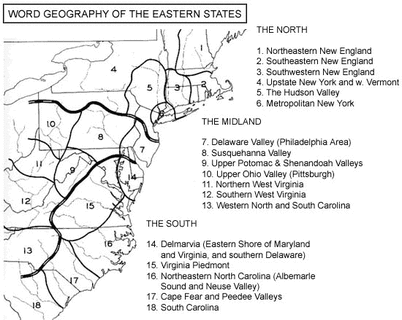
It is a fairly automatic fantasy in folk linguistics, when something occurs both in England and in some rural area of the original 13 Colonies to leap to the conclusion that the word has come down on parallel tracks from some 17th C origin. These sometimes prove out in nonstandard verb tenses, such as swum or heered, but such parallelisms are rarer for nouns and adjectives. And it is almost inconceivable for slang, which changes at a far faster rate than standard speech. Slang is tightly bound up in the social solidarity of generations, and with wittiness, which requires a certain novelty.
Once one has even thought to question whether the conventional wisdom about anything is true, all previously-known data is seen in a new light. I have long accepted the CW that "wicked" as a simple intensifier has a long lineage in New England, especially in Boston and Maine. But my inability to illustrate that causes me to reverse field, and relook at the data I already had.

So, Marshall Dodge doesn't use it.
We did a comic bit about old Yankees when I was at a summer program in 1970 that drew highschoolers from all over the state, and "wicked" never figured in it. Many used it as their own slang - wicked fast, wicked late - but not attributed to old codgers. Nor did it appear in a paper I did in college for History of the English Language about the Eastern New England Dialect. I don't have a personal copy of Hans Kurath, but I would have read it in entirety then - no wickeds anywhere. Kurath published in 1939.
Mrs. Clark, who founded my son's Christian school, did not allow her children (who are my age) to use "wicked" as an intensifier. This is unlikely to be the case for slang one grows up with unless it is quite vulgar, and even less likely for words one grew up hearing adults use. To discourage slang in general is one thing, but drawing a line to resist the moral deterioration of a synonym for evil being used neutrally is more likely when the term first appears on the stage.
I don't recall adults using it when I was a child. It was used by people older than I, but not a generation older. My own family avoided slang anyway, and may not be a good example - but when you grow up and live in the same place, you have a wide variety of acquaintances, from lowlife to elegant, and my parents had both. I don't think I heard any of them use "wicked." It was kid slang. People need to ask their old Yankee parents about this, I think.
I don't believe I ever heard the phrase "wicked good" until I heard Tim Sample use it in the 1980's. I took his word for it that Maine'ah's traditionally said it, and it seemed a natural extension of the usage I had grown up with. Certainly, it would persist because of the irony once coined and spread rapidly, but that doesn't imply it would have been common five years before.
But I don't think it has a long history. I think "wicked" as an intensifier is postwar. And "wicked good," advertised as a charming ruralism of old salts and venerable backwoodsmen, is more recent still. Those salts may be old now, in 2010, but they didn't learn that phrasing from their own grandfathers. They learned it on the school playground in the 1940's.
Update: Sponge-headed Scienceman wrote to Tim Sample and got this reply. I don't know that it helps much, but it's interesting.
Hi Dennis,
Thanks for your email. I was born in northern Aroostook County in 1951 and grew up on the coast. I did in fact hear the word "wicked" used quite frequently both as a modifier ( wicked good, wicked cold, etc. ) and an exclamation ie; Wicked! , a term used not unlike how Awesome! would be used today. So it goes back at least to coastal Maine the 1950's based on my first hand my experience. I've also noted an interesting linguistic phenomenon in that the only other place I hear and see the word used as it is in Maine is in the Caribbean islands I've visited. Here's an unscientific guess about that. I think that the true origins of wicked are likely to be found ( like so many other shards of New England dialect ) in the British Isles. 18th and 19th Century British traders did a brisk business in that part of the world and there were major trade routes between the Maine coast and Puerto Rico in the age of sail. Who knows but that's my guess.
All my best,
Tim Sample