The flexible nature of Ventura's rant (which Texan99 emphasises) is curious. One can imagine it coming from a fringe player of half-a-dozen groups, all over the American spectrum - including some from history. "Elites" are pushing us around, making money, and rubbing our noses in it - and this seems a moderately common idea, however the targets vary.
This seems related to my earlier observation that a belief in a conspiracy precedes identifying its members. (No search reveals this here. I make the observation on other sites frequently, but have apparently not mentioned it here. Huh.)
So the paranoid tendency about hidden forces controlling us and ruining everything may pre-exist targets, and the resentful tendency about open, flaunting forces controlling us and ruining everything may also be a personality trait.
Are there other political tendencies that are factory-installed, waiting only to imprint on some random local condition? There are people who seem congenitally determined to reject both sides of a conflict and seek a compromise. That's often a wise approach, and gene pool likely needs a fair number of those to keep us off each others' throats, but it does have its own weaknesses - eventually you are attempting to get Jesus and the Pharisees to sit down together and talk it out, and listen to each others' POV. (and Jesus would appreciate the reminder, right? Blessed are the peacemakers and all that? He'd thank you later.)
The disquieting thought, of course, is that all of our political and social beliefs are just local variants of relatively few genetically-acquired outlooks. I suspect all base types might be necessary for a tribe to survive over time. I'd be curious if the American immigration populations - which would bear some similarity to Canadian, Australian, and other settler groups - has different proportions to those who stayed home, and if the involuntary immigrants (slaves, transported criminals) were a third mix.
Readers are encouraged to speculate wildly on this one, without regard to whether there is solid evidence to back up their new favorite theory.
Saturday, April 30, 2011


Friday, April 29, 2011
My Uncle Again
Uncle Dave sent along a recent rant purportedly by Jesse Ventura. I thought he was sending it as an example of how insane the right-wing and Tea Party are, and I thought it sounded bogus. Searching the web I can see it attributed to Jesse, but it has the ring of someone else's rant, with Ventura's name tacked onto it.
Doesn't matter, really. When I dismissed it as insane...well I'll quote the email directly:
You who, even approximately, is this "you" he is speaking about? control our world. No, no one does. Power is diffuse.
You’ve poisoned the air we breathe, and yet Jesse lives and prospers, Funny.
contaminated the water we drink, is he talking about 1973 or something? What water? Where? Draining aquifers is the problem he should worry about
and copyrighted the food we eat. As opposed to breeds of cattle or tomatoes for the last two centuries? General Mills? Nestle? Or does he mean genetically-modified foods? What's his objection to them, other than some gut sense that they shouldn't be...well, I can't tell exactly. What the hell is he thinking is wrong? Is it 1999 again?
We fight in your wars Who? I'm still not getting it. Afghanistan and Iraq were popular wars at first - you could make a good case that the politicians fought them because the people demanded it, then they got unpopular after three years, as wars always do. If you mean Libya, I might agree.
die for your causes what causes does he mean? Whether one thinks the wars were about punishing bad guys, bringing long-term peace to the ME, or just grabbing some oil, those are pretty popular causes with Americans. I'd question the methods long before the causes. Those are pretty good causes. As wars go, those are way better than average reasons.
and sacrifice our freedoms to protect you. What freedoms were sacrificed? Airport searches, I'll grant. But the worrisome surveillance issues stem aren't particularly war-related. Yet who got protected?
You’ve liquidated our savings, OK, he must mean the government here, then, not businesses or the wealthy. Whatever else you might say about Walmart or GE or Microsoft, they haven't liquidated savings. And I'd say "eroded," not liquidated, anyway.
Hey, if this is the government that he has been talking about, then maybe Jesse and I have some common ground!
destroyed our middle class when did this happen? I must've missed it on the news, is it 1933 again?
and used our tax dollars to bailout your unending greed No we bailed out unending stupidity and I'm not sure who benefited, except unions and a lot of folks in government.
We are slaves to your corporations I pick Disney, then. I'll be their slave. Or Apple.
zombies to your airwaves okay, that one is starting to sound like my paranoid schizophrenic patients,
servants to your decadence. I'm trying to think what particular decadence I am enabling this year. Unless it's 1913 he's talking about. Is he channeling William Jennings Bryan?
You’ve stolen our elections - okay, that's the Democrats, but even I don't think they've stolen a lot of them. Maybe a handful,
assassinated our leaders - The 1960's? Is that the answer to the puzzle?,
and abolished our basic rights as human beings. And yet no one has locked Jesse up, despite his being insane. And I ate the dinner I liked, and sit typing at a computer.
You own our property So it's banks that are the problem, maybe,
shipped away our jobs, and shredded our unions See auto bailouts, above. And union member are about the only group with pensions now.
You’ve profited off of disaster Someone made money on....Katrina? Gulf Oil Spill? Or Japan? Or the tornadoes? I think those were pretty much all loss. Hiram does make some overtime whenever we have a blizzard, but we don't begrudge him that, he works hard for it
destabilized our currencies more than one? Maybe it is Bryan and the Free Silver party he's channeling,
and raised our cost of living. Only if he means government.
You’ve monopolized our freedom I have no idea what that means,
stripped away our education, Naw, the kids pretty much do that on their own
Everyone get ready to block those clustered metaphors...
and have almost extinguished our flame . We are hit… we are bleeding… but we ain’t got time to bleed. We will bring the giants to their knees and you will witness our revolution!
Doesn't matter, really. When I dismissed it as insane...well I'll quote the email directly:
AVI: Did he really write this? I can't find that it's an urban legend, but it smells odd.So I took the bait, and fisked the entire Ventura essay. Hope you have fun.
UncaDave: Yeah It does smell odd But so what
More often than not. you focus on the author
But not on what he says What difference does it make who writes? Even the marginals like Ventura (or his ghost writer ) may say something worthwhile
In which particular do you disagree with him?
AVI: Good heavens! All of it. It's insane. He talks about vague poisoners and robbers, calls them elites, and everyone can fill in the blanks with their own enemies. He's some guy they put away in a home, muttering about the commies, or the corporatists, or the jews. (For confirmation, look at the comments at the link.)
UncaDave: A continuance of attacking the author and ducking what he says
You who, even approximately, is this "you" he is speaking about? control our world. No, no one does. Power is diffuse.
You’ve poisoned the air we breathe, and yet Jesse lives and prospers, Funny.
contaminated the water we drink, is he talking about 1973 or something? What water? Where? Draining aquifers is the problem he should worry about
and copyrighted the food we eat. As opposed to breeds of cattle or tomatoes for the last two centuries? General Mills? Nestle? Or does he mean genetically-modified foods? What's his objection to them, other than some gut sense that they shouldn't be...well, I can't tell exactly. What the hell is he thinking is wrong? Is it 1999 again?
We fight in your wars Who? I'm still not getting it. Afghanistan and Iraq were popular wars at first - you could make a good case that the politicians fought them because the people demanded it, then they got unpopular after three years, as wars always do. If you mean Libya, I might agree.
die for your causes what causes does he mean? Whether one thinks the wars were about punishing bad guys, bringing long-term peace to the ME, or just grabbing some oil, those are pretty popular causes with Americans. I'd question the methods long before the causes. Those are pretty good causes. As wars go, those are way better than average reasons.
and sacrifice our freedoms to protect you. What freedoms were sacrificed? Airport searches, I'll grant. But the worrisome surveillance issues stem aren't particularly war-related. Yet who got protected?
You’ve liquidated our savings, OK, he must mean the government here, then, not businesses or the wealthy. Whatever else you might say about Walmart or GE or Microsoft, they haven't liquidated savings. And I'd say "eroded," not liquidated, anyway.
Hey, if this is the government that he has been talking about, then maybe Jesse and I have some common ground!
destroyed our middle class when did this happen? I must've missed it on the news, is it 1933 again?
and used our tax dollars to bailout your unending greed No we bailed out unending stupidity and I'm not sure who benefited, except unions and a lot of folks in government.
We are slaves to your corporations I pick Disney, then. I'll be their slave. Or Apple.
zombies to your airwaves okay, that one is starting to sound like my paranoid schizophrenic patients,
servants to your decadence. I'm trying to think what particular decadence I am enabling this year. Unless it's 1913 he's talking about. Is he channeling William Jennings Bryan?
You’ve stolen our elections - okay, that's the Democrats, but even I don't think they've stolen a lot of them. Maybe a handful,
assassinated our leaders - The 1960's? Is that the answer to the puzzle?,
and abolished our basic rights as human beings. And yet no one has locked Jesse up, despite his being insane. And I ate the dinner I liked, and sit typing at a computer.
You own our property So it's banks that are the problem, maybe,
shipped away our jobs, and shredded our unions See auto bailouts, above. And union member are about the only group with pensions now.
You’ve profited off of disaster Someone made money on....Katrina? Gulf Oil Spill? Or Japan? Or the tornadoes? I think those were pretty much all loss. Hiram does make some overtime whenever we have a blizzard, but we don't begrudge him that, he works hard for it
destabilized our currencies more than one? Maybe it is Bryan and the Free Silver party he's channeling,
and raised our cost of living. Only if he means government.
You’ve monopolized our freedom I have no idea what that means,
stripped away our education, Naw, the kids pretty much do that on their own
Everyone get ready to block those clustered metaphors...
and have almost extinguished our flame . We are hit… we are bleeding… but we ain’t got time to bleed. We will bring the giants to their knees and you will witness our revolution!
That IQ Research
I am sure that Steve Sailer is more thorough and more clever in reviewing the IQ research reported yesterday, but I am disciplining myself to do this without assistance.
The quote at the end of the article tells you what you need to know about the rest of the research. This is where she wanted to go all along:
I have little doubt that the study tells us a little something, but not quite what Duckworth thinks. That motivation influences scores is rather obvious, but perhaps it does need to be studied and teased apart a bit. Here's the thing: high motivation doesn't raise one's score much, but low motivation can certainly depress it. Thus, when the films are reviewed for sign of ebbing interest, they are picking up the losses. If one transfers thinking about this over to athletics, my statement about motivation becomes clearer. A good athlete, with training, he might cut as much as minute off his time in the mile run. If motivated by a coach, a drill instructor, a competitor, or a corny movie, might cut 10, 20 seconds off his best time during that training, especially at the beginning. And that's it.
But a less good athlete can lose a lot more than a minute by being unmotivated. He can slow to a jog, or even a walk, completing the task only for politeness or because others are yelling. In fact, it will usually be the less good athletes who do this, and the poor athletes most of all. The bad singers will get quieter, try to turn invisible, not show for practice. Unskilled artists will try to just get out with a dashed-off sketch. People like succeeding at things, and so keep doing things they are good at. Things they aren't good at, they will focus on less, unless there is some other draw - social, monetary, guilt.
This is surprising? Is this the great new knowledge in understanding IQ scores, that the kids with 120 IQ and above will fight for every point, while the kids at 85 may blow off subtests they are particularly bad at and drop to 81?
It seems a strawman that Duckworth is arguing against, that there were people who viewed IQ tests like a Sorting Hat, a smart-o-meter that reads your brain wand the dial hits a number installed at birth? Has she met such folks? There are people who take the stability of IQ more seriously, much more seriously, than Duckworth does, and have evidence to back it up. She hasn't dented their view with this.
The quote at the end of the article tells you what you need to know about the rest of the research. This is where she wanted to go all along:
Instead of limiting ourselves to narrow standardized tests, we might seek as well directly to assess motivation as well as creativity, practical skills, wisdom, and even ethics. If we did, we might find our society advancing to levels of economic productivity and, for that matter, well-being that we previously believed to be out of reach.Yes, and boo'ful kitties as well.
I have little doubt that the study tells us a little something, but not quite what Duckworth thinks. That motivation influences scores is rather obvious, but perhaps it does need to be studied and teased apart a bit. Here's the thing: high motivation doesn't raise one's score much, but low motivation can certainly depress it. Thus, when the films are reviewed for sign of ebbing interest, they are picking up the losses. If one transfers thinking about this over to athletics, my statement about motivation becomes clearer. A good athlete, with training, he might cut as much as minute off his time in the mile run. If motivated by a coach, a drill instructor, a competitor, or a corny movie, might cut 10, 20 seconds off his best time during that training, especially at the beginning. And that's it.
But a less good athlete can lose a lot more than a minute by being unmotivated. He can slow to a jog, or even a walk, completing the task only for politeness or because others are yelling. In fact, it will usually be the less good athletes who do this, and the poor athletes most of all. The bad singers will get quieter, try to turn invisible, not show for practice. Unskilled artists will try to just get out with a dashed-off sketch. People like succeeding at things, and so keep doing things they are good at. Things they aren't good at, they will focus on less, unless there is some other draw - social, monetary, guilt.
This is surprising? Is this the great new knowledge in understanding IQ scores, that the kids with 120 IQ and above will fight for every point, while the kids at 85 may blow off subtests they are particularly bad at and drop to 81?
It seems a strawman that Duckworth is arguing against, that there were people who viewed IQ tests like a Sorting Hat, a smart-o-meter that reads your brain wand the dial hits a number installed at birth? Has she met such folks? There are people who take the stability of IQ more seriously, much more seriously, than Duckworth does, and have evidence to back it up. She hasn't dented their view with this.
Thursday, April 28, 2011
Draft
The Carolina Panthers drafted Cam Newton with the first pick. Which is why they will always be the Carolina Panthers.
Wide World Of Sports
ESPN is doing the 50th anniversary of WWOS. The 1978 anniversary show has more meaning for me, because we got rid of our TV shortly after that, and I seldom saw it again. (For some reason this is labeled a Silver Anniversary show. It isn't.)
There is an odd moment late in the video, where you will do a double-take, until you remember Oh yeah, it's 1978. Weird.
Cliff-diving in Acapulco. Wrist-wrestling in Petaluma. Lots of Track and Field, lots of swimming and diving. Boxing, skating. I loved it. Looking at the partial list of events, it suddenly picks up for me in 1966, when I remember details about half the events as I see them listed. But there is usually only one event per episode, and there were usually 2-3 each week. I'm guessing that 1966 is the year my mother stopped insisting that I go outside and play rather than sit inside and watch TV.
For a lot of these sports, it was enough to have seen them once, or perhaps once a year. But for a reader such as I, it was fascinating to have only read about such things as rugby or sailing, and then get to watch them. That seems almost unbelievable to me now, but there it is. Track meets or tennis only came on when someone at a Big Three network put them on, and that mostly meant ABC. Libraries didn't have them, you couldn't rent them, and only wealthy athletic departments would have films.
Wednesday, April 27, 2011
Game 7
I'm not a hockey fan, but it is nice to turn on the radio while heading down to Cumby's and hear them win Game 7 in overtime within thirty seconds of my starting to listen. That's a nice, efficient way to be a sports fan.
Cow Hampshire
I found a charming NH history site while looking for something else. Cow Hampshire. Like many other insulting *nicknames, "Cow Hampshire" has been embraced by natives as a badge of honor instead - perhaps because it is mostly Marsschoositts folk who call us that, and we like being unperturbed by them gen'rally. Why, after all, would Maine or Vermont call us "Cow Hampshire," except perhaps as a Hail, fellow! Well met! greeting? But there are subtleties within, as there often are in ongoing PR battles. Cow Hampshire purports to embrace the rural, unsophisticated nature we are supposed to have (and believe me, there are places where it is absolutely true. There are entire towns which seem to survive on an economy of sharpening each others' saws.), but there is a bit of further mahketin' going on as well. The SE section of NH is essentially Manchester, Nashua, and suburbs of Boston. It kills us to admit that, but it's just true.

So we dig in our heels a bit to insist that we are not suburban Boston, but a pristine rural state with lots of wildlife,
farms.

and wilderness,
 So that tourists will come.

We've been doing this for a long time, actually.

Ambivalent reality: the Lakes Region (blue gray)

has a lot of Massachusetts people in the summer - other states too, but MA predominates. All of them think they are practically natives. It is in our interest to let them keep thinking that, but in reality, only a few do.
At any rate, Cow Hampshire, the blog. The first recorded use of the word cocktail was in NH. The speculation is that it comes from horse-racing, referring to a horse that is not a thoroughbred, and thus "mixed." Could be.
So we dig in our heels a bit to insist that we are not suburban Boston, but a pristine rural state with lots of wildlife,
farms.
and wilderness,
So that tourists will come. We've been doing this for a long time, actually.
Ambivalent reality: the Lakes Region (blue gray)
has a lot of Massachusetts people in the summer - other states too, but MA predominates. All of them think they are practically natives. It is in our interest to let them keep thinking that, but in reality, only a few do.
At any rate, Cow Hampshire, the blog. The first recorded use of the word cocktail was in NH. The speculation is that it comes from horse-racing, referring to a horse that is not a thoroughbred, and thus "mixed." Could be.
Tuesday, April 26, 2011
Art and Ideas
The more I see the more I doubt whether people ever really make aesthetic judgments at all. Everything is judged on political grounds which are then given an aesthetic disguise.George Orwell
There is a quote by Lewis, but I have given up on finding it, that even if one could write like (Thomas) Traherne, one wouldn't be allowed to, because every dictate of style is in fact a directive of what one may write about. Something similar to Orwell's idea there.
People will say they admire a work of art because it was done well, even though they disagree with its message. That is far less possible for me than it is for others. I suppose one can admire skill most easily in one's own field, so that one trained in classic ballet can be impressed by a Martha Graham troupe even while finding it infuriating, or a playwright enjoy well-written dialogue in a play advocating virtues opposing his own. But even in arts that I know something about I do not find such an adjustment easy. If the theme the artist is putting forth is one I hate, root and branch, I cannot enter in to admire it.*
My view is the more common, far more common, in all cultures until recently. Art for it's own sake, art as something noble in itself rather than as a vehicle for real virtues, would not have been a meaningful concept for most of our ancestors. Once we grasp that, we see Orwell's and Lewis's words in a different light. To value artistic skill regardless of the use to which it is put is not a neutral vision of art and skill, but a very emphatic statement about them. It is a claim that we should value artistic skill more than our faith, or our philosophies, that it has a claim of virtue all its own.
So also with other ideas that have been elevated over the last few centuries. We consider it a good thing to be open-minded, and to have an exchange of ideas. Maybe so, but Jesus didn't seem to think so. His aim, and that of his immediate followers, was to tell things, not learn what their ideas were and affirm them. We may imagine that Jesus would be different in 21st C America, but I think imagination would be our only basis for thinking so.
*I don't have to like all aspects of it. I get more out of hip-hop than most people my age, even though I find much of it musically appalling, because it at least has more narrative than most other popular music, which since the 50's has often been based on a single thought repeated endlessly (Hey Jude, supposedly one of the great pop-rock anthems, for example). Even the objectionable parts can be values conflicts based around other recognisable values, rather than the mere negation of virtues or complete narcissism of much popular music. Sometimes I don't much care if the music is particularly skilled or not, so long as it has quiddity - that it exemplifies peasant folk dance or operatic solo or Western Swing fairly well.
Posterity
Visiting at James's site (his most recent is about eliminating malaria in way he fears may be too cleaver by half, but expresses some hope), he has a very short post farther down
Not that it never works. There have certainly been infrastructure investments that have paid off a hundredfold. However, we have a skewed view of these, as we are seeing them only in retrospect, no longer aware of the grand plans that didn't work and slipped beneath the waves. It's one of those ideas that works well enough to persist, even though it may be an overall loss. It certainly seems to be a net loss, with neither the present nor the future generation benefiting.
When it's borrowed money, it's not our sacrifice at all, and it is deeply dishonest for politicians to say so. It is money borrowed from the future to be spent on the present.
Christianity, and most cultures, give some thought to posterity, but not like this. The focus on actual people, rather than hypothetical ones, is much stronger before the 20th C.
If a proposal promises $$BIG in savings but postpones serious cuts to some other year, that proposal is a lie.The 20th C was in general the period where we accepted the idea of people currently living paying an enormous cost for the sake of those who come after. Not only the utopian schemes of communist, national socialists, and their watered-down cousins, but neoconservative hopes of peace in the Middle East, and the whole idea of deficit spending reflects this. We used to sell education at town meeting with the idea that those were of school age now needed it. Now it is a federal idea, and we "invest" in education for the economic benefit of those who will come after. Environmentalism is now suffused with the idea. It was originally marketed as a way to clean things up for our own use now. As James noted, it doesn't seem to work that well. I wonder if people with fewer or no children fall for this line of reasoning more easily.
Not that it never works. There have certainly been infrastructure investments that have paid off a hundredfold. However, we have a skewed view of these, as we are seeing them only in retrospect, no longer aware of the grand plans that didn't work and slipped beneath the waves. It's one of those ideas that works well enough to persist, even though it may be an overall loss. It certainly seems to be a net loss, with neither the present nor the future generation benefiting.
When it's borrowed money, it's not our sacrifice at all, and it is deeply dishonest for politicians to say so. It is money borrowed from the future to be spent on the present.
Christianity, and most cultures, give some thought to posterity, but not like this. The focus on actual people, rather than hypothetical ones, is much stronger before the 20th C.
Monday, April 25, 2011
No Oil For Pacifists
For those who like their economics-blogging current and well-researched, I will note that Carl is on a roll this week at No Oil For Pacifists. He covers other subjects as well, but this has been economics week. Pick a few. Go beyond slogans. Smarten up, you slackers!
Obama's Mistaken Medicare Math
A Tipping Point On Receiving From Government
Corporate Tax Rates and Revenue
Tax Year 2000, Tax Year 2008
Liberal Economics Of The Day
Multi-employer Pension Plans - Something new to worry about.
Charts Of The Day - Regulation
Chart Of The Day - Green lobby outspends industry lobbies.
The Death of Federalism
May We Believe Our Thoughts? Part IV
You can read or listen to folks who claim that altruism doesn’t exist, because we get something back for all those good acts, such as enhanced reputation or a good feeling about ourselves. They seem to believe they have undermined the whole idea because no one can find an example of the Platonic Ideal of altruism on this earth. (Are Randians particularly prone to this line of argument, or has that just been my random experience?)
I consider the answer straightforward. We are all aware of times when we are less altruistic and more self-serving. This is not merely a matter of perception, because examining our motives can push the dial in either direction, no matter how deeply we dig. It then follows, as the night the day, that there are times when we more altruistic. It exists, and the lack of a pure example is irrelevant.
So too with the freedom of our will. It may turn out that our wills are only 10% free, or 1%, or 0.1%. But we are aware of instances when we are more compelled. Thus there are instances in which we are less compelled. I very much doubt, as with altruism, that there is any human action which is entirely free. I think we just like the idea of an entirely free will, an entirely altruistic person, or within the frame that “nobody’s perfect” we think of a “real” free will as being 95% free, a “real” altruistic act as being 95% selfless. Which is perhaps why we react so badly when evidence of even a few points’ loss from our total is brought to our attention. That we got snookered on that mail-order flower pot might be evidence that we fall below the 95% free designation. Our view of ourselves as free, rather than easily led persons is imperiled. Preachers who warn us that getting compliments is one way of getting paid back in this world make us uncomfortable, because if we drop below 90% altruistic, we go into the outer darkness of being a selfish person. There’s not much cushion, if that’s our mental picture.
Maybe we’ve been starting from the wrong end all along. Maybe humans never get above 5% altruistic, or 5% free. When we read the scriptures that way, our impression of what is being said changes, but I don’t know that we actually encounter contradictions. I admit, it looks at first like we’re going to encounter massive disconnects. But a lot of that is going to turn out to be feelings.
*************
We like certainty from our leaders, and apparently our prophets as well. Perhaps we shouldn't hold it against them, because that confidence appears to be part of their jobs, but it is a bit disquieting, in terms of our references to Dunning-Kruger, to read this account of our two most recent presidents. I haven't read Bush's memoir, perhaps he lets go of more there, and perhaps Obama will when he is out of office. I don't think Clinton's did, however. Paul Ehrlich isn't the only secular prophet to be wrong repeatedly, but certainty seems to keep them in business. Watership Down fans will remember that the Threarah said something similar about lapin prophets - being wrong seemed to actually increase their credibility somehow. Dictators seem the most certain of all, which should give us pause.
(Note on Ehrlich: He was one of my reasons for quitting the Prometheus Society decades ago. However he qualified, he became a member, and other members rather fawned on him. It was hard to get people to notice that he had been dead wrong repeatedly. This among a crowd of supposedly elite intelligences.)
I wonder if being social sure decreases/increases the ability to be insightful, or if it is unrelated. I would think it increases insight, because it shows the existence of at least one field where accurate information can get in. But not sure that it actually is. I know of no data. Thoughts?
And why should it happen at all? Chicken & egg. Do those who have no receptive feedback abilities get worse at things? That could be. Do those who are not skilled fail to develop evaluative knowledge? What is the mechanism whereby it gets worse? With a denial model, it would seem increasingly painful to contemplate reality, and thus a powerful disincentive to insight. Yet anosognosia in increasingly being seen in terms of brain injury/underperformance of brain areas/physical inability.
Looking for models here.
Tangential, but I think deeply related to the entire discussion. Children develop fears, and children in religious households develop religious fears. As adults they may blame the religion for causing the fears, which is a natural conclusion (correlation) but not a correct one (causality). Evangelical friends who had grown up Catholic described their own (Catholic-tinged) fears growing up, and had been surprised at hearing about their adult children's morbid fears when young of not being saved. (What if I didn't say the sinner's prayer quite right? What if my parents didn't teach it to me quite right?) I remember this being very painful for my son Ben, and significantly, the calming answer may have worked precisely because it contained just enough uncertainty to be believable. He had encountered Augustine's answer to the morbid fear of whether one was saved: "If you want to be, you probably are." It rings true, and rings truer than all the fundies shouting at you to have confidence in your salvation, confidence in the scriptures, confidence in God.

There is a similar moment in the Xanth novels when Grundy the Golem, a built creature of wood animated by magic, works for the Good Magician Humphrey for a year to get a single question answered: Do I have a soul? When the year is up, Humphrey gives the answer in a form that contains not only assurance, but the seeds of further assurance: Only those with souls care about the answer.
Next, on to the research and philosophical questions of whether anything we think may be trusted, or whether it is all epiphenomenon, a set of narratives that we must have because that is how our brains work.
I consider the answer straightforward. We are all aware of times when we are less altruistic and more self-serving. This is not merely a matter of perception, because examining our motives can push the dial in either direction, no matter how deeply we dig. It then follows, as the night the day, that there are times when we more altruistic. It exists, and the lack of a pure example is irrelevant.
So too with the freedom of our will. It may turn out that our wills are only 10% free, or 1%, or 0.1%. But we are aware of instances when we are more compelled. Thus there are instances in which we are less compelled. I very much doubt, as with altruism, that there is any human action which is entirely free. I think we just like the idea of an entirely free will, an entirely altruistic person, or within the frame that “nobody’s perfect” we think of a “real” free will as being 95% free, a “real” altruistic act as being 95% selfless. Which is perhaps why we react so badly when evidence of even a few points’ loss from our total is brought to our attention. That we got snookered on that mail-order flower pot might be evidence that we fall below the 95% free designation. Our view of ourselves as free, rather than easily led persons is imperiled. Preachers who warn us that getting compliments is one way of getting paid back in this world make us uncomfortable, because if we drop below 90% altruistic, we go into the outer darkness of being a selfish person. There’s not much cushion, if that’s our mental picture.
Maybe we’ve been starting from the wrong end all along. Maybe humans never get above 5% altruistic, or 5% free. When we read the scriptures that way, our impression of what is being said changes, but I don’t know that we actually encounter contradictions. I admit, it looks at first like we’re going to encounter massive disconnects. But a lot of that is going to turn out to be feelings.
*************
We like certainty from our leaders, and apparently our prophets as well. Perhaps we shouldn't hold it against them, because that confidence appears to be part of their jobs, but it is a bit disquieting, in terms of our references to Dunning-Kruger, to read this account of our two most recent presidents. I haven't read Bush's memoir, perhaps he lets go of more there, and perhaps Obama will when he is out of office. I don't think Clinton's did, however. Paul Ehrlich isn't the only secular prophet to be wrong repeatedly, but certainty seems to keep them in business. Watership Down fans will remember that the Threarah said something similar about lapin prophets - being wrong seemed to actually increase their credibility somehow. Dictators seem the most certain of all, which should give us pause.
(Note on Ehrlich: He was one of my reasons for quitting the Prometheus Society decades ago. However he qualified, he became a member, and other members rather fawned on him. It was hard to get people to notice that he had been dead wrong repeatedly. This among a crowd of supposedly elite intelligences.)
I wonder if being social sure decreases/increases the ability to be insightful, or if it is unrelated. I would think it increases insight, because it shows the existence of at least one field where accurate information can get in. But not sure that it actually is. I know of no data. Thoughts?
And why should it happen at all? Chicken & egg. Do those who have no receptive feedback abilities get worse at things? That could be. Do those who are not skilled fail to develop evaluative knowledge? What is the mechanism whereby it gets worse? With a denial model, it would seem increasingly painful to contemplate reality, and thus a powerful disincentive to insight. Yet anosognosia in increasingly being seen in terms of brain injury/underperformance of brain areas/physical inability.
Looking for models here.
Tangential, but I think deeply related to the entire discussion. Children develop fears, and children in religious households develop religious fears. As adults they may blame the religion for causing the fears, which is a natural conclusion (correlation) but not a correct one (causality). Evangelical friends who had grown up Catholic described their own (Catholic-tinged) fears growing up, and had been surprised at hearing about their adult children's morbid fears when young of not being saved. (What if I didn't say the sinner's prayer quite right? What if my parents didn't teach it to me quite right?) I remember this being very painful for my son Ben, and significantly, the calming answer may have worked precisely because it contained just enough uncertainty to be believable. He had encountered Augustine's answer to the morbid fear of whether one was saved: "If you want to be, you probably are." It rings true, and rings truer than all the fundies shouting at you to have confidence in your salvation, confidence in the scriptures, confidence in God.
There is a similar moment in the Xanth novels when Grundy the Golem, a built creature of wood animated by magic, works for the Good Magician Humphrey for a year to get a single question answered: Do I have a soul? When the year is up, Humphrey gives the answer in a form that contains not only assurance, but the seeds of further assurance: Only those with souls care about the answer.
Next, on to the research and philosophical questions of whether anything we think may be trusted, or whether it is all epiphenomenon, a set of narratives that we must have because that is how our brains work.
Pictures
Photographers see different pictures than the rest of us. Such as here. Not as different as artists, but still...
Saturday, April 23, 2011
May We Believe Our Thoughts? Part III
I am going at the easy cases of free will at first, because I think they are ultimately more powerful in our imagination than the philosophical arguments. Our worrying starts at these perceived threats to our free will, because we jump quickly to deeper worries that all our decisions might be suspect. We do not quite think “If advertising can make me buy a $200 camera I didn’t need, can it be that I have been a libertarian or a Presbyterian all these years for reasons that are little better?” Yet such worries rumble around in our brains unspoken or unacknowledged. And as we encounter these small assaults on our impression of free choice far more frequently, I think they have the greater cumulative effect. We keep getting reminded that our wills are not entirely free. We fear if we dig to the bottom we will discover that none of it is. So we don’t go at all.
But I do. There are flocks of us who started in mathematics and mentally reverse the sign, or ask what would happen if there were 50,000 geese on the island instead of 5. As Readers of Chesterton and Lewis are familiar with this – Lewis noted in his Introduction to the Psalms that the harder questions are more likely to be bush the game is hiding behind. Engineers find advantages to thinking this way, as do attorneys, and likely a dozen other professions.
*************
We read constantly about how forces we do not suspect are making our decisions for us. Here’s a fun list. Upbeat music or the smell of lemon makes us work harder, for example. Supermarkets arrange their goods so that we buy more stuff, and more expensive stuff. We had discussion here a month ago about the phenomenon of “game,” of men who believe that can artificially push certain buttons to get women to have sex with them. Accusation and counter-accusation is made throughout politics that voters are being manipulated into believing something is true or some candidate is competent. We keep track of religious groups for evidence of cultlike behavior, manipulating people who have vulnerabilities via methods that bypass their judgement and reason. Even in milder form, we are are suspicious of emotional appeals to religion as unfair somehow (I understand that feeling, but have concluded over the years that people who make unemotional appeals to religion – folks like me – are perhaps farther from reality and subtly more dangerous). One of the main themes of this blog – it was a favorite topic of CS Lewis - has been the social pressures that get us to adopt entire philosophies. Advertisers – those sneaky unscrupulous advertisers – well my goodness, they talk us into just everything! They make us buy cars we don’t need, they make kids fat, make us go into debt…and don’t even get me started on puppies, kitties, and big-eyed children.
We believe we think, but may only react.
Hold on a minute, here. Step back from the ledge a moment. Advertisers may spend millions trying to sway us from Coke to Pepsi, but if they spent that much flogging Dr. Pepper, would it be a serious competitor? Store brands of cola, whose only advertising is lower price, also get sold. If you don’t have a product that people want, all the advertising in the world won’t get sales for you.

It used to be rather a joke that the “Best TV Commercial” of every year often didn’t increase sales. Advertising does not make us do things, it only influences us. Changing the lighting or the temperature of the room may increase our productivity, our sales, or our chances for having sex in the next hour, but in none of these cases will it make a silk purse out of a sow’s ear.
One could define all art as manipulation if we wanted to take that attitude – even elegant, high cultural art. Does opera not rely on musical tricks of timing and tone, tricks for the eye to point our emotions in a set direction, tricks of plot that artificially create tension and resolution to sell us an idea? Or might we just call that “good writing” instead? We could define all sales as manipulation if we wished – and where does “sales” leave off and “producing food” pick up, really - or we could call it wealth increase, as both parties ended up with something they wanted more. Is raising children a manipulation? We could make it appear so, by highlighting certain features and suppressing others. Is perfume a manipulation? Is cleanliness?
One of our survival skills for the last 10,000 (or perhaps 100,000) years is to avoid being taken in, so we are ever-alert for those who we think are pulling a fast one on us. We repeat those stories throughout the hive, our antennae are up, we pride ourselves on being the first to recognise that ant is an invader…there’s something wrong with that mash.

Most humans have lived in situations of high competition for scarce resources, where small advantages and disadvantages can have life-or-death consequences. We naturally live in a mentality that overreacts to the discovery of trickery. 5% manipulation, once discovered, feels like 50% to us. But try and decide who is manipulating who in a strip joint, or a graduate school admission interview – or in a worship service. In all cases there are not only the direct participants, but many others who are not present, yet might have been, who have “manipulated” the behavior of those in the room in some sense. If you want to you can see all of existence this way, down to the tricking of your own body by how you feed it and shelter it.
Intentional repeat: I am going at the easy cases of free will at first, because I think they are ultimately more powerful in our imagination than the philosophical arguments. Our worrying starts at these perceived threats to our free will, because we jump quickly to deeper worries that all our decisions might be suspect. We do not quite think “If advertising can make me buy a $200 camera I didn’t need, can it be that I have been a libertarian or a Presbyterian* all these years for reasons that are little better?” Yet such worries rumble around in our brains unspoken or unacknowledged. And as we encounter these small assaults on our impression of free choice far more frequently, I think they have the greater cumulative effect. We keep getting reminded that our wills are not entirely free. We fear if we dig to the bottom we will discover that none of it is. So we don’t go at all.
*I will note in passing that I did not include atheists in that list because it’s just useless. There is at least a subset of them which believes they are the only group that this doesn’t apply to, because they have found the one place of no assumptions, and it’s all the rest of us who have to be alert. I will come back to this in a later discussion of whether certain creeds encourage this lack of insight, or whether it is just personality factors, distributed randomly across the creeds. I’m going to answer “both” to that, but atheism isn’t the only group I’m going to try and pin that tail on.
But I do. There are flocks of us who started in mathematics and mentally reverse the sign, or ask what would happen if there were 50,000 geese on the island instead of 5. As Readers of Chesterton and Lewis are familiar with this – Lewis noted in his Introduction to the Psalms that the harder questions are more likely to be bush the game is hiding behind. Engineers find advantages to thinking this way, as do attorneys, and likely a dozen other professions.
*************
We read constantly about how forces we do not suspect are making our decisions for us. Here’s a fun list. Upbeat music or the smell of lemon makes us work harder, for example. Supermarkets arrange their goods so that we buy more stuff, and more expensive stuff. We had discussion here a month ago about the phenomenon of “game,” of men who believe that can artificially push certain buttons to get women to have sex with them. Accusation and counter-accusation is made throughout politics that voters are being manipulated into believing something is true or some candidate is competent. We keep track of religious groups for evidence of cultlike behavior, manipulating people who have vulnerabilities via methods that bypass their judgement and reason. Even in milder form, we are are suspicious of emotional appeals to religion as unfair somehow (I understand that feeling, but have concluded over the years that people who make unemotional appeals to religion – folks like me – are perhaps farther from reality and subtly more dangerous). One of the main themes of this blog – it was a favorite topic of CS Lewis - has been the social pressures that get us to adopt entire philosophies. Advertisers – those sneaky unscrupulous advertisers – well my goodness, they talk us into just everything! They make us buy cars we don’t need, they make kids fat, make us go into debt…and don’t even get me started on puppies, kitties, and big-eyed children.
We believe we think, but may only react.
Hold on a minute, here. Step back from the ledge a moment. Advertisers may spend millions trying to sway us from Coke to Pepsi, but if they spent that much flogging Dr. Pepper, would it be a serious competitor? Store brands of cola, whose only advertising is lower price, also get sold. If you don’t have a product that people want, all the advertising in the world won’t get sales for you.
It used to be rather a joke that the “Best TV Commercial” of every year often didn’t increase sales. Advertising does not make us do things, it only influences us. Changing the lighting or the temperature of the room may increase our productivity, our sales, or our chances for having sex in the next hour, but in none of these cases will it make a silk purse out of a sow’s ear.
One could define all art as manipulation if we wanted to take that attitude – even elegant, high cultural art. Does opera not rely on musical tricks of timing and tone, tricks for the eye to point our emotions in a set direction, tricks of plot that artificially create tension and resolution to sell us an idea? Or might we just call that “good writing” instead? We could define all sales as manipulation if we wished – and where does “sales” leave off and “producing food” pick up, really - or we could call it wealth increase, as both parties ended up with something they wanted more. Is raising children a manipulation? We could make it appear so, by highlighting certain features and suppressing others. Is perfume a manipulation? Is cleanliness?
One of our survival skills for the last 10,000 (or perhaps 100,000) years is to avoid being taken in, so we are ever-alert for those who we think are pulling a fast one on us. We repeat those stories throughout the hive, our antennae are up, we pride ourselves on being the first to recognise that ant is an invader…there’s something wrong with that mash.
Most humans have lived in situations of high competition for scarce resources, where small advantages and disadvantages can have life-or-death consequences. We naturally live in a mentality that overreacts to the discovery of trickery. 5% manipulation, once discovered, feels like 50% to us. But try and decide who is manipulating who in a strip joint, or a graduate school admission interview – or in a worship service. In all cases there are not only the direct participants, but many others who are not present, yet might have been, who have “manipulated” the behavior of those in the room in some sense. If you want to you can see all of existence this way, down to the tricking of your own body by how you feed it and shelter it.
Intentional repeat: I am going at the easy cases of free will at first, because I think they are ultimately more powerful in our imagination than the philosophical arguments. Our worrying starts at these perceived threats to our free will, because we jump quickly to deeper worries that all our decisions might be suspect. We do not quite think “If advertising can make me buy a $200 camera I didn’t need, can it be that I have been a libertarian or a Presbyterian* all these years for reasons that are little better?” Yet such worries rumble around in our brains unspoken or unacknowledged. And as we encounter these small assaults on our impression of free choice far more frequently, I think they have the greater cumulative effect. We keep getting reminded that our wills are not entirely free. We fear if we dig to the bottom we will discover that none of it is. So we don’t go at all.
*I will note in passing that I did not include atheists in that list because it’s just useless. There is at least a subset of them which believes they are the only group that this doesn’t apply to, because they have found the one place of no assumptions, and it’s all the rest of us who have to be alert. I will come back to this in a later discussion of whether certain creeds encourage this lack of insight, or whether it is just personality factors, distributed randomly across the creeds. I’m going to answer “both” to that, but atheism isn’t the only group I’m going to try and pin that tail on.
Friday, April 22, 2011
Adult Sunday School
I will likely be teaching again. Team-teaching this time, if we can work it out, which is something I'm less used to.
The topic is identifying and using one's gifts, so that new people can integrate into the life of the church, and others can look at their possibilities with fresh eyes. Exactly what we should be doing, really.
Here's my long-standing worry: I have a peculiar horror of Christians attributing the direct action of God to entirely natural talents. Oh, he's really an anointed speaker...she has a gift of discernment... and the like. I likely object because I saw too many cases where it was claimed, but clearly untrue. Discernment turned out to be nothing more than an awareness of current evangelical fads; anointing which was nothing more than cliches delivered with energy. I could blame it on having been in a 1970's Jesus Freak culture, but I think I had that discomfort right from the start. Natural abilities are perfectly good things, also given by God, and talents we are responsible for. Acts 6 seems a good model for assigning responsibilities. You will notice that the requirement is that they are generally "full of the Spirit and wisdom." No one is testing them whether they have "gifts of administration," nor whether they have experience in administration. Either/both seems fine.
I believe in directly bestowed spiritual gifts. I am now unsure whether such gifts are given permanently, though I was originally taught this was the case. But I accept that they can be given for an occasion, because I have seen them, and even displayed them in specific situations. I don't know that I can identify a spiritual gift that has been enduring in me. I have nominations, but not entire confidence.
I suppose my worry is that we will encourage chuckleheads to be even more chuckleheaded. But in our congregation, the opposite is more likely to be the problem. Suburban congregations are more in danger of being spiritually tentative than of suddenly deciding they should be "totally changed into fire," as the Desert Father Abba Joseph said. Instead of worrying about this, perhaps I should encourage it.
With Her Head Tucked Underneath Her Arm
Surprisingly, I didn't raise my children on this one. I should have. It would have done them good.
It is originally English, lyrics slightly different, here - by the same songwriter who wrote "I'm Henry VIII, I Am."
It is originally English, lyrics slightly different, here - by the same songwriter who wrote "I'm Henry VIII, I Am."
The Ocean, and Family Culture

Walking on the beach in Scituate and looking at the precariously-placed summer houses, I commented that I couldn't see the attraction. Tracy pointed out that there was the view of the ocean: "It's always different."
"No it's not," I answered. "It's always the same."
I said this merely to be clever in a particular way. I'm not certain I really meant it. But it is the sort of thing Jonathan or Ben would say, and they weren't there, so I said it for them.
Roll Jordan Roll
Yeah, I've put this up before.
Both groups sing, but the arrangement is pure Fairfield 4
Both groups sing, but the arrangement is pure Fairfield 4
Thursday, April 21, 2011
May We Believe Our Thoughts? Part II
I have multiple posts on this now complete. I'm figuring I'd better spread them out over several days, or they will be rather tedious.
Multiple posts, but still no discussion how this relates to Christian belief, salvation, or election. Ah well, it will come.
Symptoms and insight.
If you have Obsessive-Compulsive Disorder, you have full insight – overfull insight – into the fact that you have symptoms. I keep thinking I have hit someone with my car when I know I haven’t. It’s a crazy thought, but I can’t get it out of my mind. I know intellectually that my hands are clean. But the certainty that they are dangerously germ-ridden is sometimes overwhelming. If you have OCD, you know you have symptoms. People might have any of a hundred understandings of how the symptoms arose, but there is no doubt of their existence. Anxiety disorders in general are perceivable to the patient as symptoms. Yeah, I have phobias. That’s why I’m here, doctor.
Contrast this, as we have, with schizophrenia, where insight is always impaired when the illness is untreated, and may continue even after treatment. Plenty of schizophrenics take the medications because it makes other people happy, even though they don’t believe they need them; or will take them for other symptoms, such as getting more sleep, or take them because they are under court order or guardianship. Some never believe that the voices are not real.
There’s a full spectrum in between. People who are depressed may not have insight into that at first, they may just think that life sucks and everything is hopeless. But they can often, if the depression is not severe, accept the explanation from others, and be cued into it. Yeah, I’m depressed. People who are irritable don’t see it that way at first, they just think that a lot of other people are being jerks. Yet they can sometimes be cued into the understanding as well: Have you been more irritable lately? “Y’know, I have. Small stuff bothers me more than it usually does.” A patient’s understanding of mania is more varied, but generally, the more severe the symptoms, the less likely the patient will perceive them as symptoms. The sicker one is, the less insight, which is both infuriating and tragic. Hold that point in mind.
Borderline personality disorders can learn over time, whether by specific instruction or by hard-knocks trial and error, which feelings and responses should be classified as symptoms. Until then “feelings are facts” to them. Their present feeling of being nonsuicidal and safe trumps the fact that they tried to OD just two hours ago. They are not attempting to manipulate others with this. This triumph of current feeling over all fact is their reality. They can go to the other extreme in crisis as well, being unable to understand feelings of despair or anger as temporary phenomenon. They seem world-consuming. Similar uneven insight prevails in the other personality disorders as well.
There is another anosognosia we have not yet mentioned as well. Some people are unable to perceive their incompetence regardless of the outside cues. I saw a backstage American Idol segment a few years ago while in a lobby somewhere. The girl had sung and was terrible. The judges had told her she was terrible and to give it up. She refused to believe it. She just knew that she was a great, absolutely great entertainer, and she wasn’t going to give up her dreams on their say-so. (I have since learned that this happens on American Idol all the time. Or Bulgarian Idol. Or Serbian Idol. This is why people need to stop telling elementary school children to follow their dreams, they can be anything they want to be. Despair, Inc. has it better.*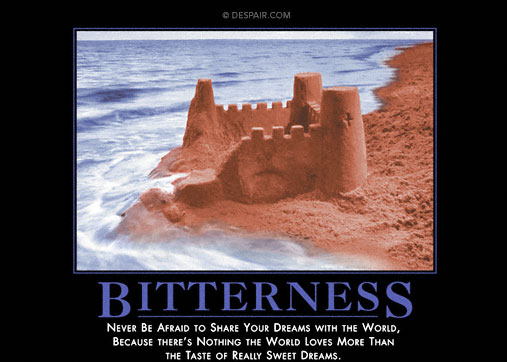
There is the more general case, the Dunning Kruger effect Here’s the money quote:
You know people like this - coworkers who who believe they are the most competent in the shop but are really a drag on the rest; choir members who cannot sing, but tell everyone else what they are getting wrong; 50% of all hockey fans calling in to sports shows; nightmarish parents who hold court on their philosophy of childrearing; all manner of showoffs and snobs. One keeps thinking that a spectacular failure will finally get the message through to them, that they will now just have to at least have a moment of doubt. But it doesn't. If anything, they get worse.
Next up, more Dunning-Kruger, this time with dictators, the confidence of prognosticators, and how in the world this foolishness can be adaptive.
*And while we’re at it, stop telling teenagers these are the best years of their lives. Great way to increase suicidality, I would think.
Multiple posts, but still no discussion how this relates to Christian belief, salvation, or election. Ah well, it will come.
Symptoms and insight.
If you have Obsessive-Compulsive Disorder, you have full insight – overfull insight – into the fact that you have symptoms. I keep thinking I have hit someone with my car when I know I haven’t. It’s a crazy thought, but I can’t get it out of my mind. I know intellectually that my hands are clean. But the certainty that they are dangerously germ-ridden is sometimes overwhelming. If you have OCD, you know you have symptoms. People might have any of a hundred understandings of how the symptoms arose, but there is no doubt of their existence. Anxiety disorders in general are perceivable to the patient as symptoms. Yeah, I have phobias. That’s why I’m here, doctor.
Contrast this, as we have, with schizophrenia, where insight is always impaired when the illness is untreated, and may continue even after treatment. Plenty of schizophrenics take the medications because it makes other people happy, even though they don’t believe they need them; or will take them for other symptoms, such as getting more sleep, or take them because they are under court order or guardianship. Some never believe that the voices are not real.
There’s a full spectrum in between. People who are depressed may not have insight into that at first, they may just think that life sucks and everything is hopeless. But they can often, if the depression is not severe, accept the explanation from others, and be cued into it. Yeah, I’m depressed. People who are irritable don’t see it that way at first, they just think that a lot of other people are being jerks. Yet they can sometimes be cued into the understanding as well: Have you been more irritable lately? “Y’know, I have. Small stuff bothers me more than it usually does.” A patient’s understanding of mania is more varied, but generally, the more severe the symptoms, the less likely the patient will perceive them as symptoms. The sicker one is, the less insight, which is both infuriating and tragic. Hold that point in mind.
Borderline personality disorders can learn over time, whether by specific instruction or by hard-knocks trial and error, which feelings and responses should be classified as symptoms. Until then “feelings are facts” to them. Their present feeling of being nonsuicidal and safe trumps the fact that they tried to OD just two hours ago. They are not attempting to manipulate others with this. This triumph of current feeling over all fact is their reality. They can go to the other extreme in crisis as well, being unable to understand feelings of despair or anger as temporary phenomenon. They seem world-consuming. Similar uneven insight prevails in the other personality disorders as well.
There is another anosognosia we have not yet mentioned as well. Some people are unable to perceive their incompetence regardless of the outside cues. I saw a backstage American Idol segment a few years ago while in a lobby somewhere. The girl had sung and was terrible. The judges had told her she was terrible and to give it up. She refused to believe it. She just knew that she was a great, absolutely great entertainer, and she wasn’t going to give up her dreams on their say-so. (I have since learned that this happens on American Idol all the time. Or Bulgarian Idol. Or Serbian Idol. This is why people need to stop telling elementary school children to follow their dreams, they can be anything they want to be. Despair, Inc. has it better.*
There is the more general case, the Dunning Kruger effect Here’s the money quote:
poor performers do not learn from feedback suggesting a need to improve.The same as with the serious mental illness – the more intense the symptoms, the less the insight. Learning does not take place. Feedback has no effect. Here’s an irony from Dunning and Kruger’s work, BTW. They quote Bertrand Russell with approval on the subject. One of the painful things about our time is that those who feel certainty are stupid, and those with any imagination and understanding are filled with doubt and indecision. And as if to illustrate this, he became quite sure of several things he proved to be entirely wrong about over the course of his career. Perhaps no worse than other opinionated folk, though.
You know people like this - coworkers who who believe they are the most competent in the shop but are really a drag on the rest; choir members who cannot sing, but tell everyone else what they are getting wrong; 50% of all hockey fans calling in to sports shows; nightmarish parents who hold court on their philosophy of childrearing; all manner of showoffs and snobs. One keeps thinking that a spectacular failure will finally get the message through to them, that they will now just have to at least have a moment of doubt. But it doesn't. If anything, they get worse.
Next up, more Dunning-Kruger, this time with dictators, the confidence of prognosticators, and how in the world this foolishness can be adaptive.
*And while we’re at it, stop telling teenagers these are the best years of their lives. Great way to increase suicidality, I would think.
Wednesday, April 20, 2011
Kenyan Distance Runners
Evidence accumulates that there are slight genetic advantages of Kenyans from the Rift Valley which help them run better at distance. These include less bulky calves and ankles, more slow-twitch fibers in their muscles, and (somewhat relatedly) more efficient use of oxygen by the muscles. West Africans, in contrast, are seen as having some genetic advantages that make them better in explosive strength sports, such as sprinting or jumping.
It bothers some people no end that there might be genetic advantages in one group versus another, because who knows where that might lead? So they go to great lengths to prove that all differences are environmental. This can lead to ridiculous claims. The study's data points screamingly points to genetic factors, which for some unexplainable reason, the article insists are environmental factors.
That said, it pays to be clear exactly what "genetic factors" mean.
1. At an elite level, even slight advantages may be great.
2. Traits we regard as under our control, such as tenacity, coachability, or pain threshold, might be just as heritable as calf size.
But most importantly, 3. Each of these traits is a single advantage, not a general advantage for "modern distance running." There has been no selection over the past 10,000 years for traits that will make you "travel across the ocean and run specific distances on the flat in special shoes." There are any number of traits that could be advantageous in distance running, or any other sport. The Kenyans have a specific suite of tiny genetic advantages. Other combinations of genetic difference might work as well, or better. Frank Shorter had a VO2 maximum that exceeded that of the Kenyans. Put that together with one other genetic trait and it might be a world beater.
This has larger implications for all genetic differences between groups. A demonstrated advantage in reflexes, IQ, cold tolerance, stress tolerance, or nasal cuteness might be quite real, but not the whole story. Genes matter, and those who play the "follow your dreams" game of pretending otherwise are being viciously cruel to young people. But there is more than one way to skin some, if not all cats. A little wisdom, a little perspective, and something similar to the dream might be found.
Monday, April 18, 2011
A Stunning Postmodernist Achievement
I have had my own sendups of postmodern and deconstructionist thought, but nothing of the quality of this site. Each time you visit, it gives you a different, randomly generated pomo essay.
Subscribe to:
Posts (Atom)